
18650 Lithium Battery Series — 2000 to 3200mAh NCM Cells
18650 lithium batteries in 2000–3200mAh NCM grades: energy, high-rate (to 8C) and low-temperature (−40 °C) variants. UN38.3 & IEC 62133-2 certified, per-lot test data, OEM/ODM. Request a quote.
18650 Lithium Battery Series — 2000 to 3200mAh NCM Cells
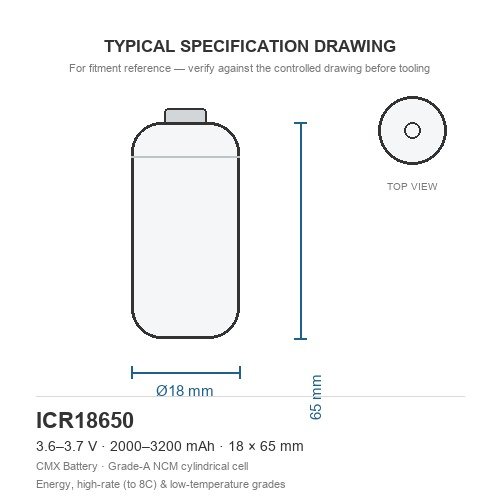
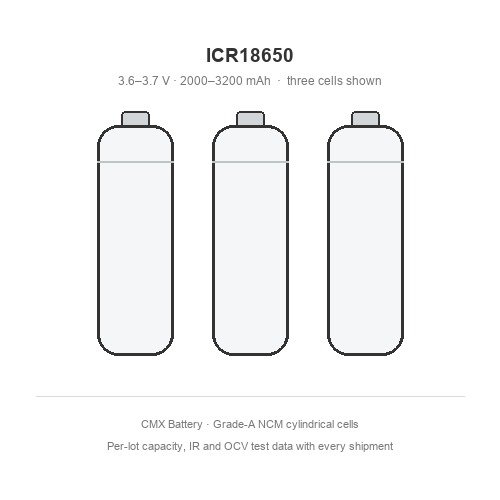
The 18650 lithium battery is the highest-volume cylindrical li-ion format in production: 18 mm in diameter, 65 mm in length, 3.6–3.7 V nominal. CMX Battery supplies the 18650 series in six production grades spanning 2000 to 3200 mAh — energy grades for long-runtime packs, high-rate grades to 8C for power tools, and a low-temperature series rated to −40 °C discharge. Every cell ships Grade-A against a controlled specification with UN38.3, IEC 62133-2 and RoHS documentation, plus per-lot capacity, internal-resistance and OCV test data.
Table of contents: Capacity Grades · Power vs Energy Selection · What Is an 18650? · Charge & Discharge · Cycle Life & Safety · Applications · Certifications · OEM/ODM & Ordering · FAQ
18650 Capacity Grades
Typical values below reflect the production standard for this format; final parameters ship against the CMX controlled product specification.
| Grade | Nominal capacity | Max continuous discharge | Typical IR | Best for |
|---|---|---|---|---|
| Energy | 2000 mAh | 3C (6.0 A) | ≤30 mΩ | Backup power, storage modules, low-rate packs |
| General purpose | 2200 mAh | 2C (4.4 A) | ≤50 mΩ | Tool battery packs, equipment power |
| High-rate | 2200 mAh | 5C (11.0 A) | ≤25 mΩ | Power tools, high-drain devices |
| High-rate | 2500 mAh | 8C (20.0 A) | ≤20 mΩ | Maximum-drain professional tools |
| General purpose | 2600 mAh | 3C (7.8 A) | ≤50 mΩ | Long-runtime equipment, larger packs |
| High energy | 3200 mAh | 3C (9.6 A) | ≤35 mΩ | Maximum runtime, single-cell devices |
| Low-temperature | 2600 / 3200 mAh | 3C-class | ≤35 mΩ | Discharge to −40 °C: cold-chain, outdoor, field equipment |
All grades share the same 18 × 65 mm envelope and 3.6–3.7 V nominal platform, so a pack design can move between grades without mechanical changes — the trade-off is capacity versus rate capability versus temperature range.
Power vs Energy: Choosing the Right 18650 Grade
Selecting an 18650 is a rate-versus-capacity decision:
- Energy grades (2000–3200 mAh, 2–3C) maximize runtime per charge. Choose them where average drain is low and cycle count matters: backup power, storage modules, instrumentation.
- High-rate grades (2200 mAh 5C, 2500 mAh 8C) trade roughly 10–20% capacity for 2–3× the continuous current. Choose them for cordless tools and equipment with motor bursts.
- Low-temperature grades keep ≥60% capacity delivery at −20 °C-class conditions and discharge to −40 °C. Choose them for cold-chain, outdoor monitoring and field equipment that standard cells cannot serve.
Rule of thumb: size the pack for the continuous current at or below the grade’s rating, and treat burst capability as headroom — sustained operation above the continuous rating accelerates fade and generates heat that the protection circuit must manage.
What Is an 18650 Battery?
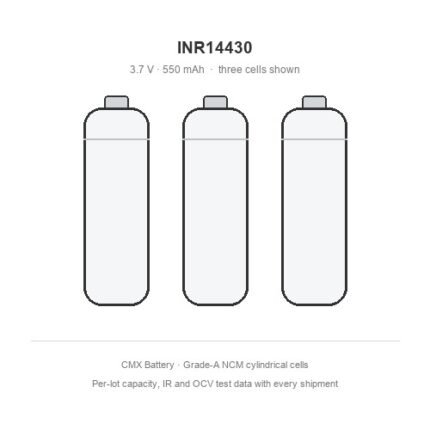
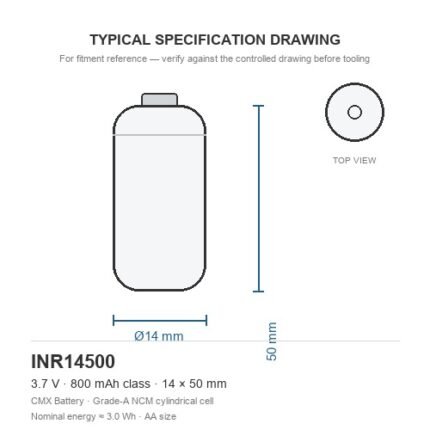
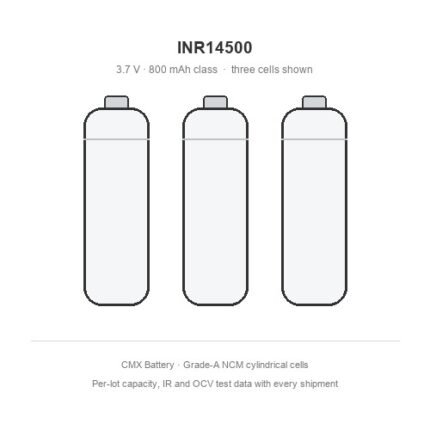
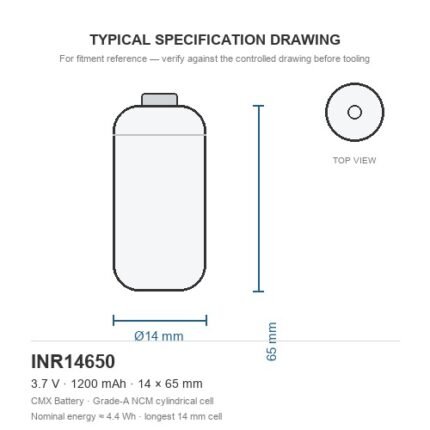
An 18650 battery is a rechargeable cylindrical lithium-ion cell whose designation encodes its geometry: 18 mm diameter, 65 mm height, cylindrical format. At 18 × 65 mm it is the large-format counterpart to the 14 mm family (14250–14650) that covers compact personal-care and lighting devices; for smaller cylindrical formats, see our small cylindrical lithium cells hub.
The cell is a sealed steel can with a CID safety vent; welding is permitted only on the top cap and bottom end, never on the side wall. The 65 mm length makes it the standard building block for 2S/3S/4S equipment packs and storage modules.
18650 Charge and Discharge Profile
Charging follows CC-CV: constant current at the standard rate (1C; 1.6C on the 2500 mAh grade) until the terminal voltage reaches 4.20 V ± 0.05 V, then hold at 4.20 V until the current tapers to the cut-off threshold. Charge temperature is specified 0–45 °C — below 0 °C, charge current must be limited or charging skipped to avoid lithium plating on the anode.
Discharging runs to a 2.75 V cut-off, with the continuous rating per grade (2C to 8C as tabulated above). Discharge must terminate if the cell surface exceeds 60 °C. Rate-discharge testing on each grade confirms the published continuous envelope; operation beyond it is pulse territory only.
18650 Cycle Life and Safety Performance
Cycle life for this format is typically specified at ≥70% of initial capacity after 300–500 cycles of standard-rate discharge at room temperature, grade-dependent. (Cycling at high temperature ≥35 °C, high rate, or high voltage shortens life.)
Safety testing for production cells of this format covers over-discharge, overcharge, external short circuit, drop, heating and crush — all with no fire, no explosion, no leakage. A CID safety vent and optional protection circuit provide overpressure and overcurrent protection inside the sealed steel can.
18650 Battery Applications
Cordless power tools. The classic high-rate application. Drill and driver bursts of 20–30 A from a 5S pack sit inside the 5C/8C grades’ continuous envelope, and the standardized envelope lets OEMs re-rate runtime by swapping grade rather than redesigning the pack.
Equipment and instrument battery packs. Serviceable 18 × 65 mm packs for test equipment, portable power stations and measurement instruments, where per-lot test data simplifies pack-level BMS validation.
Energy storage modules. Energy grades feed small storage and backup modules; the 3.6–3.7 V platform and mature supply base make capacity scaling predictable.
Cold-chain and outdoor equipment. The low-temperature series keeps capacity delivery at −20 °C-class conditions and discharges to −40 °C, serving logistics monitoring, field instruments and cold-environment deployments.
E-mobility ancillary packs. Low-speed auxiliary and onboard power packs built on the standardized envelope.
Certifications and Shipping Compliance
Every 18650 ships against the documentation compliance teams ask for first: UN38.3 (the UN Manual of Tests and Criteria test summary required for lithium transport by air and sea), MSDS, IEC 62133-2 cell safety compliance, CB report, and RoHS declaration. Lot-level documentation — capacity, internal resistance and open-circuit voltage per cell — accompanies each shipment so incoming QC starts from data rather than sampling. For the full certification scope, see our lithium battery certifications and compliance page.
OEM/ODM Customization and Ordering
CMX Battery supplies the 18650 series for OEM programs: welded tabs or connectors to your drawing, shrink-wrap or label branding with your model number, and packaging configured to your line. Cells ship at partial SOC with per-lot test data. Samples are available for bench validation before volume commitment; minimum order quantities, lead times and per-lot test-data format are confirmed with your quotation, which comes back within 24 hours. Warranty is one year from date of shipment against manufacturing defects.
Frequently Asked Questions
What is an 18650 battery?
An 18650 battery is a rechargeable cylindrical li-ion cell (18 × 65 mm, 3.6–3.7 V nominal) — the large-format standard of the cylindrical family, with production grades from 2000 to 3200 mAh.
How many amps can an 18650 battery discharge?
It depends on grade: energy grades are rated 2–3C continuous (roughly 4–10 A), high-rate grades 5C (11 A) and 8C (20 A). Size packs for the continuous rating and treat bursts as headroom.
What is the difference between 18650 power and energy cells?
Power (high-rate) cells trade about 10–20% capacity for 2–3× continuous current — built for tools and motor loads. Energy cells maximize runtime per charge — built for backup power, storage and low-drain equipment.
How do you charge an 18650 battery?
CC-CV to 4.20 V ± 0.05 V with taper cut-off; standard charge is 1C (1.6C on the 2500 mAh grade), specified within 0–45 °C. Below 0 °C, reduce current or skip charging.
How long does an 18650 battery last?
Typically ≥70% of initial capacity after 300–500 standard cycles at room temperature, grade-dependent; high temperature, high rate and high-voltage operation shorten life.
Is there a low-temperature 18650?
Yes — the low-temperature series discharges to −40 °C and holds capacity at −20 °C-class conditions, for cold-chain, outdoor and field equipment.
Are 18650 batteries available with OEM branding?
Yes — welded tabs or connectors, custom labels with your model number and tailored packaging are standard services, with per-lot test data on every shipment.
Request a Quote
Tell us your pack voltage, continuous current and temperature envelope — we will confirm the right grade, send matching datasheets and per-lot test data, and return a quotation within 24 hours.
Or email sales@cmxbattery.com. Download the series typical specifications overview: 18650 Series Typical Specifications Overview (PDF). The controlled product datasheet is issued with your quotation on request.




Reviews
There are no reviews yet.