

Blog
Can You Charge Multiple Batteries at Once? Yes – 48 Cells at Once, Each on Its Own Channel

Standard models charge 3.6/3.7 V Li-ion cylindrical cells (4.2 V cut-off) and 1.2 V Ni-MH/Ni-Cd. LiFePO4 (3.2 V / 3.65 V cut-off), LiPo pouch cells and other chemistries are available as custom-built versions — tell us your cell model and we configure the charging profile.
That chemistry split sits behind the answer on this page: everything below assumes the cells belong to the same configured line. 48-bay = 48 charging positions, not 48 volt; 168-position = 168 charging positions.
Can You Charge Multiple Batteries at Once?
The short answer
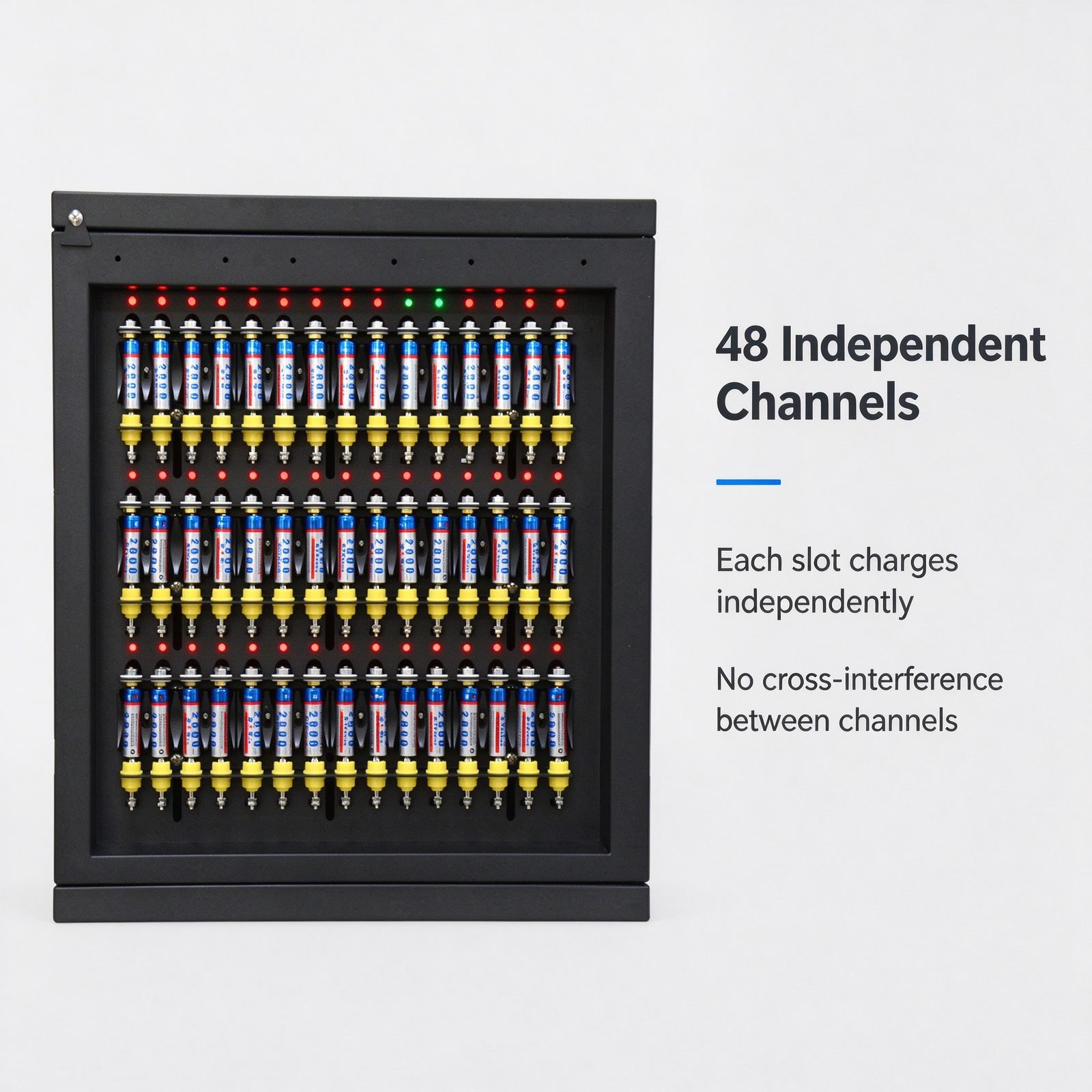
Yes — one cabinet can charge many batteries at once, as long as every position has its own charging channel. A 48-position cabinet charges 48 cells at once and a 168-position cabinet charges 168 cells at once. 48-bay is 48 charging positions, not 48 volt.
“`html
“`
What “one channel per position” means
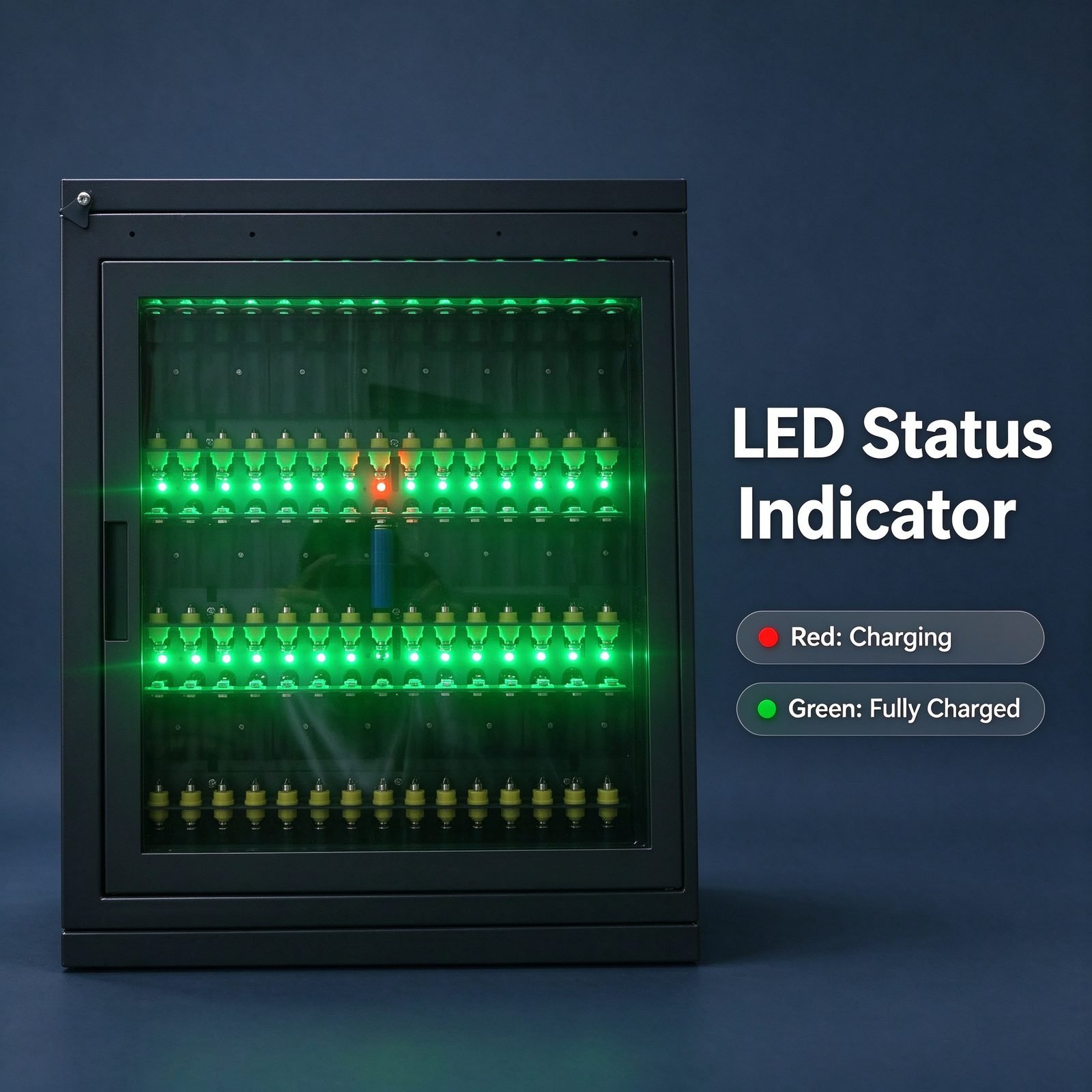
One channel per position means each charging position runs its own cell independently. A cell that finishes earlier does not hold up its neighbours, and an abnormality at one position does not change what happens at the others. That is the necessary prerequisite for loading 48 cells at once or 168 cells at once — it is why a large count works at all, not a separate benefit to advertise. The answer to the question on this page stays the count and the cycle: 48 cells at once, 168 cells at once. 48-bay = 48 charging positions, not 48 volt.
Why One Cabinet Can Do This
One module group per set of positions
The channel count is a hardware count. The 48-position CMX48 is built from 12 smart modules with four positions per module, so 48 charging positions are served by 12 controlled groups. The 168-position CMX168 is built from 42 smart modules in a 6 columns × 28 rows layout, so 168 charging positions are served by 42 controlled groups. 48-bay = 48 charging positions, not 48 volt; 168-position = 168 charging positions.
No shared charging path between positions
Positions do not share one charging path. Because each position has its own channel, cells of different ages and different capacities can be charged in the same cabinet in the same cycle without being forced to behave as one cell. This is the whole “why” behind the answer on this page, and it is kept as reasoning rather than turned into a standalone selling point.
Two clarifications: “mixing” means different cells in different positions, not several cells in one position; and every cell must belong to the same configured chemistry. 48-bay and 168-position are position counts, not 48 volt.
The Conditions That Matter
Same chemistry and same cut-off voltage
A 4.2 V Li-ion cabinet and a 3.65 V LiFePO4 cabinet are not the same machine. A standard 48-position lithium cabinet is configured for a 4.2 V cut-off, while LiFePO4 needs a 3.65 V custom build that cannot use the standard 4.2 V profile. A 1.2 V Ni-MH / Ni-Cd cabinet is a third, independent line. Mixing different chemistries therefore means first confirming the cut-off voltage — and usually means two cabinets, not one.
For the systematic version of this topic, the guide on charging multiple batteries at once explains the three model lines, the module layouts and the scenario fit in depth. This page answers only the yes-or-no question. 48-bay = 48 charging positions, not 48 volt; 168-position = 168 charging positions.
Mixing old and new batteries — what it really means
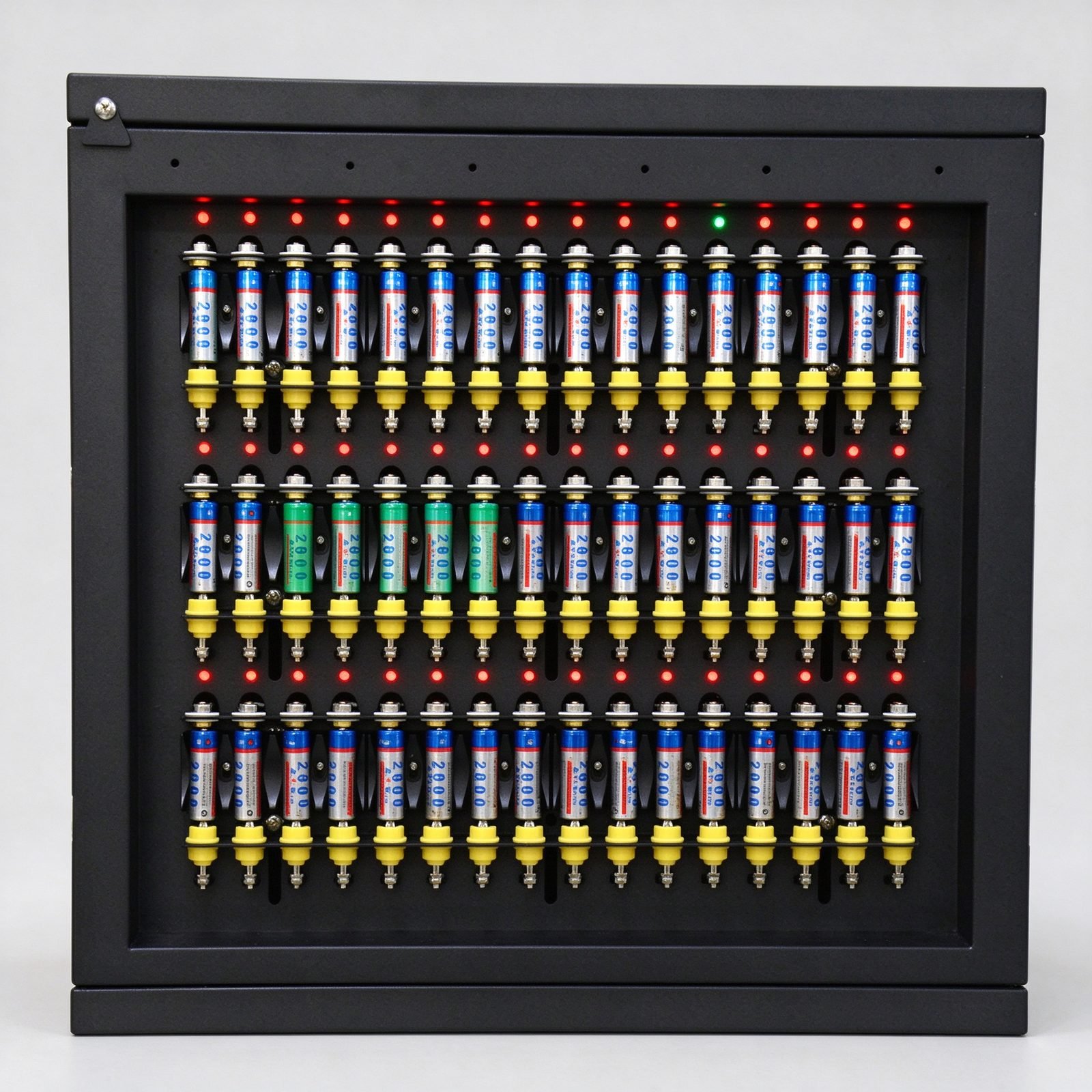
The question behind “mixing old and new batteries” is usually whether an operator has to build a matched set before loading the cabinet. The answer is no: old and new cells can sit in the same cabinet because each position has its own channel and each cell follows its own condition. That is a consequence of the design, not a separate capability page.
One position holds one cell, and one cabinet is configured for one chemistry. 48-bay is 48 charging positions, not 48 volt.
Different capacities in one cabinet
Questions such as whether you can mix batteries of different capacities, or charge cells with different amp-hour ratings together, have the same answer. Yes — because each position follows its own charge current and its own cut-off condition, cells of different capacities can be charged in one cabinet at once. The independence is at position level; it does not extend to putting two cells into a single position.
48-bay and 168-position count charging positions, not 48 volt.
48-bay is a position count, not a voltage
Write the count as 48-bay, 48-position, “48 cells at once”, 168-position and “168 cells at once”. 48-bay = 48 charging positions, not 48 volt; 168-position = 168 charging positions. Input is 90–220 V / 50 Hz on the lithium line and 110/220 V · 50 Hz on the nickel line, and neither figure describes the position count.
If a search result or an enquiry puts 48 next to a voltage, check which quantity is being counted. For the full definitions of bay, slot and position, see bay, slot and position explained.
Which Models This Applies To
Standard 48-position Li-ion cabinets
The standard CMX48 covers 3.6/3.7 V Li-ion cylindrical cells — 18650, 21700, 26650, 14500, 18350, 16340, 20700, 22650 and 26800 — including NMC ternary cylindrical cells. Its figures are a charge current of 800–1050 mA, a cut-off of approximately 4.2 V ± 0.05 V, a 100 mA cut-off current and 90–220 V / 50 Hz input. 48-bay = 48 charging positions, not 48 volt.
Pouch and LiPo cells are not part of this standard coverage; they need a clamp holder and a configured profile. For the standard lithium product, see the 48 independent-position Li-ion charging cabinet.
The 168-position Ni-MH and Ni-Cd line
The standard CMX168 is dedicated to 1.2 V Ni-MH and Ni-Cd cylindrical rechargeable cells in AA, AAA and similar formats, with a charge current below 500 mA and 110/220 V · 50 Hz input. It is an independent model line, not a variant of the lithium cabinet; a 4.2 V Li-ion profile and a 1.2 V nickel configuration do not live in the same machine. 168-position = 168 charging positions, not a voltage. For the full AA / AAA specification, see the 168-position Ni-MH charging cabinet.
Custom-built versions for LFP and pouch cells
Standard models charge 3.6/3.7 V Li-ion cylindrical cells (4.2 V cut-off) and 1.2 V Ni-MH/Ni-Cd. LiFePO4 (3.2 V / 3.65 V cut-off), LiPo pouch cells and other chemistries are available as custom-built versions — tell us your cell model and we configure the charging profile.
LiFePO4 needs a 3.65 V cut-off and a custom build; the standard 4.2 V profile cannot be used for it. A single 3.7 V LiPo pouch cell needs a clamp holder and a configured profile. Both are built to order around a real cell list. 48-bay and 168-position are position counts, not 48 volt.
| Specification reference | CMX48 (standard) | CMX168 (standard) |
|---|---|---|
| Model and slot count | CMX48 · 48 positions (48-bay / 48-position) | CMX168 · 168 positions (168-position) |
| Smart modules and allocation | 12 modules × 4 positions | 42 modules / 6 columns × 28 rows |
| Supported cells and chemistry | 3.6/3.7 V Li-ion cylindrical; LFP and pouch are custom only | 1.2 V Ni-MH / Ni-Cd AA, AAA |
| Voltage and current | ≈4.2 V ± 0.05 V, 100 mA cut-off, 800–1050 mA | 1.2 V nickel configuration, < 500 mA |
| Input | 90–220 V / 50 Hz | 110 / 220 V · 50 Hz |
| Certifications | CE / FCC / RoHS | CE / FCC / RoHS |
| Onboard features | One status LED per position; reverse-polarity protection; external air switch; power-on self-test | One status LED per position; reverse-polarity protection; external air switch; power-on self-test |
| Charge method, protection, termination and indication | CC/CV; overcharge protection; automatic charge termination; LED status change at end of charge | CC/CV; overcharge protection; automatic charge termination; LED status change at end of charge |
| Slot count clarification note | 48-bay = 48 charging positions, not 48 volt | 168-position = 168 charging positions, not a voltage |
Related Reading
The long-form version of this answer
This page answers one question — whether you can charge many cells in one cabinet at once. The wider question, why a single cabinet can do it, is covered by the long-form guide: full guide on charging many cells together. 48-bay = 48 charging positions, not 48 volt.
If your question is about voltage instead
If the real question is whether LiFePO4 can be used with a normal 4.2 V charger, that belongs to the voltage FAQ, which explains the 4.2 V versus 3.65 V difference and why LFP needs a custom build. This page answers “can it be done”; that one answers “which voltage”. 168-position = 168 charging positions, not a voltage.
If you are unsure what “bay” means
Terminology, the category boundary and the number rule are all settled on the category hub glossary: bay, slot, channel and position are names for one charging position, and 48 and 168 count positions rather than volts. 48-bay = 48 charging positions, not 48 volt.
Where to Go Next
You have the answer: yes, one cabinet can charge many cells at once, provided every position has its own channel and every cell belongs to the same configured chemistry. The next step is choosing a configuration. Fix the chemistry and its cut-off voltage first, then the position count, then the certification scope, and send the resulting cell list.
For a side-by-side comparison of the three model lines, see picking a cabinet for mixed cell sets. For the standard lithium product, the product page linked in Which Models This Applies To gives the reference specification. 48-bay = 48 charging positions, not 48 volt; 168-position = 168 charging positions.
Next step: confirm your chemistry and position count, then request a selection comparison table or submit an RFQ for your cell list.