

Blog
Charging Multiple Batteries at Once: One Cabinet, 48 or 168 Cells

Standard models charge 3.6/3.7 V Li-ion cylindrical cells (4.2 V cut-off) and 1.2 V Ni-MH/Ni-Cd. LiFePO4 (3.2 V / 3.65 V cut-off), LiPo pouch cells and other chemistries are available as custom-built versions — tell us your cell model and we configure the charging profile.
This is the long-form guide to what it means to charge many bare cells in one cabinet, why the cabinet can do it, which model line fits which cells, and where that capability is actually used. If you are new to the category, where to start with battery charging cabinets gives the short overview first. Here we go deeper. One number rule applies from the first line to the last: 48-bay and 48-position both count 48 charging positions, not 48 volt, and 168-position counts 168 charging positions, not a voltage.
What “Charging Multiple Batteries at Once” Actually Means
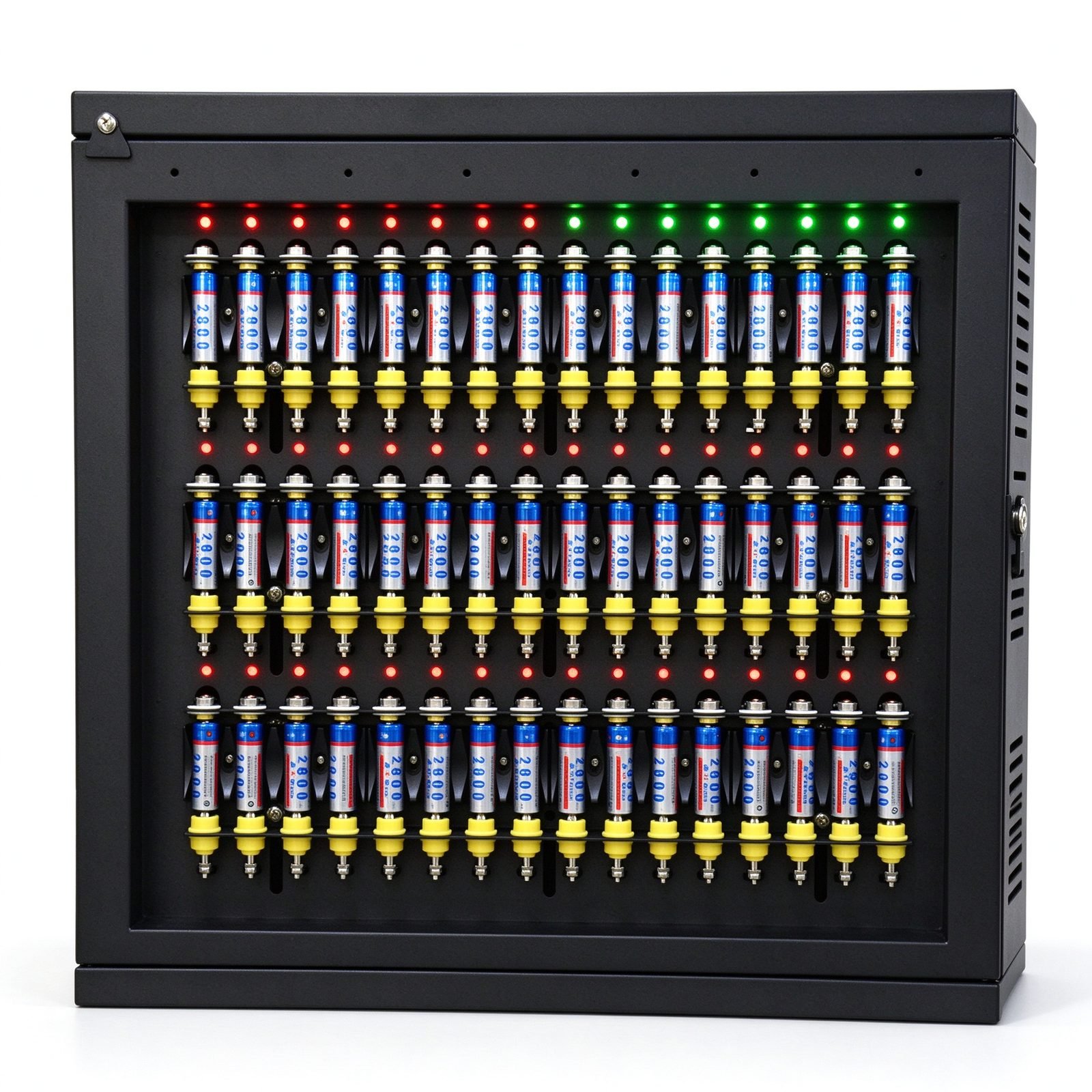
One cabinet, one cycle, many cells
The definition is deliberately narrow. A cabinet of this type is one enclosure with a fixed number of charging positions; in a single charging cycle, an operator loads many bare cylindrical cells, and every position carries one cell through its own charge. There is no queue, no rotation of the cabinet’s attention from one cell to the next, and no requirement to present a matched set. 48 cells at once and 168 cells at once describe the same idea at two different position counts. 48-bay = 48 charging positions, not 48 volt; 168-position = 168 charging positions.
The language we use for this is fixed: “48 cells at once”, “168 cells at once”, “at the same time”, “with one charger”, and the position-count forms 48-bay, 48-position and 168-position. Those phrases describe the working pattern without borrowing words that mean something else in a search engine. A cell here is a bare cylindrical cell — 18650, 21700, AA, AAA and similar formats — not a battery pack and not a finished device. The cabinet does not carry equipment; it holds cells.
Why a bench of single-cell chargers cannot match it
A bench of individual chargers can, in principle, reach the same count. What it cannot match is the operating cost of getting there. Each single charger needs its own mains lead, its own place on the bench, its own indicator to read and its own inspection at the start and end of a shift. Multiply that by 48 or by 168 and the work of managing the bench becomes larger than the work of charging the cells. 48-bay = 48 charging positions, not 48 volt; 168-position = 168 charging positions.
One cabinet consolidates all of that into a single enclosure with one mains connection and one place to check. The pool comes back from a shift, goes in as a set, and comes out as a set for the next shift. That is the whole operational argument: fewer things to wire, fewer things to walk past, fewer things to forget. It is also why the position count is the specification buyers lead with — it is the number that describes the size of the routine.
One narrow question belongs to a different page. If what you want is a direct yes-or-no answer to a single question rather than a system guide, the single-question FAQ is the better read: see the direct answer on charging many cells. That page answers “can you charge multiple batteries at once” in a few lines; this page explains the mechanism behind the answer. 48-bay and 168-position remain position counts, not 48 volt, on both pages.
The Three Parts That Make It Work: Quantity, At Once, Independent
The category can be reduced to three parts, and all three have to be present at the same time. Quantity without independence is a single shared channel. Independence without quantity is an ordinary single charger. Quantity and independence without the same cycle is a rota. Only the combination describes this product.
Quantity — 48 and 168 positions
The CMX48 provides 48 positions through 12 smart modules, four positions per module. The CMX168 provides 168 positions in a 6 columns × 28 rows layout, served by 42 smart modules. Those are hardware counts, not round numbers chosen for a headline. 48-bay = 48 charging positions, not 48 volt; 168-position = 168 charging positions.
At once — every position works in the same cycle
“At once” means every occupied position is active inside the same time window. Nothing waits for a turn, and the cabinet does not work through the positions in sequence. Each position is under the control of its own channel, so the whole set advances through its charging work together. We write this as “at once”, “at the same time” and “with one charger”, and we keep those phrases consistent across the site. 48-bay and 168-position are position counts, not 48 volt.
Several English words that look like obvious translations of the idea of charging a large set at once actually point to unrelated intents. They are not listed here, because giving them a place on the page would give them weight; they are held in the site’s negative keyword list instead. The correct phrases are the ones above. If a term is ambiguous, replace it with “48 cells at once” or “168 cells at once” and the meaning becomes unambiguous.
Independent — one channel per position
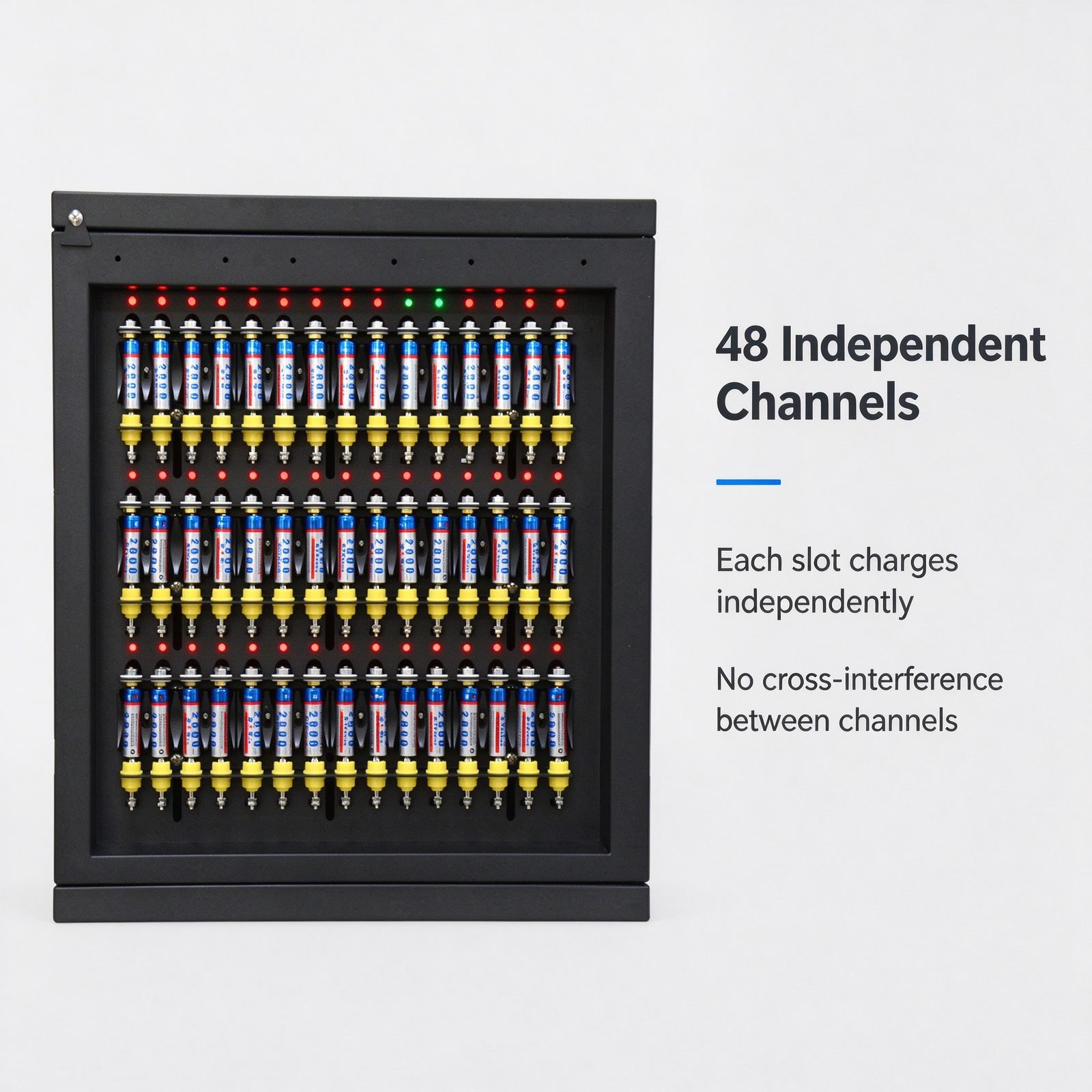
One independent channel per position is the prerequisite that makes a large count safe to specify. Cells in a real pool are not identical: some are new, some are older, some have a different capacity, and some arrive at a different state of charge. A shared charging path would force the whole set to behave like one cell. An independent channel lets each cell follow its own condition and finish on its own terms. 48-bay = 48 charging positions, not 48 volt; 168-position = 168 charging positions.
The same logic sets the chemistry boundary. Different chemistries need different cut-off voltages, so they cannot share one configured channel: a 4.2 V Li-ion profile, a 1.2 V nickel configuration and a 3.65 V LiFePO4 profile are three different configurations on three different machines. Independence is therefore both a cell-level requirement (one channel per position) and a cabinet-level requirement (one configured chemistry per cabinet). It is the reasoning behind the design, not a separate feature to advertise.
Which Product Line Fits Your Cells
That split is the map for this section. Two standard lines cover two chemistries; a custom line covers everything else. There is no cabinet that covers every chemistry, and no cabinet that offers both a 4.2 V profile and a 1.2 V profile. 48-bay = 48 charging positions, not 48 volt; 168-position = 168 charging positions.
CMX48 for 3.6/3.7 V Li-ion cylindrical cells
The CMX48 is the standard 48-position lithium line, built from 12 smart modules with four positions per module. It covers 3.6/3.7 V Li-ion cylindrical cells — 18650, 21700, 26650, 14500, 18350, 16340, 20700, 22650 and 26800 — including NMC ternary cylindrical cells. Its figures are a charge current of 800–1050 mA, a cut-off of approximately 4.2 V ± 0.05 V, a 100 mA cut-off current and 90–220 V / 50 Hz input. 48-bay = 48 charging positions, not 48 volt.
An adjustable negative plate height lets the same cabinet accept several cylindrical lengths and diameters, which is the mechanical reason a mixed set of sizes can be loaded in one cycle. A single 3.7 V polymer or pouch cell is not part of this standard coverage: it needs a clamp holder and a configured profile, so it belongs to the custom chemistry line. The same is true of LiFePO4, which needs a 3.65 V cut-off and cannot be run on the standard 4.2 V profile. 48-position and 168-position are position counts, not voltages.
CMX168 for 1.2 V Ni-MH and Ni-Cd
The CMX168 is the standard 168-position nickel line, laid out as 6 columns × 28 rows with 42 smart modules. It is dedicated to 1.2 V Ni-MH and Ni-Cd cylindrical rechargeable cells in AA, AAA and similar formats, with a charge current below 500 mA and 110/220 V · 50 Hz input. 168-position = 168 charging positions, not a voltage.
This is an independent model line, not a variant of the lithium cabinet. The 4.2 V Li-ion profile and the 1.2 V nickel configuration are separate configurations on separate machines; a nickel AA cell does not belong in the lithium cabinet and a 18650 Li-ion cell does not belong in this one. For the product page with the full AA / AAA specification, see the 168-position Ni-MH and Ni-Cd cabinet. 48-bay is 48 charging positions, not 48 volt, and 168-position is 168 charging positions.
Custom-built cabinets for LFP, pouch and other chemistries
Standard models charge 3.6/3.7 V Li-ion cylindrical cells (4.2 V cut-off) and 1.2 V Ni-MH/Ni-Cd. LiFePO4 (3.2 V / 3.65 V cut-off), LiPo pouch cells and other chemistries are available as custom-built versions — tell us your cell model and we configure the charging profile.
The custom line is where LiFePO4 (LFP) belongs, including 32700, 32650 and 26650 LFP formats, along with LiPo and pouch cells, NMC cells, large 4680 cylindrical cells and other rechargeable chemistries. Four items are configured by order: the voltage profile, the holder or clamp, the plug format and the slot layout. Chemistry and cut-off voltage are not a menu of settings on one machine — they are matched one-to-one to the cell model the buyer sends.
LFP is the clearest example. It needs a 3.65 V cut-off, and the standard 4.2 V profile cannot be used for it. A single 3.7 V LiPo pouch cell needs a clamp holder as well as its configured profile. Both are built to order rather than taken from stock. If your question is about the voltage difference itself, LiFePO4 voltage question answered covers it in FAQ form. For the cell-chemistry route, see 3.65 V cut-off for LiFePO4 cells; for the commercial route — RFQ fields and what is configurable — see custom-built cabinets for other chemistries. A custom slot layout is quoted as a position count, not as 48 volt or any other voltage.
Where It Makes Sense: Venue, Workshop, Warehouse and Fleet
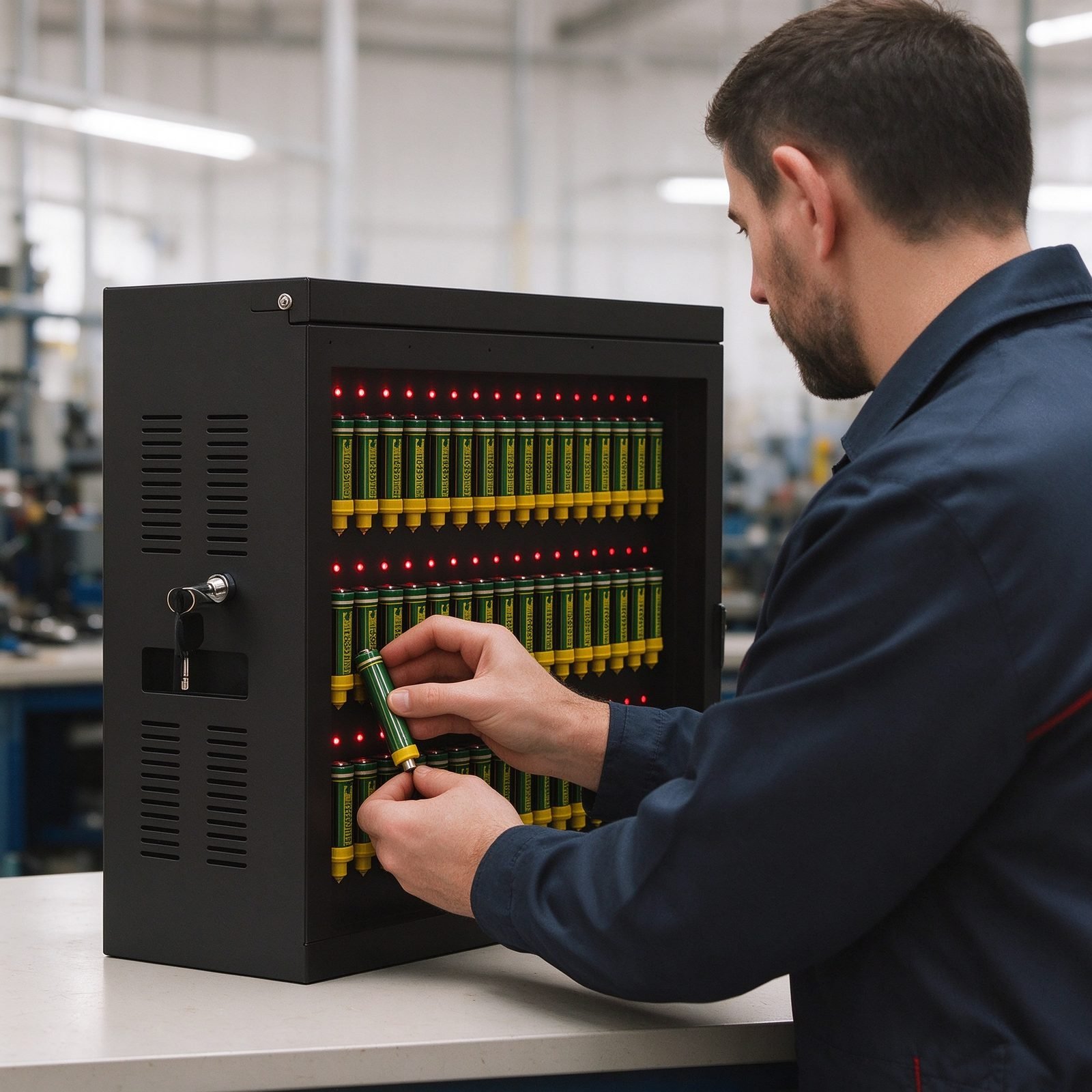
The same working pattern shows up in several B2B settings: a pool of loose cells comes back, a pool of charged cells has to be issued, and the two events are separated by one shift. 48-bay = 48 charging positions, not 48 volt; 168-position = 168 charging positions. In each setting below, the reason for a many-position cabinet is that the whole set has to be ready at the same moment.
Venues, hotels, retail and healthcare
In venues, hotels, retail operations and healthcare settings, equipment is in use for a defined period and then returns to a central point. Handheld terminals, meters, radios and similar devices run on cells that are collected, charged and redistributed. The manual calls this a battery pool, and the phrase is useful here as a description of the workflow rather than as a product term: the pool is what turns over, and the cabinet is where it turns over.
Central charging means one place to issue from and one place to return to. It also means the operator can see the whole set at a glance instead of checking a shelf of individual chargers. For a venue running back-to-back events or a hospital running shift handovers, that visibility is the point. 48-bay and 168-position are position counts, not 48 volt.
Workshops and site teams
Workshops and site teams charge bare cylindrical cells between jobs. The important boundary here is that these are loose cells, not branded tool battery packs and not finished devices — a pack-level charger is a different product with a different connector and a different charging configuration. Naming individual tool brands would confuse that boundary, so this guide stays at cell level.
The operational gain is the same one described earlier: one cabinet replaces a row of independent chargers, and the cell pool is managed centrally. A bench full of separate chargers asks for a separate lead, a separate check and a separate decision for every cell. A 48-position or 168-position cabinet asks for one. See workshop and warehouse charging setups for the workshop route. 48-bay = 48 charging positions, not 48 volt.
Warehouses, security rounds and rental fleets
Warehouses, security patrol teams and rental fleets run on shift rhythm more explicitly than most settings. Scanners, two-way radios, patrol equipment and rented devices come back at the end of a round; the cells go into the cabinet; the next shift takes a charged set out. A battery pool is returned, charged and issued as a set, and the cabinet is the single point where that happens. 168-position = 168 charging positions, not a voltage; 48-bay = 48 charging positions, not 48 volt.
The phrase battery pool stays in this scenario description only. It is not a headline term here, not a paid exact-match target and not the name of a product feature — it describes how a fleet handles its cells. For the warehouse and fleet rotation route, see workshop and warehouse charging setups.
Specification Reference
| Field | CMX48 (standard) | CMX168 (standard) | ODM custom |
|---|---|---|---|
| Model line / capacity | CMX48 · 48 positions | CMX168 · 168 positions | ODM custom |
| Slot count notation | 48-bay / 48-position / “48 cells at once” | 168-position / “168 cells at once” | Custom layout quoted as a position count |
| Smart modules and allocation | 12 modules × 4 positions | 42 modules / 6 columns × 28 rows | Configured to order |
| Supported cells and chemistry | 3.6/3.7 V Li-ion cylindrical; 1.2 V Ni-MH / Ni-Cd on the other line; single-cell 3.7 V pouch with clamp holder (custom); LFP 3.65 V (custom) | 1.2 V Ni-MH / Ni-Cd AA, AAA | LFP, LiPo / pouch, NMC, 4680 and other rechargeable chemistries |
| Voltage and current | ≈4.2 V ± 0.05 V, 100 mA cut-off, 800–1050 mA | 1.2 V nickel configuration, < 500 mA | Configured to cell model, 3.65 V for LFP |
| Input | 90–220 V / 50 Hz | 110 / 220 V · 50 Hz | Configured to order |
| Certifications | CE / FCC / RoHS | CE / FCC / RoHS | CE / FCC / RoHS |
| Onboard features | One status LED per position; reverse-polarity protection; external air switch; power-on self-test; adjustable negative plate height; battery pool shift rotation | One status LED per position; reverse-polarity protection; external air switch; power-on self-test; battery pool shift rotation | Configured to order |
| Charge method, protection, termination and indication | CC/CV; overcharge protection; automatic charge termination; LED status change at end of charge | CC/CV; overcharge protection; automatic charge termination; LED status change at end of charge | Configured to cell model |
| Slot count clarification note | 48-bay = 48 charging positions, not 48 volt | 168-position = 168 charging positions, not a voltage | Position count is quoted as positions, not volts |
Common Misunderstandings and Better Words
Terminology is where most of the confusion in this category lives. For the definitions of bay, slot, channel and position, see the cabinet terminology glossary on the category hub. This section gives the correct forms and points out the traps without repeating the full glossary.
“48 slots” and the 48 volt mix-up
The correct forms are 48-bay, 48-position and “charge 48 cells at once”. A bare slot count written without the word positions is easily read as a supply voltage, and 48 volt is a real product category with its own chargers — which is exactly why the phrasing matters. 48-bay = 48 charging positions, not 48 volt. Input on the lithium line is 90–220 V / 50 Hz and on the nickel line 110/220 V · 50 Hz; both are separate from the position count.
If a search result, a specification sheet or an enquiry puts a number next to a voltage, check which quantity is being counted. In this category 48 and 168 always count charging positions. 168-position = 168 charging positions, not a voltage.
Words that describe something else entirely
A set of tempting English words looks like it should describe charging a large set of cells, but each one has been empirically shown to point to an unrelated intent — charging stages, wiring diagrams, wholesale purchasing, phone charging stands, medical terms or consumer electronics. They are held in the site’s negative keyword list and are not reproduced here, because listing them would give them weight on the page.
The correct language is small and consistent: “at once”, “at the same time”, “with one charger”, 48-bay, 48-position, “multiple … station” and “large capacity … station”. Those phrases describe one cabinet taking many cells in one cycle. 48-bay = 48 charging positions, not 48 volt.
Cell level and battery pack level are different products
A 12 V or 24 V leisure battery pack, a vehicle starter pack and a power-tool pack are pack-level products. They have their own connectors, their own charging configuration and their own safety requirements. A 3.6/3.7 V cylindrical cell and a 1.2 V AA cell are cell-level products. This guide is about cell-level charging only, and the cabinets described here hold bare cells in individual positions.
Search phrases worth using
Real questions in this category tend to be phrased as tasks, not as product names. The following are worth treating as question seeds for an FAQ or a buying guide: “how to charge multiple 18650 batteries at once”, “how to charge 100 batteries at the same time”, “charge 168 cells at once” and “large battery charging station”. Each points at the same underlying need — one cabinet, many cells, one cycle — rather than at a brand or a chemistry.
Answering them well means giving the position count, the chemistry boundary and the one-channel-per-position reasoning, in that order. It also means keeping the number disambiguated: 48-bay = 48 charging positions, not 48 volt, and 168-position = 168 charging positions.
Frequently Asked Questions
Can one cabinet mix cell ages and capacities?
Yes. A cabinet can be loaded with cells of different ages and different capacities in the same cycle, because each position has its own independent channel and each cell follows its own condition. That is the prerequisite for charging many cells at once, not a separate feature. The short Q&A page covers the same point in a few lines. 48-bay = 48 charging positions, not 48 volt; 168-position = 168 charging positions.
Does charging many cells at once need a different charger?
It needs a cabinet with one independent channel per position, plus a cut-off voltage that matches the chemistry. It does not need a single larger channel with more power behind it. A 4.2 V Li-ion cylindrical cell, a 1.2 V Ni-MH cell and a 3.65 V LiFePO4 cell cannot share one configured profile, which is why they belong to different model lines. 48-bay and 168-position are position counts, not 48 volt.
How long does a full cycle take?
A full cycle depends on the charge current, the capacity of the cells in the pool and the number of occupied positions. This page describes that structural relationship only; it publishes no duration figure, no throughput figure and no delivery or lead-time figure. A quote is built from a real cell list, not from a time estimate. 48-bay = 48 charging positions, not 48 volt; 168-position = 168 charging positions.
Is 48-bay the same as 48 volt?
No. 48 is the number of charging positions. Input is 90–220 V / 50 Hz on the lithium line and 110/220 V · 50 Hz on the nickel line, and neither figure describes the position count. The complete terminology table is on the category hub glossary. 168-position = 168 charging positions, not a voltage.
Summary and Where to Go Next
Three parts, one idea: quantity, at once, independent. A cabinet provides a fixed count of charging positions — 48 or 168 as standard, or a custom layout — every occupied position works within the same cycle, and every position has its own channel. Take away any one of the three and you no longer have this product. 48-bay = 48 charging positions, not 48 volt; 168-position = 168 charging positions.
Three model lines, one cell list: the standard 48-position CMX48 for 3.6/3.7 V Li-ion cylindrical cells, the standard 168-position CMX168 for 1.2 V Ni-MH and Ni-Cd cells, and a custom line for LiFePO4 at a 3.65 V cut-off, single-cell 3.7 V pouch cells with a clamp holder, NMC, large 4680 cylindrical cells and other rechargeable chemistries. There is no cabinet that covers every chemistry and no cabinet that offers both a 4.2 V and a 1.2 V profile. 48-bay and 168-position are position counts, not 48 volt.
Where you go next depends on what is in your cell list. If it is standard 3.6/3.7 V Li-ion cylindrical cells, the lithium product page is the destination. If it is LFP or pouch cells, the custom chemistry page is the destination, and the custom RFQ page handles the order itself. If you are still unsure what bay, slot, channel and position mean, the category hub glossary settles it. If you are comparing cabinets and ready to specify, a single cabinet for many cells is the transactional comparison page. 48-bay = 48 charging positions, not 48 volt; 168-position = 168 charging positions.
Next step: confirm your chemistry and cut-off voltage first, then your position count, then talk about one cabinet. Start with the 48-position cabinet that charges 48 cells at once for the standard lithium line, or send your cell list for a comparison table and a quote.