
Customized Battery Charger Manufacturer: Build a 48- or 168-Position Cabinet Around Your Cells
Submit RFQ: send your cell model, chemistry, nominal and cut-off voltage, position count and certification scope. We return a configuration built around your cell list.
What We Build to Order
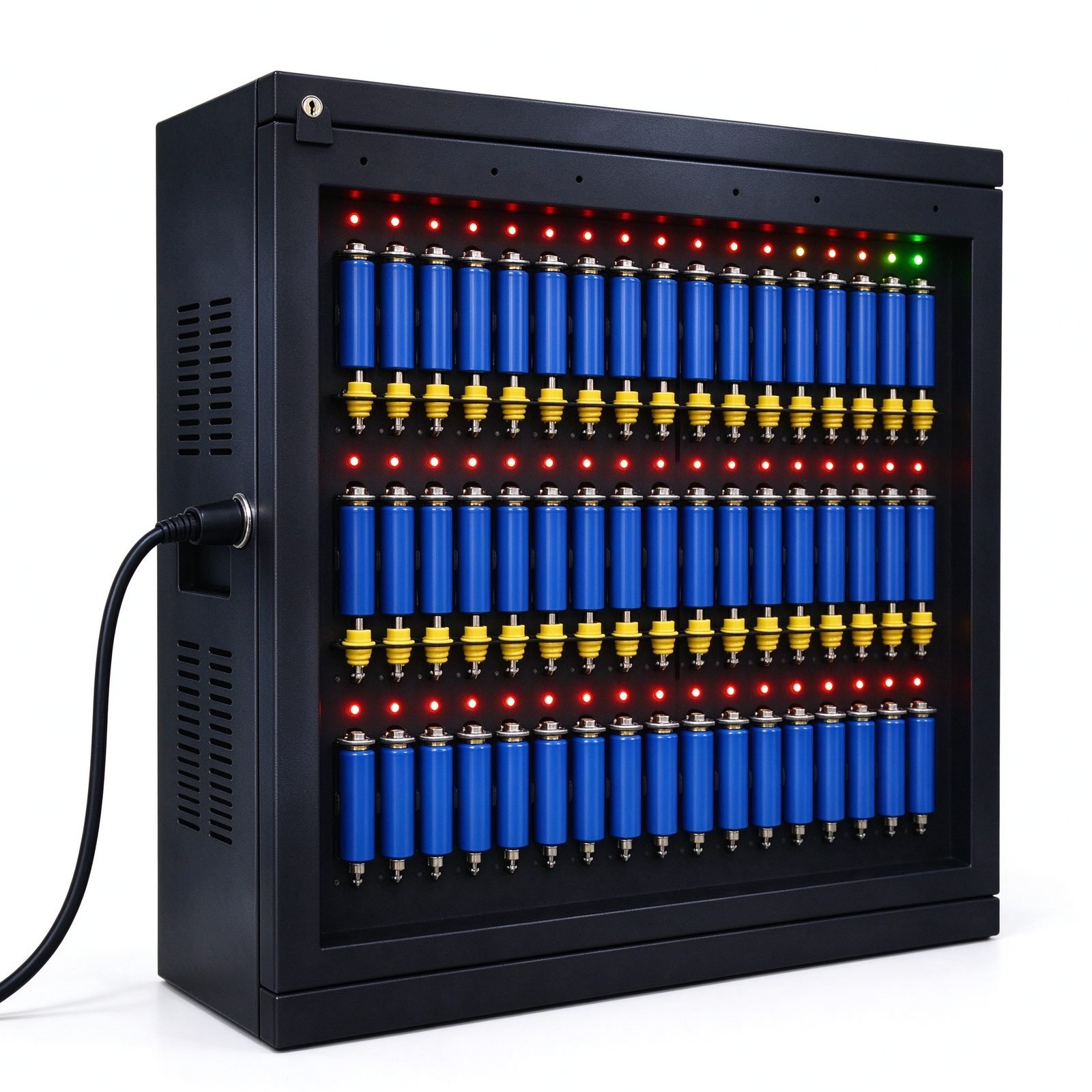
Standard models charge 3.6/3.7 V Li-ion cylindrical cells (4.2 V cut-off) and 1.2 V Ni-MH/Ni-Cd. LiFePO4 (3.2 V / 3.65 V cut-off), LiPo pouch cells and other chemistries are available as custom-built versions — tell us your cell model and we configure the charging profile.
As a customized battery charger manufacturer, we build each cabinet to order around four variables: the voltage and charge profile, the cell holder or clamp, the plug format, and the slot layout with its module count. A custom build keeps the same working shape as the standard line — one cabinet charges many cells at once, each position on its own independent channel — because the value is in the count, not in the enclosure. 48-bay and 48-position mean 48 charging positions, not 48 volt; 168-position means 168 charging positions. Any 48 or 168 on this page counts charging positions, never a supply voltage.
The buyers who come to a custom build are cell makers, test laboratories, and turnover pools that work from a fixed cell list. They know the model, the chemistry and the cut-off voltage their cells need, and they want a cabinet configured against that list rather than a general-purpose machine. The routine is a cell pool: cells come back from a shift, the set is loaded, and a charged set is ready for the next one. That is why a cabinet is specified by position count first. 48-bay = 48 charging positions, not 48 volt.
Search language for this route varies — custom battery charger manufacturer, custom voltage battery charger, custom battery charging station, custom battery charging cabinet, ODM battery charging cabinet, custom built battery charger and custom made battery charger all describe the same build-to-order process. They describe how a cabinet is specified, not a claim that one machine covers every chemistry. 48-bay and 168-position are position counts, not 48 volt.
Why Buyers Move to a Custom Build
A Fixed Cell List
When the cell models and dimensions are fixed and reordered over a long period, the first question is whether a standard cabinet already fits. If the whole list is 3.6/3.7 V Li-ion cylindrical cells, the standard CMX48 line covers it; if it is 1.2 V Ni-MH / Ni-Cd AA or AAA cells, the standard CMX168 line covers it. A custom build becomes relevant when the fixed list falls outside those two lines, or when the cut-off voltage, holder or plug format must be matched to a named model. 48-bay = 48 charging positions, not 48 volt; 168-position = 168 charging positions.
Chemistry Outside the Standard Range
Three groups sit outside the standard range. LiFePO4 / LFP cells need a 3.65 V cut-off and cannot use the standard 4.2 V profile. Single 3.7 V LiPo / pouch cells need a clamp holder and a configured single-cell profile. Other rechargeable systems, including large 4680 cylindrical cells, are evaluated per order rather than offered as a fixed option. Each group needs its own charge profile, so a cell list spanning two chemistries is quoted as two configured builds, not as one cabinet that handles everything. 48-bay here is 48 charging positions, not 48 volt.
Site Conditions
Plug format, slot layout and the voltage range are configured to the site and the cell pool. A custom layout is quoted as a position count, not as volts. 48-bay and 168-position stay the two reference figures even when a layout is built to order. 48-bay = 48 charging positions, not 48 volt.
What Can Be Customized
Voltage and Charge Profile
The voltage step and the cut-off voltage are set together, and they must correspond one-to-one with the chemistry. A 3.6/3.7 V Li-ion cylindrical cell uses a 4.2 V ± 0.05 V cut-off; 1.2 V Ni-MH / Ni-Cd cells use the nickel configuration; LiFePO4 (3.2 V nominal) uses a 3.65 V custom cut-off. LiFePO4 needs the 3.65 V custom build and cannot run on the standard 4.2 V profile. A single 3.7 V pouch cell needs a custom profile with a clamp holder. 48-bay and 168-position are position counts, not 48 volt.
Holder and Clamp
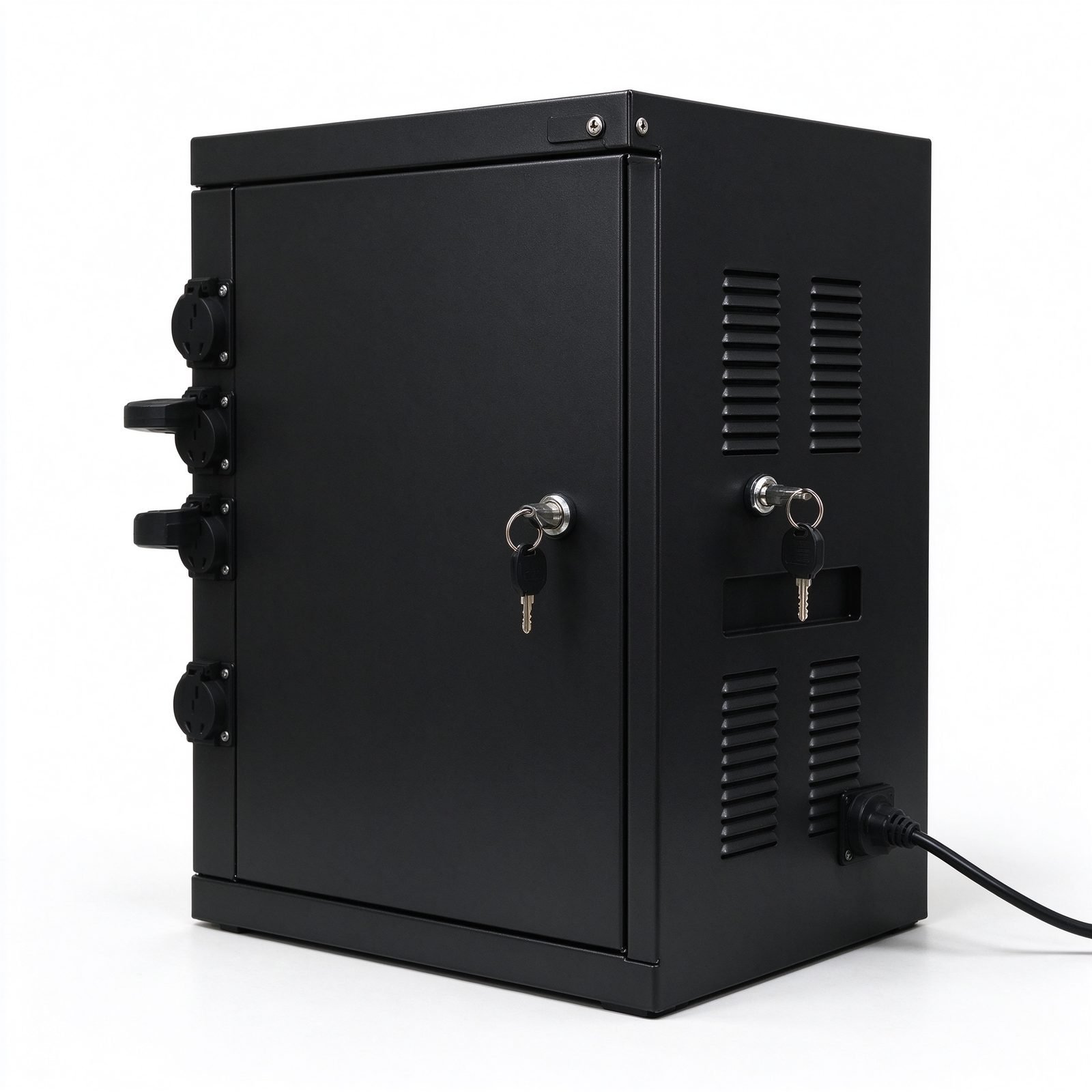
The holder follows the cell form. Cylindrical cells use the adjustable negative plate height, which lets one cabinet accept several cylindrical lengths and diameters in one cycle; pouch cells use a clamp holder built to order. The clamp form, plug and slot layout are confirmed in the RFQ. 48-bay = 48 charging positions, not 48 volt.
Plug, Slot Layout and Module Count
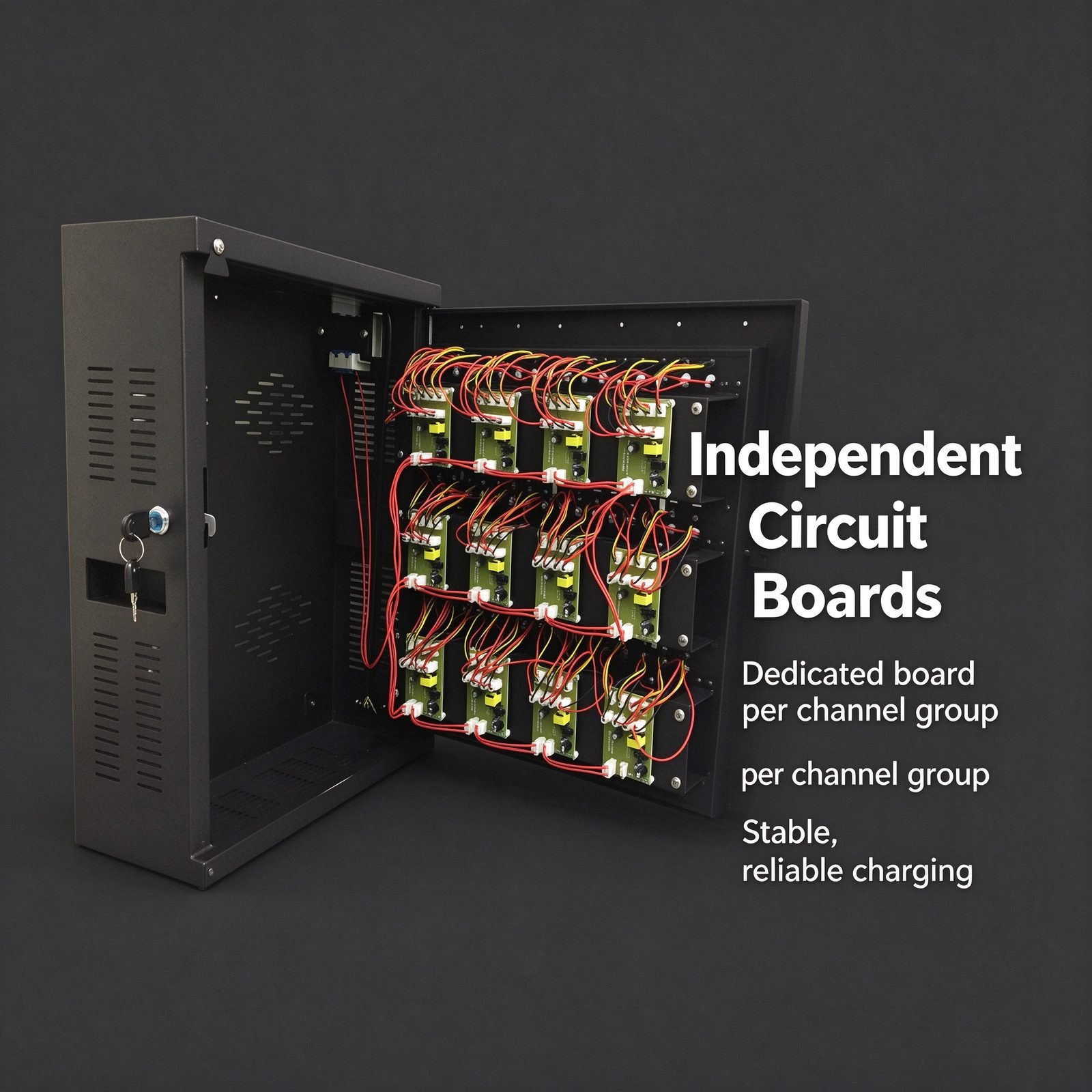
Plug format, slot layout and module count are configured to the order. The standard reference is 48 positions built from 12 smart modules of four positions each, and 168 positions built from 42 smart modules in a 6 columns × 28 rows layout. A custom position count is quoted as positions, not volts. 48-bay = 48 charging positions, not 48 volt; 168-position = 168 charging positions.
Chemistry and Voltage — Where 3.65 V Is Required
Three voltage steps sit side by side, and the boundary between them is the reason a custom RFQ exists. 48-bay and 168-position count charging positions, not 48 volt.
- 3.6/3.7 V Li-ion cylindrical, 4.2 V cut-off (standard CMX48). The standard line covers 18650, 21700, 26650, 14500, 18350, 16340, 20700, 22650 and 26800, including NMC ternary cylindrical cells. For the size and holder detail, see the cylindrical cell size compatibility list. This is the 4.2 V standard profile; it is not the 3.65 V LFP profile.
- 1.2 V Ni-MH / Ni-Cd (standard CMX168). AA, AAA and similar 1.2 V cylindrical cells use their own machine. See the 168-position Ni-MH and Ni-Cd charging cabinet. 168-position = 168 charging positions, not a voltage.
- LiFePO4, 3.2 V nominal / 3.65 V cut-off (custom). LFP cells including 32700, 32650 and 26650 LFP are built to order at 3.65 V. See the LFP cell charging cabinet with 3.65 V profile; the 4.2 V standard profile is not applicable to that line.
- LiPo / pouch, single-cell 3.7 V (custom). A pouch cell needs a clamp holder and a configured profile. See the pouch cell custom charging cabinet; this is a custom single-cell 3.7 V build, not standard 4.2 V coverage.
Standard 4.2 V cannot be used for LiFePO4. Applying the higher cut-off to a 3.2 V LFP chemistry is exactly the mismatch a custom build prevents, so the two are quoted as separate configured cabinets. For the plain-language answer, see LiFePO4 charging voltage requirements.
Standard models charge 3.6/3.7 V Li-ion cylindrical cells (4.2 V cut-off) and 1.2 V Ni-MH/Ni-Cd. LiFePO4 (3.2 V / 3.65 V cut-off), LiPo pouch cells and other chemistries are available as custom-built versions — tell us your cell model and we configure the charging profile.
That split is the most common source of a mismatched enquiry: a request that names several chemistries is a request for several configured builds, not for one universal cabinet. 48-bay = 48 charging positions, not 48 volt.
RFQ Fields — What to Send
Five fields make a custom RFQ complete. Each has a simple way to write it.
- Cell model. Give the exact model, for example
18650,32700 LiFePO4 (3.65 V custom)or18650 pouch. Write the chemistry next to the model when the format alone does not fix it. - Chemistry. For example
NMC,LFP,LiPo / pouchorNi-MH / Ni-Cd. One chemistry per configured build. - Voltage. Nominal voltage plus the expected cut-off, for example
3.6/3.7 V + 4.2 V cut-off,3.2 V + 3.65 V cut-offor1.2 V. The cut-off must match the chemistry. - Slot count.
48,168or a custom position count. 48-bay = 48 charging positions, not 48 volt. - Certification requirement. State the scope you need declared. The published scope is CE / FCC / RoHS; other requirements should be described in the enquiry so they can be reviewed. No fire-safety or safety-cabinet certification is offered.
Submit the five fields through the site enquiry form. No price figure, lead time, customer name or certificate number is published here, and no certification beyond the three-item scope is promised. See quote factors for customized charging cabinets for the variables that shape a quote. 48-bay and 168-position are position counts, not 48 volt.
Next step: send your cell list through the RFQ form and receive a configuration built around those five fields.
Custom Build vs Standard Off-the-Shelf Cabinet
For the category overview, start with the multi battery charging station category. The two routes are different products with different buying questions: a standard cabinet is chosen from a fixed specification; a custom cabinet is configured from a cell list. This page covers the custom RFQ route only — the standard stock supply qualification is a separate topic.
| Dimension | Standard off-the-shelf cabinet | Custom build to order |
|---|---|---|
| How it is chosen | From a fixed model line | From a named cell list |
| Chemistry | Fixed: 3.6/3.7 V Li-ion cylindrical or 1.2 V Ni-MH / Ni-Cd | Configured: LFP 3.65 V, single-cell 3.7 V pouch, other systems by evaluation |
| Voltage and cut-off | 4.2 V standard or 1.2 V nickel | Matched to the chemistry, one-to-one |
| Holder, plug, layout | Standard build | Voltage, holder / clamp, plug, slot layout and module count by order |
| Certification scope | CE / FCC / RoHS | CE / FCC / RoHS; other requirements raised in the RFQ |
| Typical buyer | A cell pool that fits a standard line | A fixed list outside the two standard lines |
For the stock supply side, see standard off-the-shelf cabinet supply — that phrase refers to the standard machine, not to the custom RFQ path described here. If you have not yet decided whether you need a custom build at all, the buying guide for charging many cells in one cabinet compares the model lines first. 48-bay = 48 charging positions, not 48 volt; 168-position = 168 charging positions.
Certification Scope
The published certification scope is CE, FCC and RoHS — three items only. No fire-safety or safety-cabinet certification is claimed or implied, and this product is not a fireproof safety cabinet. A buyer whose specification calls for a fire-rated enclosure is describing a different product. No certificate numbers, issuing bodies, test report identifiers or customer names are published here.
This closes the loop with the fifth RFQ field: state the certification requirement in the enquiry and it is reviewed against the published three-item scope. Nothing on this page is a promise of a certification beyond CE / FCC / RoHS. 48-bay and 168-position are position counts, not 48 volt.
Specification Snapshot and RFQ Entry
| Field | Build-to-order specification |
|---|---|
| Build type | Custom to order (ODM) |
| Slot count (bays / positions) | 48-bay / 168-position / custom — 48-bay = 48 charging positions, not 48 volt |
| Charging modules | 12 × 4-way (48 positions) / 42 modules, 6 × 28 (168 positions); configured to order |
| Chargeable chemistry | 3.6/3.7 V Li-ion cylindrical; 1.2 V Ni-MH / Ni-Cd; LiFePO4 3.2 V / 3.65 V cut-off custom; LiPo pouch custom-built with clamp holder; 4680 and large cylindrical cells evaluated per order |
| Nominal cell voltage | 3.6 / 3.7 V Li-ion; 1.2 V Ni-MH / Ni-Cd; 3.2 V LiFePO4 custom |
| Charge cut-off voltage | 4.2 V ± 0.05 V standard; 1.2 V nickel configuration; 3.65 V for LFP custom; 3.7 V single-cell pouch custom |
| Charge current | 800–1050 mA (CMX48); < 500 mA (CMX168); set to the cell model on custom builds |
| Charge method | CC/CV |
| Cut-off current | 100 mA standard; configured to the cell model on custom builds |
| Status indication | One LED per position |
| Protection | Reverse-polarity protection; overcharge protection |
| Input power | 90–220 V / 50 Hz; 110/220 V · 50 Hz; plug configurable on request |
| Customization options | Voltage profile / holder & clamp / plug / slot layout / module count |
| Onboard features | External air switch; power-on self-test; adjustable negative plate height |
| Certifications | CE / FCC / RoHS |
| RFQ required fields | Cell model / chemistry / nominal + cut-off voltage / slot count / certification requirement |
Table note: the routine charging characteristics above — CC/CV, cut-off current, one LED per position, protection, the external air switch, the power-on self-test and the adjustable negative plate height — are construction facts recorded here only, not reasons to buy. The reason to buy a custom cabinet is a cell list that no standard profile fits. 48-bay = 48 charging positions, not 48 volt; 168-position = 168 charging positions. Standard 4.2 V cannot be used for LiFePO4, which needs the 3.65 V custom cut-off.
Related Products
For a machine that is in stock rather than configured to order, see the off-the-shelf 48-position Li-ion charger product page — a standard off-the-shelf model, not a custom build, on the 4.2 V Li-ion line. Alongside it, the site enquiry form is the entry point for a custom build. 48-bay = 48 charging positions, not 48 volt.