

Battery Charging Station Manufacturers: CE, FCC and RoHS Standard Cabinets
Shortcut: check the declared certification, confirm the input voltage range and the cell system, then pick a slot count. One supplier scope, two model lines, one enquiry.
What to Check When Choosing a Charging Station Manufacturer
What This Page Covers
Standard models charge 3.6/3.7 V Li-ion cylindrical cells (4.2 V cut-off) and 1.2 V Ni-MH/Ni-Cd. LiFePO4 (3.2 V / 3.65 V cut-off), LiPo pouch cells and other chemistries are available as custom-built versions — tell us your cell model and we configure the charging profile.
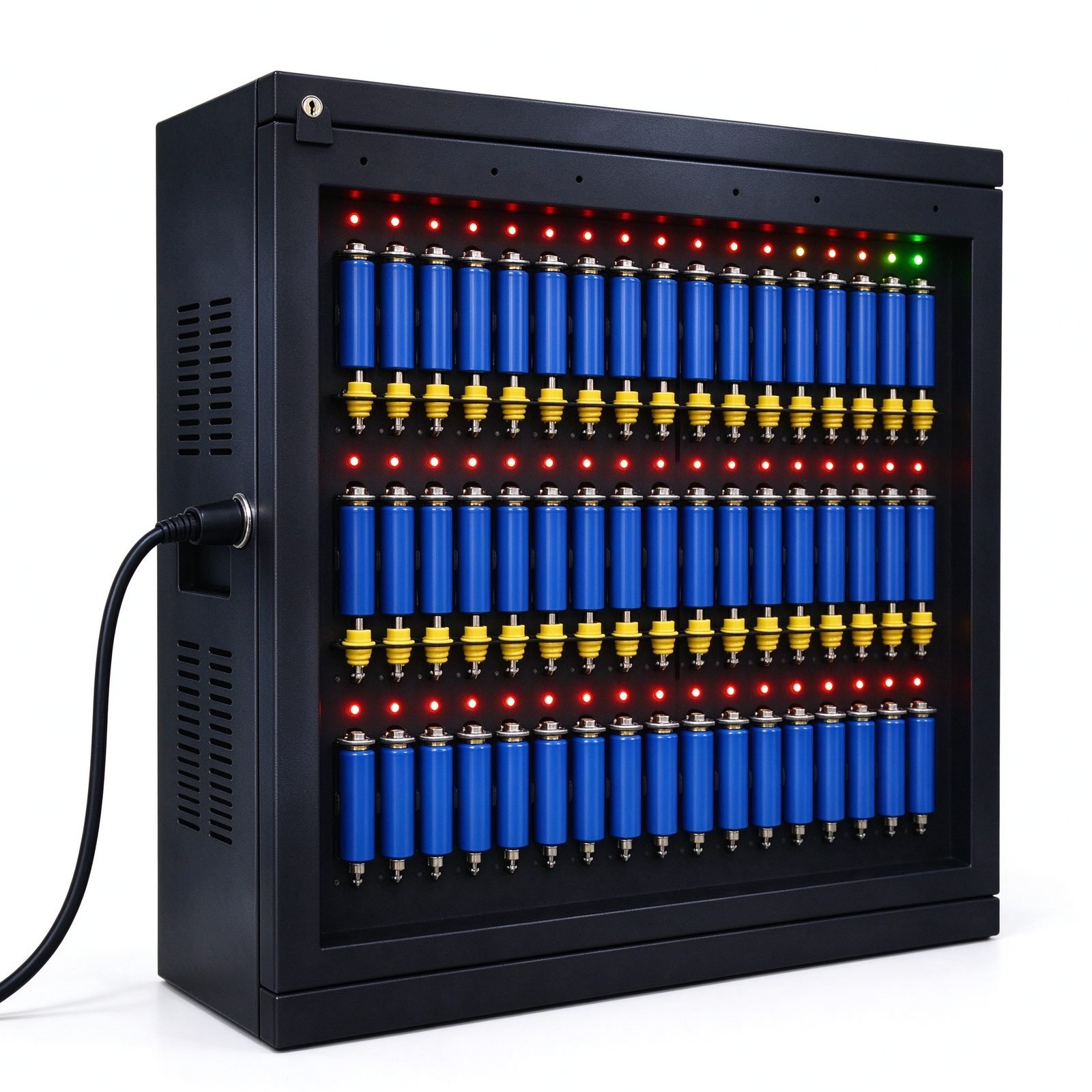
As battery charging station manufacturers, we supply standard stock cabinets on two model lines, and the declared scope is part of the product description rather than a sales line: three certifications, a stated input voltage range, and two fixed chemistry profiles. One cabinet charges many bare cells at once, each position on its own independent channel. 48-bay, 48-position and 168-position mean charging positions, not 48 volt; every 48 or 168 on this page counts positions, never a supply voltage. The 90–220 V / 50 Hz figure elsewhere on this page is an input voltage range, a separate matter.
This page answers a procurement question: who can supply a standard cabinet, what exactly is declared for it, and which selection dimensions shape an enquiry. Buyers are cell pools at venues, retail and logistics operations, security patrol teams, workshops and laboratories — all running the same routine of a pool of cells returning at a handover and a charged set being needed for the next one. For the wider category, see the cabinet portfolio for standard models.
Standard Stock, Not a Custom Program
The supply scope here is standard stock cabinets by model line. A voltage profile built to order, a clamp holder for pouch cells, a non-standard plug or a non-standard position count belongs to a separate enquiry route, linked once below with the standard-versus-custom distinction stated. Phrases such as battery charging cabinet manufacturer, battery charging cabinet supplier and battery charging cabinet factory describe that factory supply of a fixed model line, not a design service. A battery charging cabinet for sale or a wholesale battery charging cabinet in this catalogue means a standard cabinet supplied by model line; neither phrase carries a stock-level, availability-window or figure commitment. A ce certified battery charging cabinet and a ce fcc rohs battery charging cabinet both refer to the same three-item scope described below.
Certification Scope — CE, FCC and RoHS Only
The Three Certifications We Can State
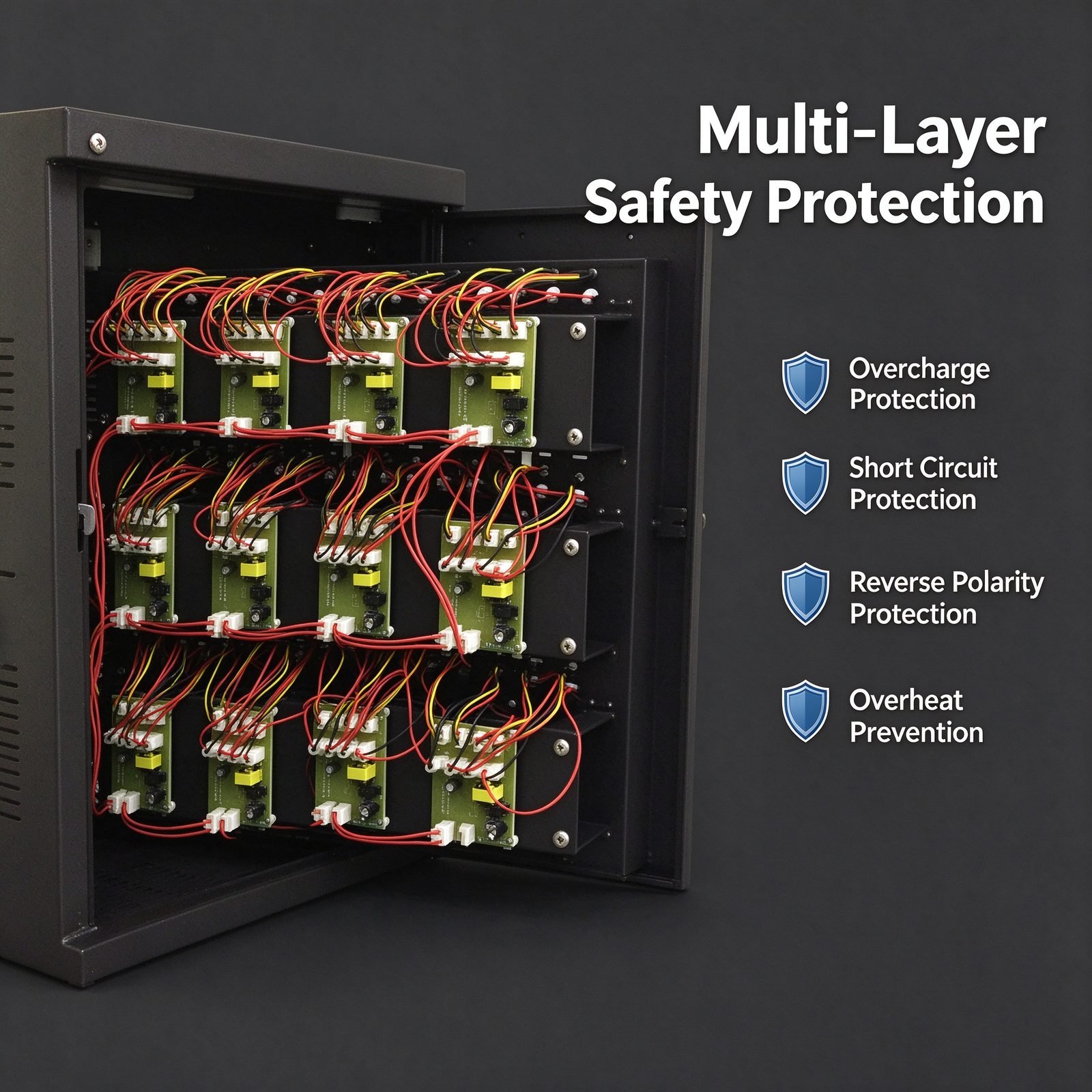
Three items can be stated for these cabinets: CE, FCC and RoHS. CE covers the applicable European conformity requirements for the equipment, FCC covers electromagnetic compatibility for the US market, and RoHS restricts the use of certain hazardous substances in materials. Those three items are the whole of the published scope. No certificate numbers, issuing bodies, test report identifiers, customer names or case data are published here, and no fourth item is offered. If a procurement checklist calls for a declaration, the enquiry is where it is checked against the three-item scope.
What We Do Not Claim
This product is a charging cabinet, not a fireproof safety cabinet, and no fire-resistance or safety-cabinet certification is claimed or implied. A buyer whose specification calls for a fire-rated enclosure is describing a different product category, and we do not suggest the two are comparable. The published scope stays at CE, FCC and RoHS; no other certification is offered and none is hinted at. For the naming boundary between a charger and a cabinet, see charger versus cabinet category boundaries.
Voltage Range and Global Site Readiness
90–220 V Wide Input
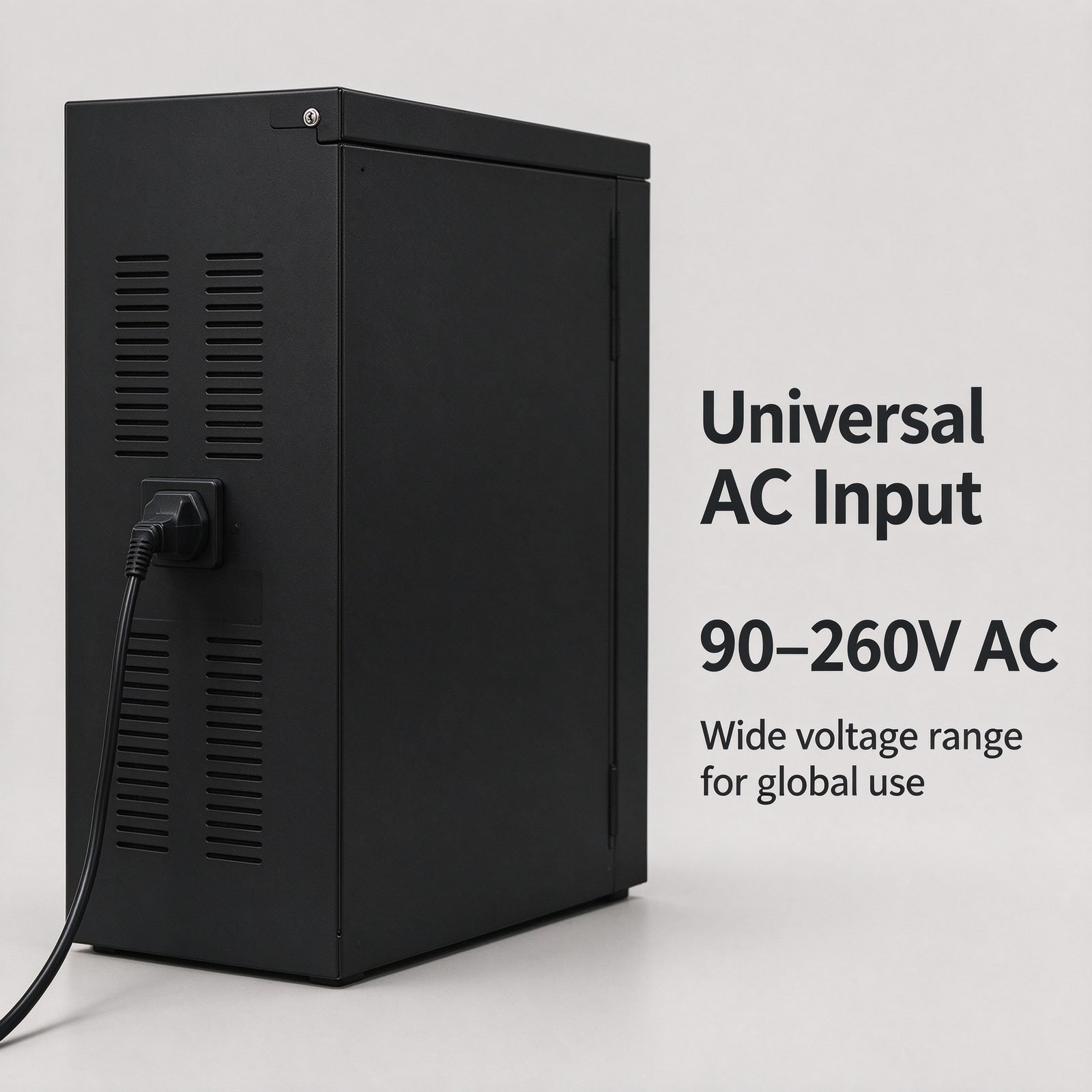
The standard CMX48 accepts 90–220 V / 50 Hz input; the standard CMX168 accepts 110/220 V · 50 Hz. A 110v 220v battery charging cabinet therefore describes an input voltage range for the two lines, not a slot count: 48-position = 48 charging positions, not 48 volt, and 168-position = 168 charging positions, not a voltage. Keeping the input figure next to that sentence is how the two numbers stay separate for a reader comparing specifications. Plug format can be configured to the order as a custom item; no specific plug model, cord set or accompanying accessory list is promised, and no regional availability claim is made.
Two Standard Model Lines and Their Chemistry Boundaries
Standard models charge 3.6/3.7 V Li-ion cylindrical cells (4.2 V cut-off) and 1.2 V Ni-MH/Ni-Cd. LiFePO4 (3.2 V / 3.65 V cut-off), LiPo pouch cells and other chemistries are available as custom-built versions — tell us your cell model and we configure the charging profile.
4.2 V Li-Ion Cylindrical Line
The lithium line is a 48-position cabinet built with 12 smart modules, charging 3.6/3.7 V Li-ion cylindrical cells to a 4.2 V ± 0.05 V cut-off. Its boundary is the chemistry: LiFePO4 at 3.2 V needs a 3.65 V custom cut-off, and a single-cell 3.7 V pouch cell needs a clamp holder and its own configured profile; neither is standard coverage, and the standard 4.2 V profile is not applicable to LiFePO4. This page gives model-line boundaries only — the cylindrical size list and the chemistry detail live on the selection page and the custom-chemistry page, and are not copied into this table. For the plain-language version of the voltage boundary, see voltage and certification boundaries. 48-bay = 48 charging positions, not 48 volt.
1.2 V Ni-MH and Ni-Cd Line
The nickel line is a 168-position cabinet built with 42 smart modules in a 6 columns × 28 rows layout for 1.2 V Ni-MH / Ni-Cd AA and AAA cells. Standard models charge 3.6/3.7 V Li-ion cylindrical cells to a 4.2 V cut-off and 1.2 V Ni-MH/Ni-Cd cells on two separate machines, not as two settings on one cabinet: see the 168-position Ni-MH and Ni-Cd cell pool cabinet. The 4.2 V and 1.2 V profiles each keep their own cut-off and their own machine. 168-position = 168 charging positions, not a voltage.
Selection Dimensions for a Standard Cabinet Purchase
Position Count
Choose 48-bay or 168-position by the number of cells one shift must turn over. 48-bay = 48 charging positions, not 48 volt; 168-position = 168 charging positions, not 168 volt. Input voltage is a separate figure and is not part of this count.
Chemistry and Voltage Profile
Confirm the cell system and nominal voltage first, then the step: 4.2 V Li-ion cylindrical, 1.2 V Ni-MH / Ni-Cd, or a 3.65 V LFP / 3.7 V pouch custom profile built to order. The cut-off must match the chemistry one-to-one; a list that spans two systems is quoted as two configured builds rather than one universal cabinet.
Certification Requirements
The three declared items are CE, FCC and RoHS. State the scope you need declared in the enquiry and it is reviewed against those three. No fourth item, no certificate number and no issuing-body detail is published here.
Factory Supply and Build Scope
Standard stock cabinets are supplied by model line at the factory. Custom voltage, clamp holder, plug and position count are quoted on the custom enquiry route, which is not itself a standard stock order. No price figure, lead time, customer name, unit count, capacity figure or case data is published here. See quote factors to review for the dimensions that shape a quote.
Standard Model vs Custom Build
When a Standard Cabinet Is Enough
If your cells are 3.6/3.7 V Li-ion cylindrical or 1.2 V Ni-MH / Ni-Cd, and the slot count falls on the 48 or 168 step, a standard stock cabinet is the right route. To compare the two lines before ordering, see standard versus custom cabinet selection; the 4.2 V lithium line and the 1.2 V nickel line are separate machines, not two settings on one cabinet. 48-bay = 48 charging positions, not 48 volt.
When a Custom Build Is Needed
A 3.65 V LFP cut-off, a pouch clamp holder, a non-standard position count, or a non-standard voltage or plug goes through the custom enquiry route. This is the standard-machine versus custom-machine split: this page covers factory supply of standard stock cabinets, while the custom build versus standard stock page covers the built-to-order request. Neither page lists the other’s main phrase as its own, and neither route is presented as a substitute for the other. 48-bay = 48 charging positions, not 48 volt.
Battery Charging Cabinet Price — What Affects the Quote
Why We Do Not Publish a Price List
This section carries the quote topic after the v2.1 merge: battery charging cabinet price is a heading-level phrase here, not a second landing page, and no price list is published. Enquiries about battery charging station price, battery charging station cost, a 48 bay battery charger price or a 48 position battery charger are answered with the dimensions that shape a quote, not with a number. No currency figure, range, starting amount, unit figure or availability-window promise is stated anywhere on this page. The reason is simple: a quote depends on the configuration, and the configuration depends on the cell list.
The Four Dimensions That Change a Quote
Four dimensions decide a standard cabinet quotation. Position count: 48-bay, 168-position, or a non-standard count built to order — 48-bay = 48 charging positions, not 48 volt; 168-position = 168 charging positions. Chemistry and voltage profile: 4.2 V Li-ion cylindrical, 1.2 V Ni-MH / Ni-Cd, or a 3.65 V LFP / 3.7 V pouch custom profile. Custom depth: voltage, clamp holder, plug and position count configured to the order. Certification requirements: CE, FCC and RoHS, three items only. No other dimension is quoted here, and a market size listing is not carried as a supplied specification on this page. The enquiry is three steps: submit your cell model and chemistry, confirm the voltage step and position count, and receive a configuration proposal. No price figure, lead time, customer name, certificate number, unit count or case data is published. 48-bay and 168-position are position counts, not 48 volt.
Where to Send the Enquiry
Standard stock orders belong on this page; built-to-order work belongs on the custom enquiry page. The split is standard machine versus custom machine, and the two routes are not mixed in one request. This section closes the chain by linking the selection comparison at the end: compare the model lines, then decide. An enquiry to battery charging station manufacturers is answered with a model-line suggestion and a declared scope, not with a published figure.
Specification Table
| Field | Standard stock cabinet |
|---|---|
| Certifications | CE / FCC / RoHS |
| Input voltage | 90–220 V / 50 Hz (CMX48); 110/220 V · 50 Hz (CMX168) |
| Positions | 48-bay / 168-position (slot count, not volts) |
| Model lines | 4.2 V Li-ion cylindrical (CMX48); 1.2 V Ni-MH / Ni-Cd (CMX168) |
| Charge cut-off voltage | ≈4.2 V ±0.05 V, 100 mA cut-off (Li-ion line); 1.2 V profile (Ni-MH / Ni-Cd line) |
| Charging current | 800–1050 mA per position (Li-ion line); < 500 mA (Ni-MH / Ni-Cd line) |
| Smart modules | One module per 4 positions (12 modules at 48 positions; 42 modules at 168 positions) |
| Independent channel per position | One channel per cell |
| Per-position status | One status LED per position |
| Protections | Reverse polarity protection; external air switch; power-on self-test |
| Mechanical | CMX48 adjustable negative plate height |
| Supply scope | Standard stock cabinets by model line; custom voltage / clamp / plug / position count on request |
| Certification note | CE / FCC / RoHS only; no fire-resistance or safety-cabinet certification claimed |
Table note: this is a model-line-level stock supply table, not a multi-chemistry compatibility table. 48 / 168 are slot counts, not 48 volt; the 90–220 V / 50 Hz and 110/220 V · 50 Hz rows are input voltage ranges. CC/CV, charge termination, protection and indicator behaviour appear here as fields only — baseline charging characteristics, not reasons to buy. The published scope is CE, FCC and RoHS, three items only.
FAQ and Where to Go Next
Which certifications can the manufacturer state? CE, FCC and RoHS — three items. CE covers applicable European conformity requirements, FCC covers electromagnetic compatibility for the US market, and RoHS restricts certain hazardous substances in materials. No fourth certification is claimed.
Which input voltages are covered? The CMX48 accepts 90–220 V / 50 Hz and the CMX168 accepts 110/220 V · 50 Hz. Those are input ranges; 48-position = 48 charging positions, not 48 volt.
How do I choose between 48 and 168? Count the cells one shift must turn over. 48-bay = 48 charging positions, not 48 volt; 168-position = 168 charging positions. Confirm the cell system next, since the lithium and nickel lines are separate machines.
When must I go to a custom build? When the cells need a 3.65 V LFP cut-off, a pouch clamp holder, a non-standard position count, or a non-standard voltage or plug. That is the standard-versus-custom split; standard stock is supplied by model line. For the wider background, see blog guide to charging cabinet standards.
Related Products
For the in-stock machine on the 4.2 V Li-ion line, see the CMX 48-position Li-ion charging cabinet product page. Standard models charge 3.6/3.7 V Li-ion cylindrical cells to a 4.2 V cut-off and 1.2 V Ni-MH/Ni-Cd cells; LiFePO4 at 3.2 V uses a 3.65 V custom cut-off instead, so this in-stock model is the lithium line, not an LFP cabinet. 48-position = 48 charging positions, not 48 volt. Alongside it, the site enquiry form is the entry point for a standard stock order.
Next step: confirm your cell system and slot count, compare the two standard model lines, then send the enquiry for a configuration proposal.