

Charge Multiple Batteries at Once: Compare 48-Bay, 168-Position and Custom Cabinets
Need a quote? Send your cell list — model, chemistry, voltage, position count and certification scope — and we will return a selection comparison table.
Selection Dimensions at a Glance
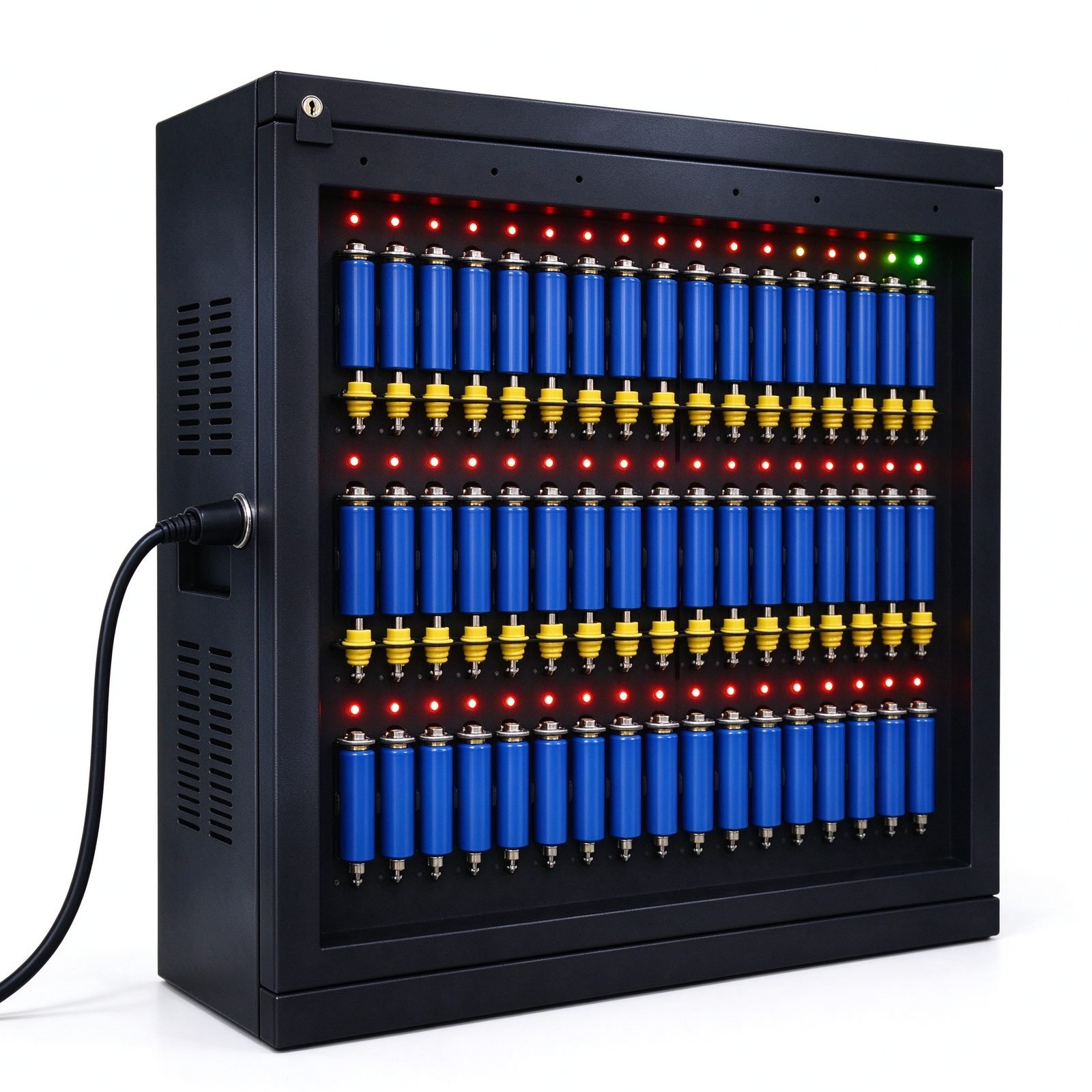
Standard models charge 3.6/3.7 V Li-ion cylindrical cells (4.2 V cut-off) and 1.2 V Ni-MH/Ni-Cd. LiFePO4 (3.2 V / 3.65 V cut-off), LiPo pouch cells and other chemistries are available as custom-built versions — tell us your cell model and we configure the charging profile.
To charge multiple batteries at once, fix four things before a quote: how many cells must finish in one cycle, which chemistry and cut-off voltage, how much is built to order, and which certification scope. 48-bay means 48 charging positions, not 48 volt; 168-position counts 168 charging positions. This is the transactional landing page under the category hub; for the overview and the glossary of bay, slot, channel and position, see the multi battery charging station category guide.
Compare by Slot Count
48-Bay Cabinets
The standard CMX48 has 48 positions and 12 smart modules, four positions per module. 48-bay and 48-position both mean 48 charging positions, not 48 volt; input is 90–220 V / 50 Hz, a separate figure. It covers 3.6/3.7 V Li-ion cylindrical cells including NMC ternary cylindrical cells — 18650, 21700, 26650, 14500, 18350, 16340, 20700, 22650, 26800. A single 3.7 V LiPo / pouch cell and LiFePO4 (3.65 V cut-off) are not standard coverage; both are custom builds. 48-bay = 48 charging positions, not 48 volt.
168-Position Cabinets
The standard CMX168 is laid out as 6 columns × 28 rows with 42 smart modules, one per four positions. 168-position means 168 charging positions, not a voltage. It is dedicated to 1.2 V Ni-MH and Ni-Cd AA, AAA and similar cylindrical rechargeable cells, below 500 mA on 110/220 V · 50 Hz. The split from 48-bay is by chemistry, not preference: a 4.2 V Li-ion cell and a 1.2 V Ni-MH cell are charged on two different machines. For the AA / AAA line, see the 168-position AA and AAA charging cabinet page.
Custom Slot Counts
Slot layout is configurable alongside voltage, holder and plug format. A custom layout is quoted as a position count, not as volts; 48-bay and 168-position are the standard figures.
| Dimension | CMX48 (standard) | CMX168 (standard) | ODM custom |
|---|---|---|---|
| Slot count | 48-bay / 48-position | 168-position | Custom layout |
| Cell chemistry | 3.6/3.7 V Li-ion cylindrical (NMC ternary cylindrical included) | 1.2 V Ni-MH / Ni-Cd | LFP, LiPo / pouch, NMC, 4680 and other rechargeable chemistries |
| Cut-off voltage | 4.2 V ± 0.05 V standard | 1.2 V nickel configuration | 3.65 V for LFP; 3.7 V single-cell pouch custom |
| Customization depth | Standard, with adjustable negative plate height | Standard | Voltage, holder, plug, slot layout |
| Certification dimension | CE / FCC / RoHS | CE / FCC / RoHS | CE / FCC / RoHS |
| Typical buyer | Li-ion cylindrical cell pools | AA / AAA nickel cell pools | Cell lists outside the two standard lines |
Table note: 48-bay = 48 charging positions, not 48 volt; 168-position = 168 charging positions.
Cylindrical Cell Charger — Sizes and Adjustable Holders
One Cabinet for Many Cylindrical Sizes
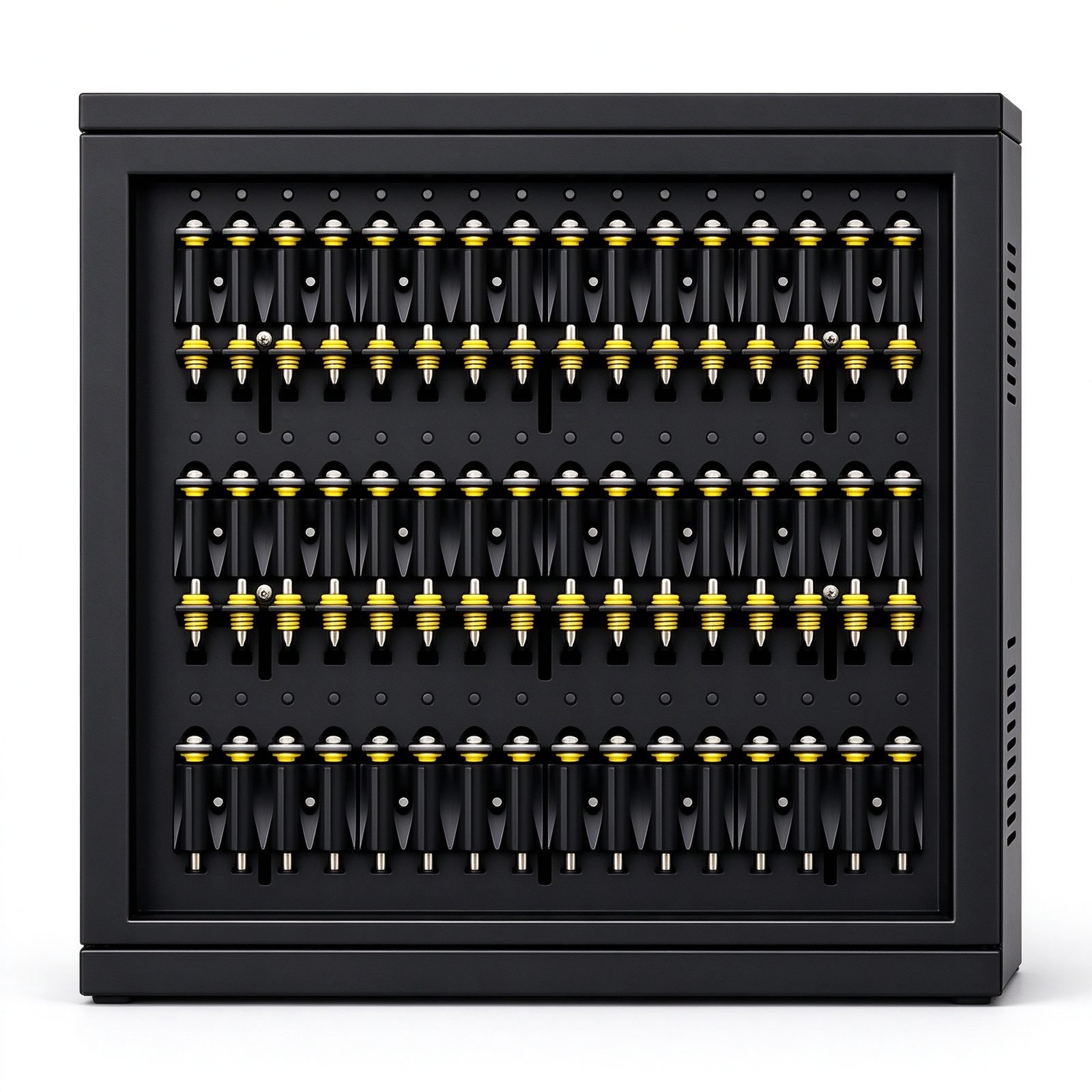
The CMX48’s adjustable negative plate height lets one 48-position cabinet accept several cylindrical lengths and diameters in one cycle — the mechanical prerequisite for charging many cells at once, not a standalone claim. Phrases such as a multi size cylindrical cell charger, a universal cylindrical battery charger, a charger for 18650 21700 26650 26800 formats, an adjustable battery holder charger and a cylindrical lithium battery charging cabinet all point to that adjustment and live in this section. 48-bay here is 48 charging positions, not 48 volt.
Cylindrical Size Compatibility Table
The table gives format, size family and profile only.
| Cell format | Size family | Profile |
|---|---|---|
| 18650 | 3.6/3.7 V Li-ion cylindrical | 4.2 V standard |
| 21700 | 3.6/3.7 V Li-ion cylindrical | 4.2 V standard |
| 26650 | 3.6/3.7 V Li-ion cylindrical | 4.2 V standard |
| 14500 | 3.6/3.7 V Li-ion cylindrical | 4.2 V standard |
| 18350 | 3.6/3.7 V Li-ion cylindrical | 4.2 V standard |
| 16340 | 3.6/3.7 V Li-ion cylindrical | 4.2 V standard |
| 20700 | 3.6/3.7 V Li-ion cylindrical | 4.2 V standard |
| 22650 | 3.6/3.7 V Li-ion cylindrical | 4.2 V standard |
| 26800 | 3.6/3.7 V Li-ion cylindrical | 4.2 V standard |
| 32700 / 32650 / 26650 LiFePO4 | LFP cylindrical | 3.65 V custom, not the standard 4.2 V profile |
| LiPo / pouch single cell | Pouch | 3.7 V custom with clamp holder |
Table notes: 48-bay and 168-position count charging positions, not 48 volt. This is not one machine that covers every chemistry — the LFP rows need a 3.65 V custom build and the pouch row a custom clamp holder, and both are custom-only. Split a cell list by chemistry: pure Li-ion cylindrical cells go to the CMX48 line, Ni-MH / Ni-Cd cells to the CMX168 line (see the 168-position page), LFP and pouch cells to the custom line (see the custom chemistry and RFQ pages). Each route has its own cut-off: 4.2 V standard Li-ion, 1.2 V nickel, 3.65 V LFP custom, 3.7 V single-cell pouch custom.
Compare the Three Model Lines
| Field | CMX48 (standard Li-ion) | CMX168 (standard nickel) | ODM custom |
|---|---|---|---|
| Slot count | 48-bay / 48-position | 168-position | Custom position count |
| Cell chemistry | 3.6/3.7 V Li-ion cylindrical, incl. NMC ternary cylindrical | 1.2 V Ni-MH / Ni-Cd AA, AAA | LiFePO4 / LFP, LiPo / pouch, NMC, 4680, other rechargeable chemistries |
| Voltage and cut-off | 4.2 V ± 0.05 V standard | 1.2 V nickel configuration | 3.65 V LFP charging cabinet options for LFP rows; pouch cell charging cabinet options for pouch rows |
| Customization depth | Standard build | Standard build | Voltage, holder, plug, slot layout |
| Certification dimension | CE / FCC / RoHS — see battery charging station manufacturer profile | CE / FCC / RoHS | CE / FCC / RoHS |
| Typical buyer scenario | Li-ion cylindrical cell pools | AA / AAA nickel cell pools | Cell lists outside the two standard lines |
Standard models charge 3.6/3.7 V Li-ion cylindrical cells (4.2 V cut-off) and 1.2 V Ni-MH/Ni-Cd. LiFePO4 (3.2 V / 3.65 V cut-off), LiPo pouch cells and other chemistries are available as custom-built versions — tell us your cell model and we configure the charging profile.
The LFP row is a 3.65 V custom build that cannot run on the standard 4.2 V profile; the pouch row is a single-cell 3.7 V custom build with a clamp holder, not standard coverage. For the voltage difference, see 4.2 V versus 3.65 V charging voltage; for the size and holder detail, see multi size cylindrical cell charging cabinet on this page. 48-bay is 48 charging positions, not 48 volt; 168-position is 168 charging positions.
One Cabinet vs a Row of Single Chargers
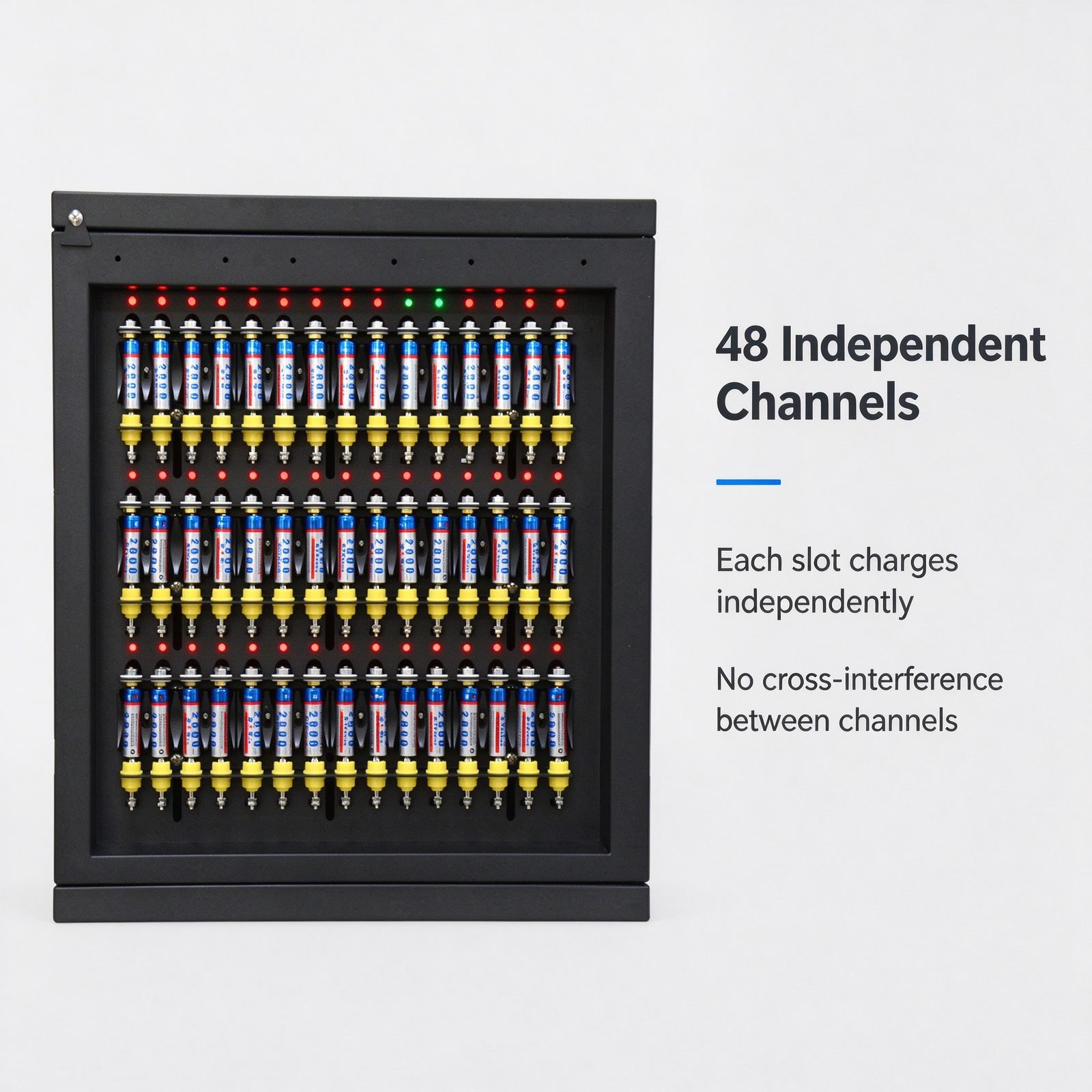
A bench of single chargers can reach the same count in principle, but it asks the operator to manage one lead, one indicator and one inspection point per charger. A cabinet puts 48 charging positions, or 168 charging positions, behind one enclosure with one mains connection. 48-bay = 48 charging positions, not 48 volt; 168-position = 168 charging positions.
One independent channel per position is what makes this possible. Cells from a shift differ in age, capacity and state of charge, and an independent channel lets each follow its own condition instead of forcing the set to behave as one cell. That is the prerequisite for charging many cells at once, not a separate feature. For the short Q&A, see independent channel battery charger basics; for the long-form explanation, see blog guide to charging many cells in one cabinet. The payoff is shift rhythm: the pool returns, charges and is issued as a set.
How to Request a Quote
Prepare five items before an RFQ: cell model, chemistry, nominal and cut-off voltage, position count, and required certification scope. A quote moves with the position count, the chemistry, the depth of customization and the certification scope; no price figure or lead time is published here. See quote factors for charging cabinets for the variables, and custom voltage and slot count charging cabinet for a custom configuration. 48-bay and 168-position are position counts, not 48 volt.
Next step: send your cell list and request a selection comparison table — no figures are quoted until the chemistry and position count are fixed.
Specification Snapshot
| Field | CMX48 (standard) | CMX168 (standard) | ODM custom |
|---|---|---|---|
| Model line | CMX48 | CMX168 | ODM custom |
| Slot count (bays / positions) | 48-bay / 48-position | 168-position | Custom layout |
| Charging modules | 12 smart modules × 4 positions | 42 smart modules, 6 columns × 28 rows | Configured to order |
| Supported cell chemistry | 3.6/3.7 V Li-ion cylindrical (incl. NMC ternary cylindrical) | 1.2 V Ni-MH / Ni-Cd | LFP, LiPo / pouch, NMC, 4680 and other rechargeable chemistries |
| Nominal cell voltage | 3.6 / 3.7 V | 1.2 V | Set by cell model |
| Charge cut-off voltage | 4.2 V ± 0.05 V standard | 1.2 V nickel configuration | 3.65 V for LFP custom; 3.7 V for single-cell pouch custom |
| Charge current | 800–1050 mA | < 500 mA | Configured to cell model |
| Charge method | CC/CV | CC/CV | Configured to cell model |
| Cut-off current | 100 mA | Per nickel configuration | Configured to cell model |
| Status indication | One LED per position | One LED per position | One LED per position |
| Protection | Reverse-polarity protection; overcharge protection | Reverse-polarity protection; overcharge protection | Reverse-polarity protection; overcharge protection |
| Input power | 90–220 V / 50 Hz | 110/220 V · 50 Hz | Configured to order |
| Onboard features | External air switch; power-on self-test; adjustable negative plate height | External air switch; power-on self-test | Configured to order |
| Certifications | CE / FCC / RoHS | CE / FCC / RoHS | CE / FCC / RoHS |
| Customization options | Standard build; slot layout by order only | Standard build; slot layout by order only | Voltage / holder / plug / slot layout |
| Slot count clarification note | 48-bay = 48 charging positions, not 48 volt | 168-position = 168 charging positions, not a voltage | Position count quoted as positions, not volts |
Table note: multi bay charger terminology guide defines bay, slot, channel and position on the category hub. 48-bay and 168-position are position counts, not 48 volt.
Related Products
The standard lithium line is on the standard 48-bay Li-ion charging cabinet product page. Compare slot counts and cell chemistry, then request a selection comparison table for your cell list.
FAQ
Can I charge multiple batteries at once with one cabinet? Yes. One 48-position cabinet charges 48 cells at once and one 168-position cabinet charges 168 cells at once, each on its own channel. 48-bay is 48 charging positions, not 48 volt. The independent-channel FAQ linked above covers mixing cell conditions.
Does 48-bay mean 48 volt? No. 48-bay = 48 charging positions. Input is 90–220 V / 50 Hz or 110/220 V · 50 Hz. The voltage FAQ covers 4.2 V versus 3.65 V; the category hub glossary covers bay and position.
Can one cabinet handle LiFePO4 and standard Li-ion cells? No. LFP needs a 3.65 V custom build; the standard lithium cabinet is a 4.2 V build.
Which cylindrical sizes fit? The formats in the size table, on the standard 4.2 V lithium line. 48-bay and 168-position count positions, not 48 volt.
Related Reading and Next Step
- 1.2 V Ni-MH / Ni-Cd line. The 168-position page linked in Compare by Slot Count covers AA / AAA cells and the 6 columns × 28 layout.
- Custom chemistries. The custom chemistry page linked in the model-line comparison covers LiFePO4 at 3.65 V and single-cell 3.7 V pouch cells with a clamp holder.
- Supplier and quote. The supplier page linked in the certification column covers factory credentials; the quote-factors link covers what moves a quote.
Cylindrical size options are handled in the section above. 48-bay and 168-position are position counts, not 48 volt.
Next step: fix the chemistry and the position count, then request a selection comparison table or submit an RFQ. The standard lithium line is described in the Related Products block above.