Blog
Cylindrical Lithium Battery Sizes: The Complete 14250–46950 Guide

Cylindrical lithium battery sizes are encoded in the model number itself: an 18650 is 18 mm in diameter and 65 mm long, a 26650 is 26 mm × 65 mm, and a 14500 is 14 mm × 50 mm. Once you can read the code, the whole lineup opens up — and the choice stops being a guessing game.
This guide covers every cylindrical size CMX Battery produces, from the 14 mm family (14250 to 14650) through the 18 mm standard (18650) to the 26 mm power format (26650). Each size is documented in both chemistries where available — NCM at 3.7 V nominal and LiFePO4 at 3.2 V nominal — because the same mechanical envelope behaves very differently depending on the chemistry inside it.
Who this guide is for: pack designers confirming fitment, procurement engineers comparing cell formats, and OEM teams shortlisting a cylindrical platform. If you need the reverse — a pack built to your specification rather than a cell to build with — see our custom cylindrical battery packs service.
Table of contents: How size codes work · Master size chart · The 14 mm family · The 18 mm family · The 26 mm family · NCM vs LiFePO4 in the same size · How to choose · Sizes we do not produce · FAQ
How Cylindrical Battery Size Codes Work
Every cylindrical lithium cell model number is a dimension code in millimetres:
– First two digits = diameter in mm – Last three digits = height in mm
So a 14650 is a 14 mm × 65 mm cell, and an 18650 is 18 mm × 65 mm. The code tells you the envelope — nothing more. Two cells with the same code can differ by a factor of three in capacity, depending on chemistry and internal design.
The prefix letters tell you the cathode chemistry:
| Prefix | Chemistry | Nominal voltage | Full-charge voltage |
|---|---|---|---|
| ICR | Lithium cobalt oxide (LCO) | 3.7 V | 4.20 V |
| INR | Lithium nickel manganese (NCM) | 3.7 V | 4.20 V |
| IFR | Lithium iron phosphate (LiFePO4 / LFP) | 3.2 V | 3.65 V |
This distinction matters more than most buyers expect. An IFR18650 and an INR18650 share the same 18 × 65 mm envelope, but they are not drop-in replacements for each other: the voltage platforms differ by 0.5 V per cell, and the charge voltage limits (3.65 V vs 4.20 V) are the single most important safety boundary in pack design. Charging an IFR cell on a 4.20 V lithium-ion charger is a misuse condition, not a performance trade-off.
One practical note on dimensions: nominal codes are rounded. A production 18650 measures roughly 18.1–18.3 mm across and 64.5–65.5 mm long depending on wrapper, terminal style and protection board. Always design against the controlled drawing for the exact model, not the nominal code.
The Master Chart: Cylindrical Sizes at a Glance
The table below covers every cylindrical size in CMX Battery’s production range, with both chemistries where the size is offered in each. Typical values reflect the production standard across established manufacturers; guaranteed parameters ship against the CMX controlled product specification.
| Size code | Dimensions (D × H) | NCM (3.7 V) typical capacity | LiFePO4 (3.2 V) typical capacity | Typical applications | Model page |
|---|---|---|---|---|---|
| 14250 | 14 × 25 mm | 250–300 mAh | — | Miniature sensors, key fobs | Contact us |
| 14280 | 14.1 × 27.7 mm | 350 mAh | — | Toothbrushes, shavers, TWS cases, IoT | 14280 specs |
| 14430 | 14 × 43 mm | 550 mAh | — | Beauty instruments, larger personal care | 14430 specs |
| 14500 | 14 × 50 mm | 680–950 mAh | 600 mAh | Flashlights, AA-form devices (NCM); solar lights, IoT sensors, 12.8 V packs (LFP) | 14500 NCM · IFR14500 |
| 14650 | 14 × 65 mm | 1,000–1,200 mAh | — | Higher-energy instrument packs, two-way radios | 14650 specs |
| 18650 | 18 × 65 mm | 2,000–3,200 mAh by grade | 1,500 mAh | Tool packs, backup power, storage modules (NCM); off-grid storage, cold-climate backup (LFP) | 18650 series · IFR18650 |
| 26650 | 26.3 × 65.3 mm | — | 3,000 mAh | Engine starters, UPS, solar storage, AGV | IFR26650 specs |
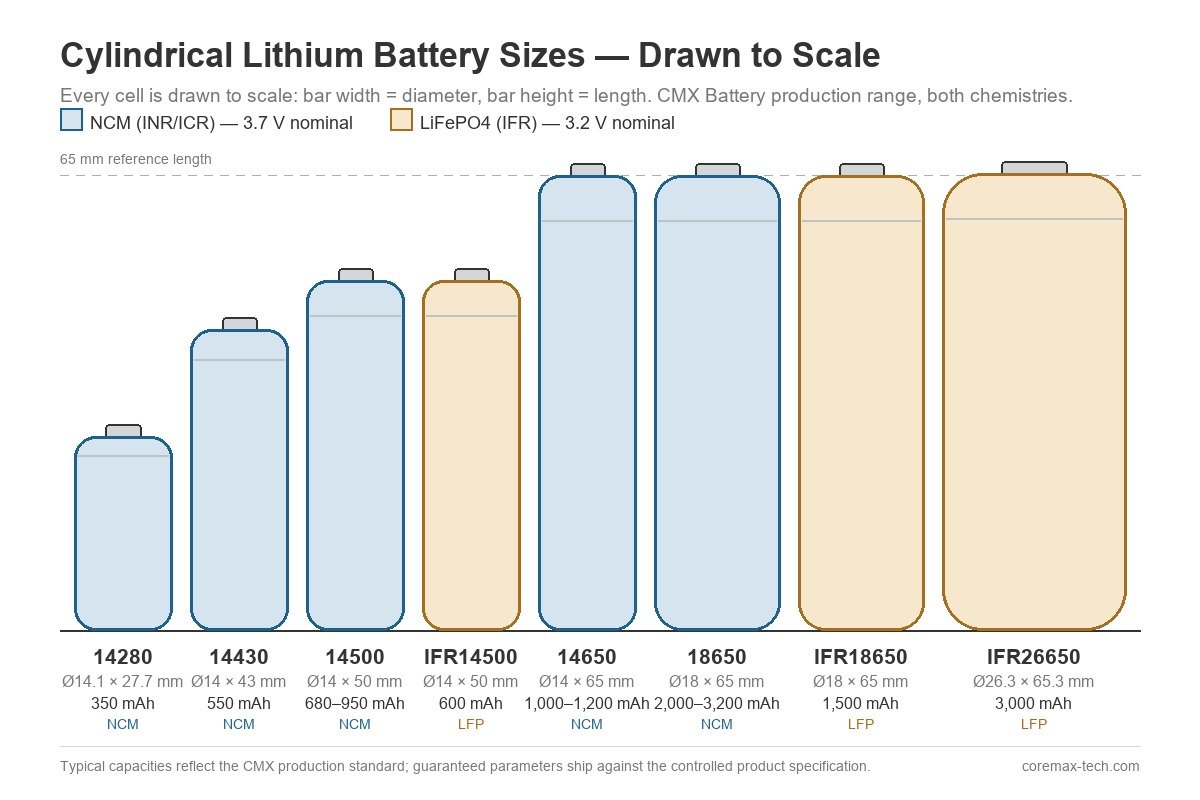
Three patterns are worth reading off this chart before the detail sections:
- Within a diameter family, length buys capacity. The 14 mm family runs from 250 mAh at 25 mm to 1,200 mAh at 65 mm — a 4.8× capacity range inside one diameter.
- Capacity per cell is not energy. The 26650 LFP holds 3,000 mAh at 3.2 V (≈9.6 Wh); the 18650 NCM high-energy grade holds 2,600 mAh at 3.7 V (≈9.6 Wh). Same watt-hours, different envelope — mAh alone will mislead you.
- The 26 mm format is a power and storage format, not a consumer one. CMX produces it exclusively in LiFePO4, aimed at engine starters, UPS packs and daily-cycling storage rather than portable electronics.
The chart above is drawn to scale — bar width equals cell diameter, bar height equals cell length — so the envelope differences are directly comparable.
The 14 mm Family: 14250 to 14650
All five models share a 14 mm diameter. Length — and therefore capacity — is what separates them. If your product already has a 14 mm bay, the only design variable is depth.
| Model | Dimensions | Typical capacity | Typical applications |
|---|---|---|---|
| 14250 | 14 × 25 mm | 250–300 mAh | Miniature sensors, key fobs |
| 14280 (NCM14280-035) | 14.1 × 27.7 mm | 350 mAh | Toothbrushes, shavers, TWS cases, IoT |
| 14430 (INR14430) | 14 × 43 mm | 550 mAh | Beauty instruments, larger personal care |
| 14500 (INR14500) | 14 × 50 mm | 680–950 mAh | Flashlights, AA-form-factor devices |
| 14500 LiFePO4 (IFR14500) | 14 × 50 mm | 600 mAh @ 3.2 V | Solar lights, IoT sensors, 12.8 V packs |
| 14650 (INR14650) | 14 × 65 mm | 1,000–1,200 mAh | Higher-energy hobby and instrument packs |
Fitment rules for the family: a 14280 needs about 3 mm of extra clearance to accept a 14250; a 14430 needs roughly 15 mm of extra bay depth over a 14280; a 14500 needs a further 7 mm over a 14430. The voltage platform (3.6–3.7 V nominal, 4.20 V full charge for NCM) and the protection architecture stay the same across the family, so the trade is runtime versus bay depth.
Where LiFePO4 fits: the same 14 × 50 mm envelope is produced as the IFR14500 at 600 mAh and 3.2 V. The capacity is lower than the NCM 14500 — that is the chemistry’s energy-density penalty — but the cell delivers 2000+ cycle life at full depth of discharge and thermal stability that suits solar lighting and IoT sensors left in the field for years. For a daily-cycling solar light, an IFR14500 will outlive several NCM cells.
The 14650 closes the family at 65 mm — the same length as an 18650 but in the 14 mm diameter. It is the format of choice for two-way radios and instrument packs that need AA-family diameter with roughly double the runtime of a 14430.
The 18 mm Family: 18500 and 18650
The 18 × 65 mm 18650 is the highest-volume li-ion format in production — the reference point every other cylindrical size is compared against. CMX Battery supplies it in graded production series with per-lot test data:
| Grade | Typical capacity | Typical internal resistance | Typical applications |
|---|---|---|---|
| Energy | 2,000 mAh | ≤35 mΩ | Backup power, storage modules, low-rate packs |
| General purpose | 2,200 mAh | ≤50 mΩ | Tool battery packs, equipment power |
| High-rate | 2,200–2,500 mAh | ≤25 mΩ | Power tools, high-drain devices |
| High energy | 2,600–3,200 mAh | ≤35 mΩ | Long-runtime equipment, large packs |
A low-temperature series (discharge to −40 °C) is available in selected grades. Full per-model specifications, rate tables and cycle-life conditions are published on the 18650 series page.
Note that “18650” does not mean one capacity. The gap between an energy-grade and a high-energy-grade cell is 60% more capacity in the identical envelope — which is why datasheet-matching matters more than format-matching when you are replacing or specifying cells. For bulk standard-cell programs, the flat-top ICR18650 2600 mAh (3.7 V, ≈9.6 Wh) is the common reference grade.
The 18 mm family in LiFePO4: the same 18 × 65 mm envelope is produced as the IFR18650 — 1,500 mAh at 3.2 V (≈4.8 Wh), ≤65 mΩ internal resistance, 2000+ cycles at full depth of discharge, 3C continuous and 5C pulse standard with 10C/20C high-rate grades available. It is the long-life, thermally stable choice for daily-cycling solar storage and cold-climate deployments. The shorter 18 × 50 mm 18500 exists in the market but sits outside CMX’s current production range.
If your application is drone or high-power RC packs built from 18650 cells, our complete guide to drone battery configurations (6S/8S/12S) covers series-parallel layout and C-rate matching at pack level.
The 26 mm Family: 26650
The 26650 is a different animal from the 14 mm and 18 mm families. At 26.3 × 65.3 mm and roughly 85 g, it is a power and storage format: buyers specify it for continuous current and cycle life, not for portable consumer devices.
CMX produces the size as the IFR26650 — 3,000 mAh at 3.2 V (≈9.6 Wh) with:
– 3C (9 A) continuous and 5C (15 A) pulse on the standard grade; 10C (30 A) continuous and 20C (60 A) on the high-rate class – ≤25 mΩ internal resistance — roughly 40 mΩ below the IFR18650, which is what makes the high continuous currents practical – 2000+ cycles at full depth of discharge – UN38.3, MSDS, IEC 62133-2, CE, RoHS and REACH documentation
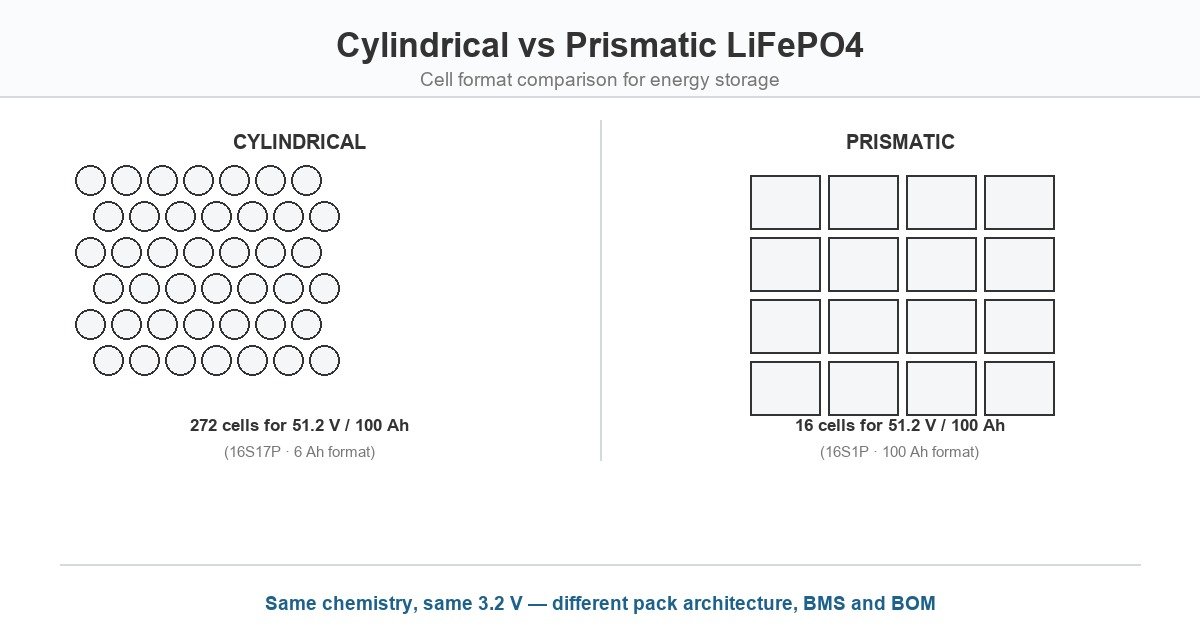
Typical applications: engine starter packs (12 V and 24 V), UPS modules, solar storage banks, and AGV / industrial cycling equipment. In each case the design logic is the same — the larger can halves the cell count for a given pack energy, which halves the weld points, BMS channels and assembly labour.
The honest trade-off: a 26650 is about 8 mm wider and twice the mass of an 18650. It is not a drop-in upgrade. It wins where the housing accepts the larger diameter and the pack values fewer cells over envelope flexibility.
Same Envelope, Two Chemistries: NCM vs LiFePO4
Most size charts you will find list one voltage — 3.7 V — because they assume NCM chemistry. That misses the decision most industrial buyers actually face: for a given mechanical envelope, do I want energy density or cycle life?
| Parameter | NCM (INR/ICR) | LiFePO4 (IFR) |
|---|---|---|
| Nominal voltage | 3.7 V | 3.2 V |
| Full-charge voltage | 4.20 V | 3.65 V |
| Discharge cut-off | 2.5–3.0 V | 2.0 V |
| Energy density | Higher (more Wh per kg and per mm) | Lower |
| Cycle life at full DoD | Typically 500–1,000+ cycles | 2000+ cycles |
| Thermal runaway onset | Lower | Higher (iron-phosphate bond) |
| Best fit | Energy-density-first, weight-critical, high-rate consumer/industrial | Daily cycling, storage, safety-critical, cold-climate |
The engineering consequences are concrete:
– Pack architecture. A 12.8 V 4S IFR14500 pack and a 14.8 V 4S INR14500 pack occupy the same bay but need different BMS voltage windows and different chargers. Decide the chemistry before the mechanical layout, not after. – The charge red line. 3.65 V for IFR, 4.20 V for INR/ICR. This is the single most common field failure we see in mixed-chemistry programs — a pack assembled with IFR cells and charged on a generic 4.2 V lithium-ion profile. – Capacity versus energy. LFP cells carry fewer mAh than NCM cells of the same size — roughly 25–35% less against standard NCM grades (1,500 mAh vs 2,000–2,200 mAh in the 18650 envelope). What they buy back is cycle life: 2000+ cycles at full depth of discharge versus the several-hundred-cycle range typical of NCM in the same duty.
For a deeper treatment, the NCM vs LiFePO4 comparison in cylindrical formats on our cylindrical cells overview page covers grade selection, low-temperature variants and certification documentation.
How to Choose the Right Cylindrical Size
Choosing between formats is a fitment decision first and a capacity decision second. The sequence that avoids rework:
- Measure the bay. Diameter fixes the family (14, 18 or 26 mm); available depth picks the model. Design against the controlled drawing, never the nominal code.
- Fix the voltage platform. 3.7 V NCM or 3.2 V LiFePO4 — this is an architecture decision that drives BMS, charger and cut-off settings for the life of the program.
- Size the energy in Wh, not mAh. Convert the duty cycle to watt-hours at the system voltage, then divide by cell Wh to get the cell count. A 26650 LFP (≈9.6 Wh) and a 2600 mAh 18650 NCM (≈9.6 Wh) deliver the same energy per cell — the choice is envelope and current, not capacity.
- Size the current. Continuous draw should stay within the cell’s continuous rating for cycle use; pulse ratings are for transient envelopes, demonstrated by rate-discharge testing. High-rate grades exist in both 18650 (≤25 mΩ) and 26650 (10C class) formats.
- Choose chemistry by duty cycle. Daily deep cycling (solar storage, AGV, UPS) points to LiFePO4. Weight-critical or energy-density-first applications point to NCM.
- Check the temperature envelope. Standard cells discharge −20 °C to 60 °C and charge 0–45 °C; low-temperature variants extend discharge to −40 °C (18650 NCM series) or −50 °C (IFR18650 grade).
- Confirm certification and shipping class. UN38.3, MSDS and IEC 62133-2 documentation ship with every CMX cell — required for air freight and most OEM qualification processes.
If no standard cylindrical layout fits the envelope efficiently, a custom pack design — cell format selection, series-parallel configuration, protection circuit, connectors and enclosure — is usually the faster path than forcing a standard size.
The 32–46 mm Families: Large Cylindrical Formats
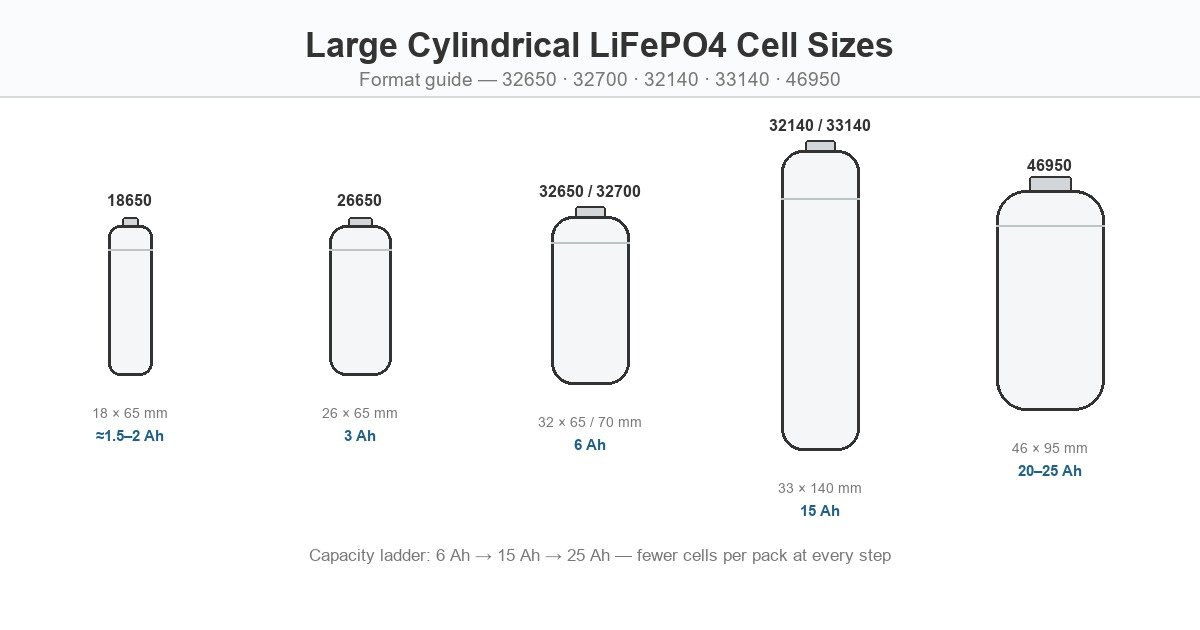
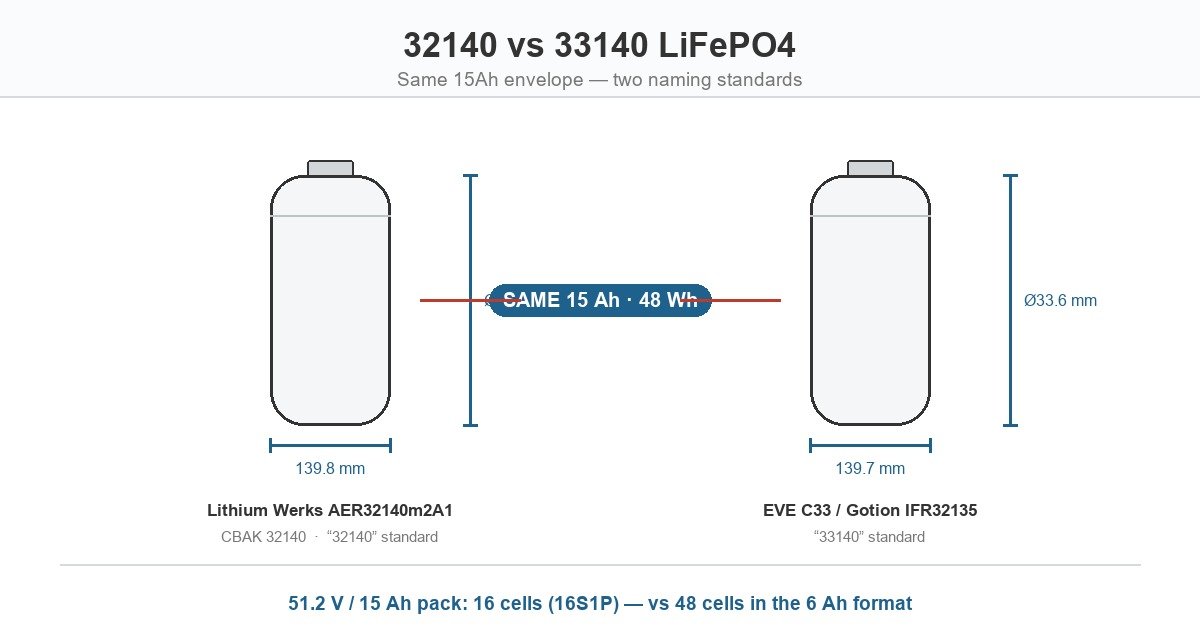
Beyond the 26 mm family, cylindrical LiFePO4 scales into the large formats that carry stationary-storage volume: the 32 mm 6Ah class (32650/32700), the 33 mm 15Ah class (32140/33140) and the 46 mm 20–25Ah class (46950). The naming rule is unchanged — first two digits are the diameter, the rest the length in tenths of a millimetre — and each rung continues the same trend: more capacity per cell, fewer cells per pack.
| Size | Dimensions | Typical capacity | Energy per cell | Common applications |
|---|---|---|---|---|
| 32650 / 32700 | Ø32 × 65 / 70 mm | 6,000 mAh | 19.2 Wh | ESS, telecom backup, light EV |
| 32140 / 33140 | Ø33 × 140 mm | 15,000 mAh | 48 Wh | ESS, AGV, UPS, telecom |
| 46950 | Ø46 × 95 mm | 20,000–25,000 mAh | 64–80 Wh | High-capacity storage |
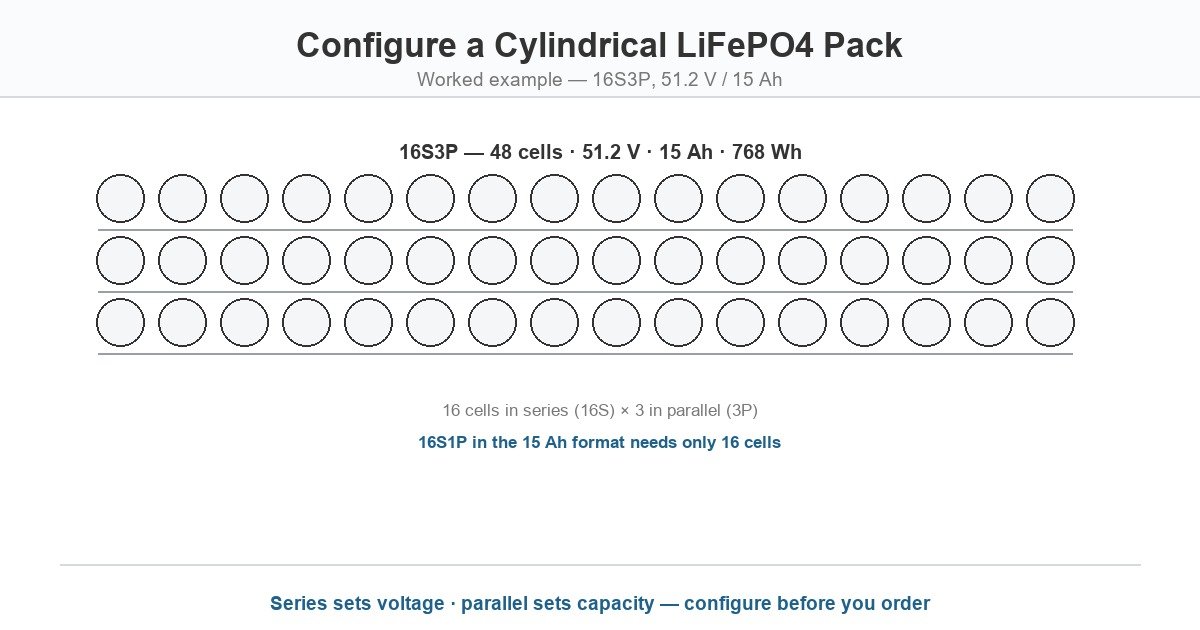
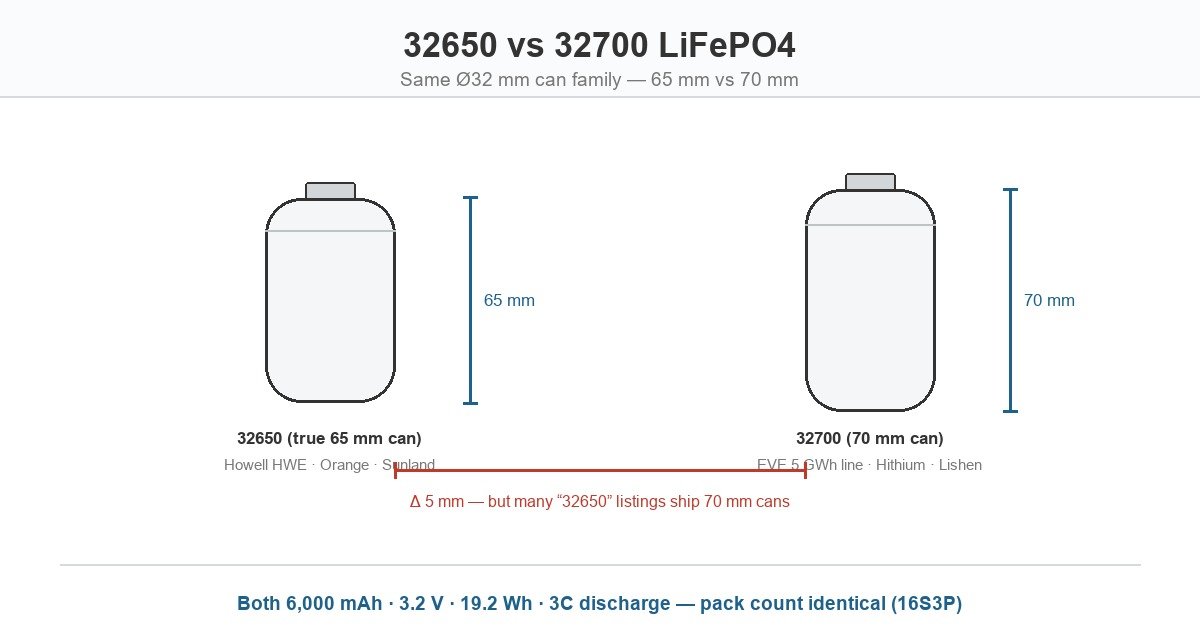
Two practical notes for buyers. First, the 32650 and 32700 share the same Ø32 mm diameter and differ in nominal length (65 vs 70 mm) — and in practice many cells sold as “32650” ship in 70 mm cans, so the datasheet dimension line, not the model code, defines the cell. Second, capacity steps cut cell count quickly: a 51.2 V / 15 Ah pack needs 48 cells in the 6Ah format but only 16 in the 15Ah format.
CMX Battery supplies these large cylindrical LiFePO4 formats as Grade-A cells with UN 38.3, IEC 62619, CE and MSDS documentation, MOQ 100 pcs and 15-day lead time. For the format-by-format trade-offs, see 32650 vs 32700 LiFePO4, 32140 vs 33140: the 15Ah dual-standard and cylindrical vs prismatic LiFePO4 for ESS.
Sizes We Do Not Produce
For completeness, the cylindrical sizes you will encounter in the market that sit outside CMX’s current production range:
| Size | Dimensions | Market position |
|---|---|---|
| 18500 | 18 × 50 mm | Shorter 18650 variant |
| 21700 | 21 × 70 mm | EV and e-mobility mainstream |
| 38120 / 40152 | 38 × 120 / 40 × 152 mm | High-capacity storage cells |
Our production, testing and documentation infrastructure is deepest in the 14 mm, 18 mm and 26 mm families — Grade-A sorting, per-lot capacity/IR/OCV test data and controlled datasheets on every shipment — and the large cylindrical formats above are supplied alongside them as Grade-A cells. If your program requires a format outside this range, our custom cylindrical battery packs team can build to specification around the cells that do fit the application.
Frequently Asked Questions
What do the numbers in a cylindrical battery size mean?
They are the dimensions in millimetres: the first two digits are the diameter, the last three the height. An 18650 is 18 mm across and 65 mm long; a 26650 is 26 mm × 65 mm; a 14500 is 14 mm × 50 mm.
What is the difference between ICR, INR and IFR batteries?
The prefix identifies the cathode chemistry: ICR is lithium cobalt oxide, INR is lithium nickel manganese (NCM), and IFR is lithium iron phosphate (LiFePO4). ICR and INR cells run at 3.7 V nominal with a 4.20 V charge limit; IFR cells run at 3.2 V nominal with a 3.65 V charge limit. Same envelope, different voltage platform — never mixed in one pack.
Can I replace an 18650 with a 26650?
Not without redesigning the holder or enclosure. A 26650 is about 8 mm wider and twice the mass, and the terminal, protection and charging requirements can also differ. Substituting formats damages holders, insulation and terminals in most devices built around an 18650 bay.
Is a 14500 battery the same as an AA battery?
It is the same size — 14 × 50 mm — but not electrically equivalent. An AA alkaline cell is 1.5 V; a 14500 lithium cell is 3.7 V (NCM) or 3.2 V (LiFePO4). Devices designed for alkaline AA cells need a different chemistry or a voltage converter before a 14500 can be considered.
Why is LiFePO4 (IFR) 3.2 V while NCM is 3.7 V?
The nominal voltage is set by the cathode chemistry. Lithium iron phosphate has a lower electrochemical potential than nickel-manganese or cobalt oxide chemistries, giving 3.2 V nominal instead of 3.7 V. The trade buys thermal stability and 2000+ cycle life at full depth of discharge.
Which cylindrical size stores the most energy?
In CMX’s small-format production range, the IFR26650 at ≈9.6 Wh per cell (3,000 mAh at 3.2 V). The large cylindrical formats hold more per cell — 19.2 Wh for the 32700, 48 Wh for the 32140/33140 and up to 80 Wh for the 46950 — and are supplied as Grade-A cells; see the table above.
Are all 18650 batteries the same capacity?
No. In the same 18 × 65 mm envelope, production grades run from 2,000 mAh (energy grade, ≤35 mΩ) to 3,200 mAh (high-energy grade). Capacity trades against internal resistance and rate capability, which is why the datasheet — not the size code — determines suitability.
Does CMX produce 21700 or 32700 cells?
The 21700 is not currently in range. The 32700 is supplied as a Grade-A cylindrical LiFePO4 cell (Ø32 × 70 mm, 6,000 mAh, 3.2 V), alongside the 32140/33140 15Ah formats and the 46950. CMX concentrates its own production on the 14 mm (14250–14650), 18 mm (18650) and 26 mm (26650) families, in both NCM and LiFePO4 where the format supports it; programs requiring other formats can be served through custom pack design.
Request a Quote
Send your target voltage, capacity, continuous current and mechanical envelope — you will receive a datasheet-matched quotation, sample options and lead time within 24 hours. For packs rather than cells, our custom cylindrical battery pack service covers cell selection, BMS, connectors and enclosure as a single documented deliverable.
Or email sales@cmxbattery.com. Browse the full cylindrical lineup on the small cylindrical lithium cells overview.