Blog
32650 vs 32700 LiFePO4: Which Cell Fits Your Pack?

TL;DR / Key Takeaways
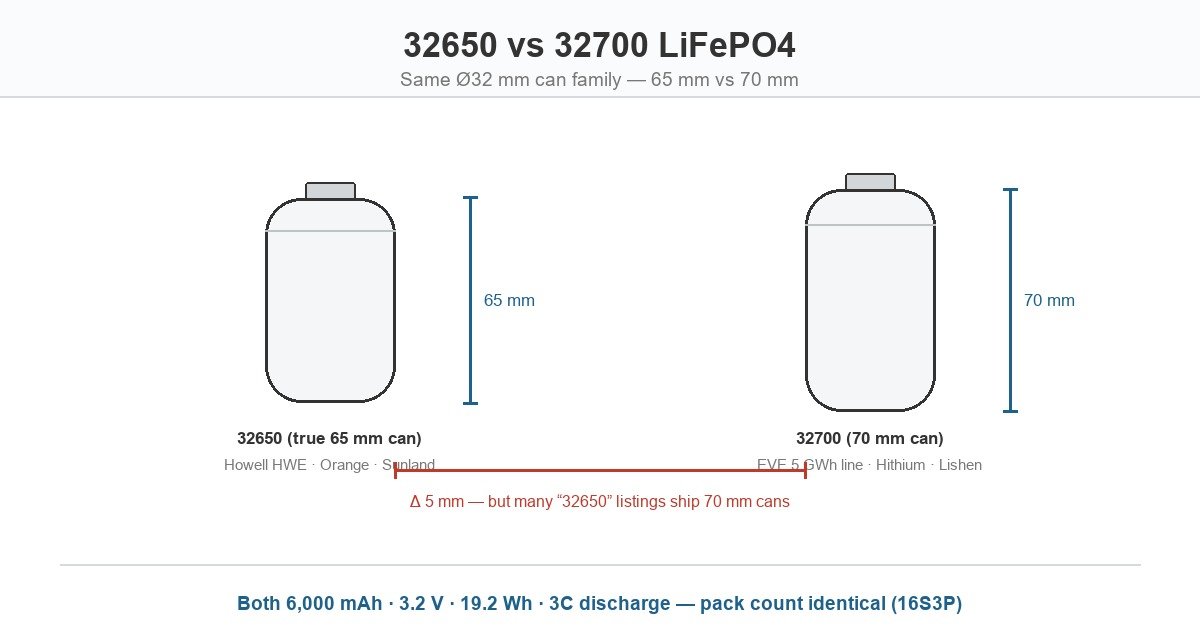
- 32650 and 32700 are both Ø32 mm cylindrical LiFePO4 cells rated 6,000 mAh / 19.2 Wh at 3.2 V nominal — the designation difference is nominal can length (65 mm vs 70 mm), and the market ships both lengths under both names.
- The 32700 is the industry mainstream 6Ah format: EVE operates a dedicated 5 GWh line, and Lishen, REPT, Hithium, Dynanonic and Aokly all produce it.
- The differentiators that matter are AC internal resistance (8–25 mΩ class), standard charge current (0.2C–1C) and the charge-temperature ceiling (45–60 °C) — not the size name on the quotation.
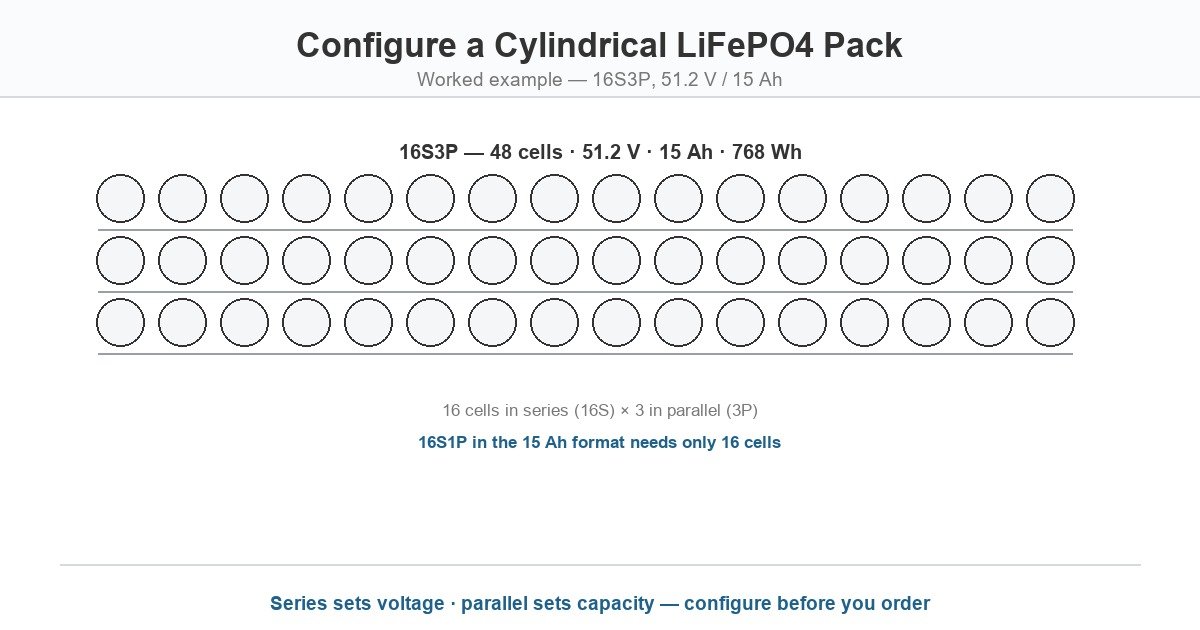
- Pack economics are identical: a 51.2 V / 15 Ah pack needs 48 cells (16S3P) in either format.
- Rule of thumb: specify 32700 for new designs (supply depth, low-IR lines, 1C charging); keep 32650 only for drop-in replacement of legacy 65 mm cans.
Table of Contents
- [What Is a 32650 LiFePO4 Cell?](#what-is-a-32650-lifepo4-cell)
- [What Is a 32700 LiFePO4 Cell?](#what-is-a-32700-lifepo4-cell)
- [Same Diameter, Two Lengths: Why the Confusion?](#same-diameter-two-lengths-why-the-confusion)
- [32650 vs 32700: Side-by-Side Specifications](#32650-vs-32700-side-by-side-specifications)
- [The Three Differences That Actually Matter](#the-three-differences-that-actually-matter)
- [Market Landscape: 32700 Is the Mainstream 6Ah Format](#market-landscape-32700-is-the-mainstream-6ah-format)
- [Pack Economics: Identical Cell Count, Identical BOM](#pack-economics-identical-cell-count-identical-bom)
- [Which Should You Choose?](#which-should-you-choose)
- [Procurement Checklist for 6Ah Cylindrical LFP Cells](#procurement-checklist-for-6ah-cylindrical-lfp-cells)
- [Frequently Asked Questions](#frequently-asked-questions)
- [Final Thoughts](#final-thoughts)
What Is a 32650 LiFePO4 Cell?
A 32650 LiFePO4 cell is a cylindrical lithium iron phosphate cell whose name encodes its nominal dimensions: 32 mm diameter × 65 mm length. The format delivers 6,000 mAh at 3.2 V nominal — 19.2 Wh per cell — at a published weight of 145–195 g depending on the can design.
Reference cells under this designation cluster tightly on the core electricals. The Howell Energy HWE IFR32650-6000 is a Ø32 × 65 mm, 195 g cell rated above 3,000 cycles at 100% DOD, with 0.5C maximum charge and 1C maximum discharge (2C peak), certified CE, UL and RoHS per its manufacturer listing. The Orange IFR32650-6000mAh datasheet specifies 6,000 mAh typical / 5,980 mAh minimum, 145 g, 0.2C standard charge in approximately 6 hours, 1C fast charge in approximately 2.5 hours, and 3C maximum continuous discharge, with charging at 0–45 °C and discharging at −10–60 °C. The Sunland Power IFR32650 adds a published internal impedance of 25 mΩ, 3,000 cycles at 80% DOD and an 18 A maximum discharge, certified to SGS, UL, UN 38.3 and REACH.
What Is a 32700 LiFePO4 Cell?
A 32700 LiFePO4 cell is the same Ø32 mm diameter in a 70 mm can: 6,000 mAh at 3.2 V, 19.2 Wh, typically 120–150 g. Where the 32650 is a fragmented format, the 32700 is the reference 6Ah cylindrical LFP product across the industry — the format tier-1 makers build dedicated capacity around.
The distribution channel benchmarks three lines in particular: the EVE LF32700 at 6.0 Ah with 2,000+ cycles and 10 A maximum discharge, the Sinopoly BP32700H at 5.8 Ah with 3,000+ cycles, and the CATL EnerBlue CB32700 at 6.0 Ah with 5,000+ cycles and 15 A maximum discharge, as compiled in the Alibaba SmartBuy buyer’s guide. Behind those retail-visible lines sit multi-GWh production commitments: EVE commissioned a 5 GWh line dedicated to 32700 cylindrical LiFePO4 cells in September 2025, and Hithium supplies 32700 cells rated above 6,000 cycles, per the PW Consulting cylindrical LiFePO4 market report.
Same Diameter, Two Lengths: Why the Confusion?
Cylindrical cell naming follows a simple convention — the first two digits encode diameter, the final two or three encode length in tenths of millimeters — but manufacturers apply it inconsistently once a can is designed to a wall thickness rather than a nominal bore. The result in this format family is genuine ambiguity: a significant share of cells sold as “32650” are 70 mm cans, dimensionally identical to a 32700.
The Conno Power IFR32650-6000mAh measures Ø32.2 × 70.5 mm at 145 g, with ≤8 mΩ internal impedance at 1 kHz, 0.5C (3 A) standard charge, 3C (18 A) maximum continuous discharge, a 10C (60 A) pulse rating and ≥2,000 cycles at 100% DOD. A distributor listing on ECER shows the same pattern: Ø32.0 × 70.0 mm, 148 g, 1C charging, 3C maximum discharge, 2,000 cycles at 70% SOC / 80% DOD. Meanwhile the Howell, Orange and Sunland cells above are true 65 mm cans.
The practical consequence for buyers: the model code on a quotation does not guarantee the can length. Two cells sold as “32650” can differ by 5.5 mm in length and 50 g in weight. Always read the dimension line on the datasheet before committing to a holder, sleeve or pack design — and note that where a supplier offers the 32650 in a 70 mm can, the two formats are drop-in interchangeable in 32700 holders.
32650 vs 32700: Side-by-Side Specifications
The table below consolidates the format-level picture across published listings and datasheets.
| Attribute | 32650 | 32700 |
|---|---|---|
| Nominal dimensions (name) | Ø32 × 65 mm | Ø32 × 70 mm |
| Lengths actually shipped | 65–70.5 mm | 70–70.5 mm |
| Nominal capacity | 6,000 mAh (typ.) | 6,000 mAh (typ.) |
| Nominal voltage / energy | 3.2 V / 19.2 Wh | 3.2 V / 19.2 Wh |
| Published weight | 145–195 g | 120–150 g |
| AC internal resistance (1 kHz) | 8–25 mΩ | ≤8–30 mΩ |
| Standard charge current | 0.2C–0.5C | 0.2C–1C |
| Max continuous discharge | 3C (18 A) | 3C (18 A) |
| Pulse discharge | up to 10C (60 A) | 10–15 A continuous benchmark |
| Published cycle life | 2,000–3,000+ | 2,000–6,000+ |
| Charge temperature | 0–45 °C | 0–45 °C (60 °C on premium lines) |
| Producer depth | trading-heavy | tier-1 multi-GWh |
Reference-cell detail behind the ranges:
| Reference cell | Can length | Weight | ACIR (1 kHz) | Std charge | Max cont. discharge | Cycle life |
|---|---|---|---|---|---|---|
| Howell HWE IFR32650 | 65 mm | 195 g | — | 0.5C max charge | 1C (2C peak) | >3,000 @100% DOD |
| Orange IFR32650-6000 | 65 mm | 145 g | — | 0.2C (1C fast) | 3C | per datasheet |
| Sunland IFR32650 | 65.5 mm | 150 g | 25 mΩ | 1 A (6 A fast) | 3C (18 A) | 3,000 @80% DOD |
| Conno IFR32650-6000 | 70.5 mm | 145 g | ≤8 mΩ | 0.5C (3 A) | 3C (18 A), 10C pulse | ≥2,000 @100% DOD |
| EVE LF32700 (benchmark) | 70 mm | — | — | — | 10 A | 2,000+ |
| CATL EnerBlue CB32700 | 70 mm | — | — | — | 15 A | 5,000+ |
Two readings follow. First, spec dispersion within each size name exceeds the gap between the two names — the 8 mΩ to 25 mΩ spread inside the 32650 designation is three times the difference between the best 32650 and a typical 32700. Second, the premium specifications (≤8 mΩ, 1C charging, 5,000+ cycles) concentrate on the 32700 side, because that is where tier-1 production capacity sits.
The Three Differences That Actually Matter
Internal resistance and its thermal cost. At a 3C discharge (18 A per cell), a 25 mΩ cell dissipates I²R = 8.1 W of heat and sags 450 mV under load; an 8 mΩ cell dissipates 2.6 W and sags 144 mV. Across a 48-cell pack that difference compounds into pack-level thermal design — cooling budget, busbar sizing and cell-to-cell balancing all inherit it. For high-rate duty, internal resistance is the number to compare, not the size designation.
Charge current and recharge time. Published standard charge currents span 0.2C (1.2 A, roughly 6 hours to full) to 1C (6 A, roughly 2.5 hours). The Orange datasheet publishes both profiles explicitly — 0.2C standard at approximately 6.0 hours and 1C fast at approximately 2.5 hours. For solar and day-cycling ESS with a limited charge window, a 1C-rated line recovers a full cycle in less than half the time of a 0.2C line.
Charge-temperature ceiling. Most listings in both formats specify charging at 0–45 °C; premium 32700 lines extend to 0–60 °C. In hot-climate installations — Middle East, South Asia, outdoor telecom cabinets — that ceiling decides whether the pack needs active cooling of the charge path or can run passive.
Cycle life deserves a caution rather than a ranking: published ratings span 2,000 to 6,000+ cycles depending on test temperature, C-rate and DOD. The Hithium 32700 rating above 6,000 cycles and the Howell 32650 rating above 3,000 cycles at 100% DOD are not measured under identical conditions — compare cells at your operating temperature and DOD, not at the headline number.
Market Landscape: 32700 Is the Mainstream 6Ah Format
The supply-side picture is asymmetric. The 32700 is produced at industrial scale: EVE’s 5 GWh dedicated line (September 2025), Tianjin Lishen, REPT BATTERO — which released a 32Ah cylindrical LiFePO4 cell with 6,000+ cycles for ESS in June 2025 — Hithium with above-6,000-cycle 32700 cells and a 2 GWh European telecom supply contract, plus Dynanonic and Aokly, per the PW Consulting report. The 32650 side of the market is dominated by trading companies and regional assemblers listing on B2B directories, with thinner datasheet documentation and wider spec dispersion.
Demand data points the same direction. In our own Search Console data (July–October 2026 window), 32700 manufacturer and factory queries generated 147 impressions at positions 27–31, against 9 impressions for 32650 supplier queries — a roughly 15:1 demand ratio that mirrors the supply-side concentration.
The market context supports both formats: the worldwide cylindrical LiFePO4 battery market was valued at USD 12,450 million in 2025 and is forecast to reach USD 47,233.65 million by 2032, a 21.05% CAGR, with “32650 and 32700 Series” identified as a named segment alongside 18650/21700 and large cylindrical formats, per PW Consulting.
Pack Economics: Identical Cell Count, Identical BOM
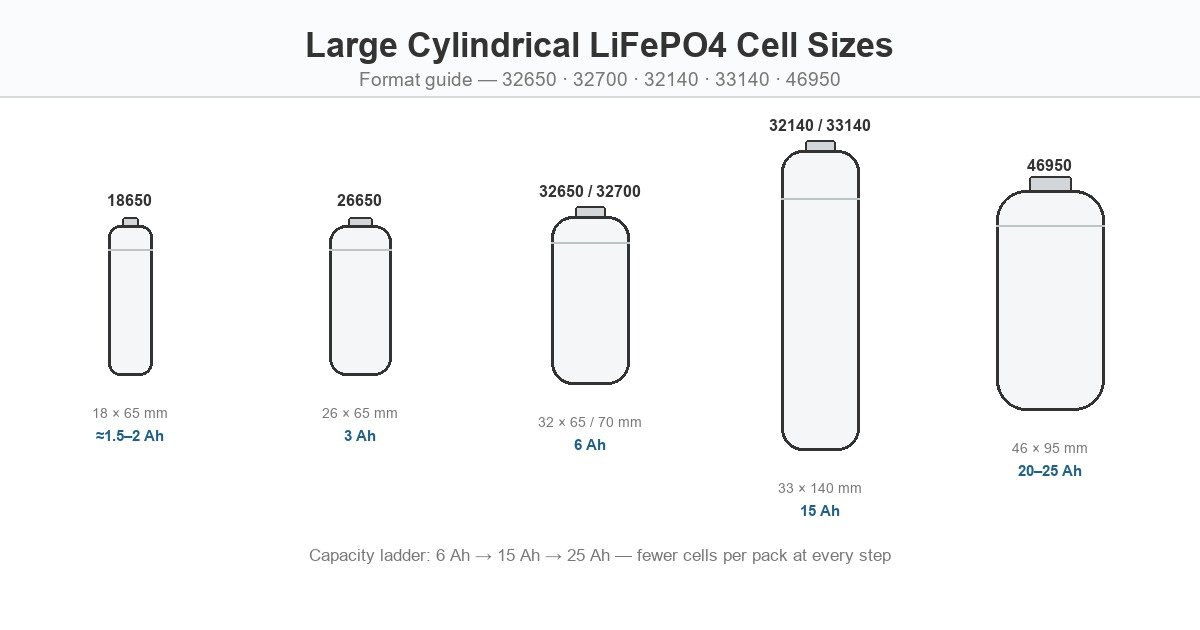
Because both formats deliver 6 Ah, pack architecture is a wash between them. The cell-count lever sits one rung up the format ladder:
| Format (capacity) | Cells for 51.2 V / 15 Ah |
|---|---|
| 18650-class (~2 Ah) | 128 (16S8P) |
| 26650 (3 Ah) | 80 (16S5P) |
| 32650 / 32700 (6 Ah) | 48 (16S3P) |
| 32140 / 33140 (15 Ah) | 16 (16S1P) |
| 46950 (20–25 Ah) | 16 (overshoots to 25 Ah) |
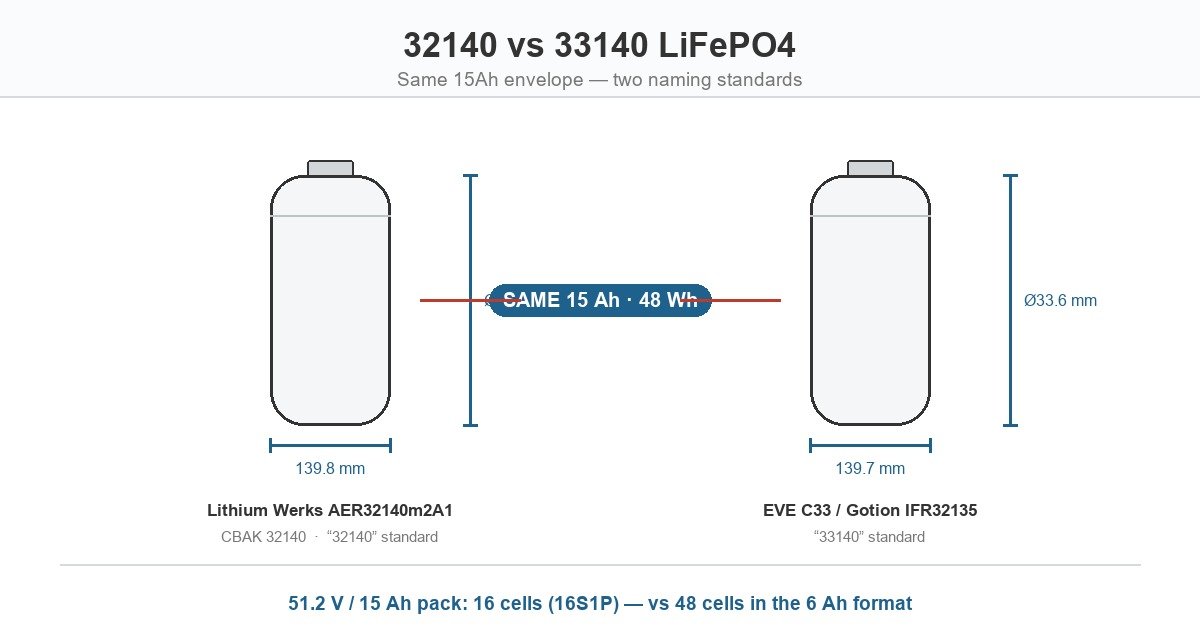
A 51.2 V / 15 Ah pack built from either 6Ah format needs 48 cells, 48 weld sets and 48 BMS sampling points; the same pack in the 15Ah format needs 16. If your design brief is cell-count and BOM reduction, the 32650-vs-32700 choice is not where the savings are — stepping up to 15Ah-class formats is. (That comparison is covered separately in [32140 vs 33140 LiFePO4: The 15Ah Dual-Standard, Explained].)
Which Should You Choose?
| If your priority is… | Choose… | Because… |
|---|---|---|
| New ESS / telecom / solar pack design | 32700 | Tier-1 multi-GWh supply, ≤8 mΩ class IR, 1C charge, deepest datasheet pool |
| Drop-in for legacy 65 mm 32650 holders | 32650 (65 mm can) | Only the 65 mm length fits legacy holders |
| Fast recharge in limited charge windows | 32700 with 1C charge | ~2.5 h full charge vs ~6 h at 0.2C |
| Hot-climate installation (charge >45 °C) | 32700 premium line | 0–60 °C charge window on premium lines |
| Maximum published cycle life | 32700 premium lines | 5,000+ cycles (CATL EnerBlue) to 6,000+ (Hithium) |
| Both formats quoted at similar commercial terms | Compare datasheets, not names | Spec dispersion within each name exceeds the gap between them |
For the 6Ah class specifically, the honest engineering answer is that the 32700 wins on supply security and premium-line availability, while the 32650 remains the correct choice only where an existing 65 mm mechanical design dictates it.
Procurement Checklist for 6Ah Cylindrical LFP Cells
Before issuing a purchase order for 32650 or 32700 cells, confirm the following with your supplier:
- Dimension line — Ø32 × 65 mm vs Ø32 × 70 mm, read from the datasheet rather than the model code; this is the single most common mismatch in the format.
- AC internal resistance — value and test condition (1 kHz), with batch-to-batch sorting data for series strings.
- Charge profile — standard and maximum charge current, plus the charge-temperature window against your installation environment.
- Cycle-life test conditions — temperature, C-rate and DOD behind the headline number.
- Certification set — UN 38.3 (transport), IEC 62619 (industrial storage safety), CE and MSDS as the baseline for international B2B supply.
- Commercial terms — MOQ (100 pcs is standard at CMX Battery), sample policy, lead time (15 days) and payment structure, confirmed in writing before volume commitment.
CMX Battery supplies both 32650 and 32700 LiFePO4 cells as a Grade-A cells supplier, with specification review, cell matching and sample validation for 6Ah cylindrical programs — inquiries through the contact form receive a datasheet-matched response within 24 hours.
Request a Quote
Frequently Asked Questions
What is the difference between 32650 and 32700?
The designations encode nominal can length: 32650 is Ø32 × 65 mm and 32700 is Ø32 × 70 mm. Both deliver 6,000 mAh at 3.2 V (19.2 Wh) and share the same Ø32 mm diameter. In practice the market ships both lengths under both names, so the datasheet dimension line — not the model code — defines the cell.
Are 32650 and 32700 batteries the same size?
They share the same 32 mm diameter and the same 6Ah capacity, but nominal length differs: 65 mm for a true 32650 versus 70 mm for a 32700. Many cells sold as “32650” are actually 70 mm cans — the Conno Power IFR32650-6000mAh measures Ø32.2 × 70.5 mm — so check the datasheet before assuming a 65 mm part.
Can I replace a 32650 with a 32700?
Only where the mechanical design allows a 70 mm can. In a legacy 65 mm holder the 32700 will not fit; where the 32650 on offer is a 70 mm variant, the two are drop-in interchangeable. Verify three items first: holder depth for the exact measured length, discharge-rate rating against your load profile, and charge-temperature window against your installation.
Which has lower internal resistance, 32650 or 32700?
Published values overlap, but the low end concentrates on the 32700 side: 32650 listings span 8–25 mΩ at 1 kHz, while premium 32700 lines specify ≤8 mΩ. At a 3C discharge (18 A), the difference is 8.1 W versus 2.6 W of heat per cell — a pack-level thermal design factor.
What is the cycle life of 32650 and 32700 LiFePO4 cells?
Published ratings span 2,000–3,000+ cycles for 32650 listings (Howell above 3,000 at 100% DOD; Sunland 3,000 at 80% DOD) and 2,000–6,000+ for 32700 lines (EVE LF32700 2,000+; CATL EnerBlue CB32700 5,000+; Hithium above 6,000). Ratings depend on test temperature, C-rate and DOD — compare at your operating conditions.
How many 32650 or 32700 cells do I need for a 51.2V battery?
A 51.2 V nominal pack needs 16 cells in series at 3.2 V per cell. At 6 Ah per cell, a 15 Ah pack requires 48 cells total (16S3P) in either format. Moving to the 15Ah 32140/33140 format cuts the same pack to 16 cells (16S1P).
Which is better for energy storage: 32650 or 32700?
For new ESS designs, 32700: tier-1 multi-GWh production (EVE, Lishen, Hithium, REPT), ≤8 mΩ class internal resistance on premium lines, 1C charging and published cycle life up to 6,000+. The 32650 remains relevant mainly for drop-in replacement of legacy 65 mm designs and for cost-sensitive volume where a qualified supplier can document the full spec set.
Final Thoughts
The 32650 vs 32700 question turns out to be mostly a naming question: both designations cover the same Ø32 mm, 6Ah cylindrical LiFePO4 envelope, and the market ships both can lengths under both names. What separates a good cell from a mediocre one is not the size designation but the datasheet behind it — internal resistance, charge current, charge-temperature window and cycle-life test conditions.
For new designs the 32700 is the default choice on supply security alone: dedicated multi-GWh lines, a deep pool of tier-1 datasheets and premium lines at ≤8 mΩ, 1C charging and 5,000–6,000+ cycle ratings. The 32650 stays on the bill of materials where a legacy 65 mm holder dictates it. And where the real objective is fewer cells, less welding and a smaller BMS, the answer sits one rung up the ladder in the 15Ah-class formats.
For specification support on 32650 or 32700 cells — including datasheet-matched quotation, cell matching and sample validation — submit your requirement through the inquiry form for a response within 24 hours.
Further Reading
- Cylindrical lithium battery sizes: the complete 14250–46950 guide
- 32140 vs 33140 LiFePO4: the 15Ah dual-standard explained
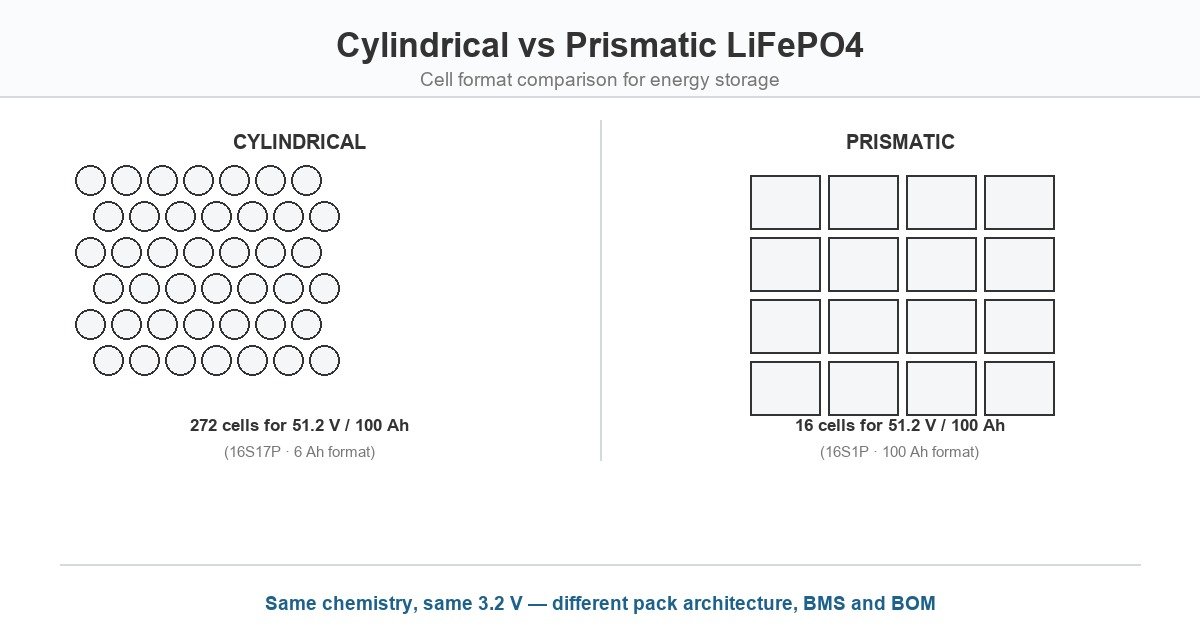
- Cylindrical vs prismatic LiFePO4 cells for ESS
- 32650 LiFePO4 battery (IFR32650, 3.2V 6000mAh)
- 32700 LiFePO4 battery (IFR32700, 3.2V 6000mAh)
- Large cylindrical LiFePO4 battery cells — product hub
- Customized cylindrical battery packs