Blog
Large Cylindrical LiFePO4 Cell Sizes: Complete Format Guide

TL;DR / Key Takeaways
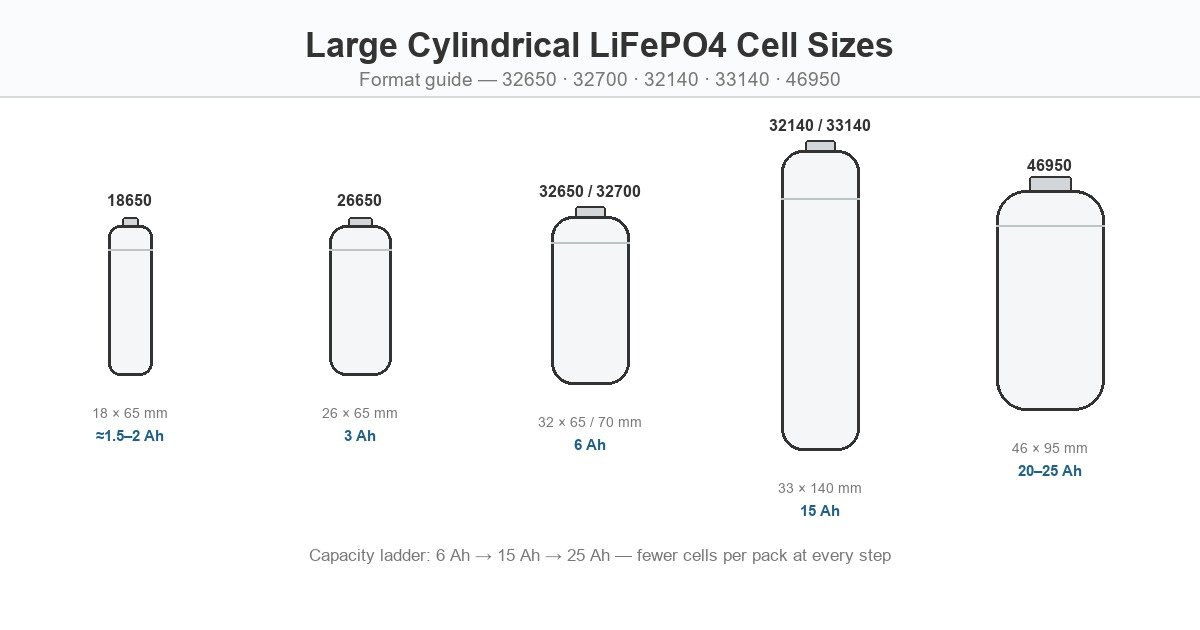
- “Large cylindrical” in LiFePO4 means the Ø32 mm and above families: 32650/32700 (6 Ah), 32140/33140 (15 Ah) and 46950 (20–25 Ah) — all at 3.2 V nominal.
- The naming convention encodes dimensions: first two digits diameter, the rest length in tenths of a millimetre (32700 = Ø32 × 70 mm).
- Capacity per cell steps 6 → 15 → 25 Ah across the ladder, cutting the cell count for a 51.2 V / 15 Ah pack from 48 to 16.
- The 32700 is the industry-mainstream 6Ah format (EVE 5 GWh dedicated line); the 15Ah class splits into two naming standards (32140 vs 33140); the 46950 is the high-capacity frontier.
- Larger formats you will encounter but CMX does not currently supply: 4680, 38121, 38910 and 40152 — covered here for completeness.
Table of Contents
- [What Counts as “Large Cylindrical” in LiFePO4?](#what-counts-as-large-cylindrical-in-lifepo4)
- [How Cylindrical Size Codes Work](#how-cylindrical-size-codes-work)
- [The 6Ah Class: 32650 and 32700](#the-6ah-class-32650-and-32700)
- [The 15Ah Class: 32140 and 33140](#the-15ah-class-32140-and-33140)
- [The 20–25Ah Class: 46950](#the-2025ah-class-46950)
- [Format Comparison at a Glance](#format-comparison-at-a-glance)
- [Why Cell Count Drops at Every Rung](#why-cell-count-drops-at-every-rung)
- [Formats We Do Not Supply: 4680, 38121, 38910, 40152](#formats-we-do-not-supply-4680-38121-38910-40152)
- [How to Choose a Large Cylindrical Format](#how-to-choose-a-large-cylindrical-format)
- [Frequently Asked Questions](#frequently-asked-questions)
- [Final Thoughts](#final-thoughts)
What Counts as “Large Cylindrical” in LiFePO4?
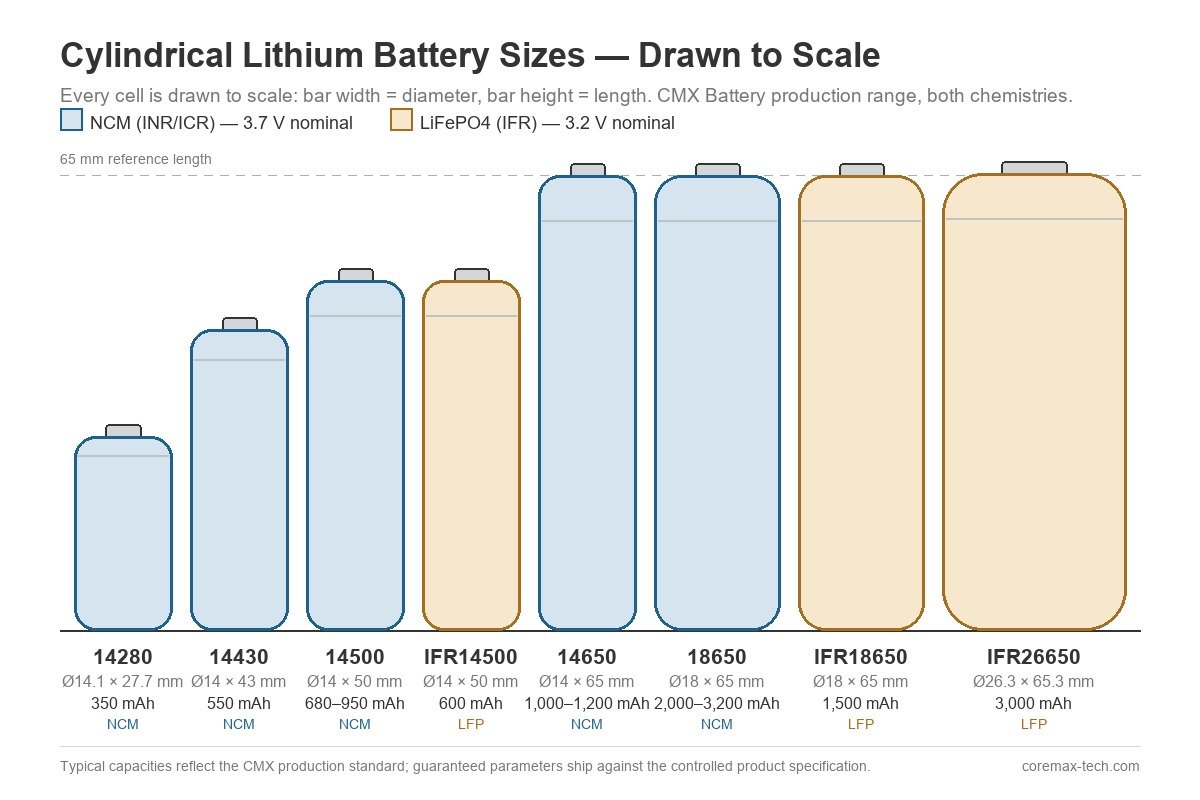
Cylindrical cell naming is dimensional: the digits encode diameter and length in tenths of a millimetre. In LiFePO4 chemistry, the practical dividing line for “large” sits at Ø32 mm. Below it — 14250, 14430, 14500, 14650, 18650, 26650 — the formats serve consumer, light-EV and modular applications at 0.6–3 Ah. At and above Ø32 mm, the same Ø-driven convention produces the storage-class cells that carry ESS, telecom and light-commercial volume: 32650, 32700, 32140, 33140 and 46950.
The distinction is not arbitrary. Large cylindrical LFP cells exist because stationary storage buys energy in kilowatt-hours, and every cell added to a pack adds a weld, a BMS channel and a failure point. Moving up the ladder trades per-cell flexibility for pack-level simplicity — the same engineering logic that made 21700 succeed 18650 in e-mobility, applied to storage.
How Cylindrical Size Codes Work
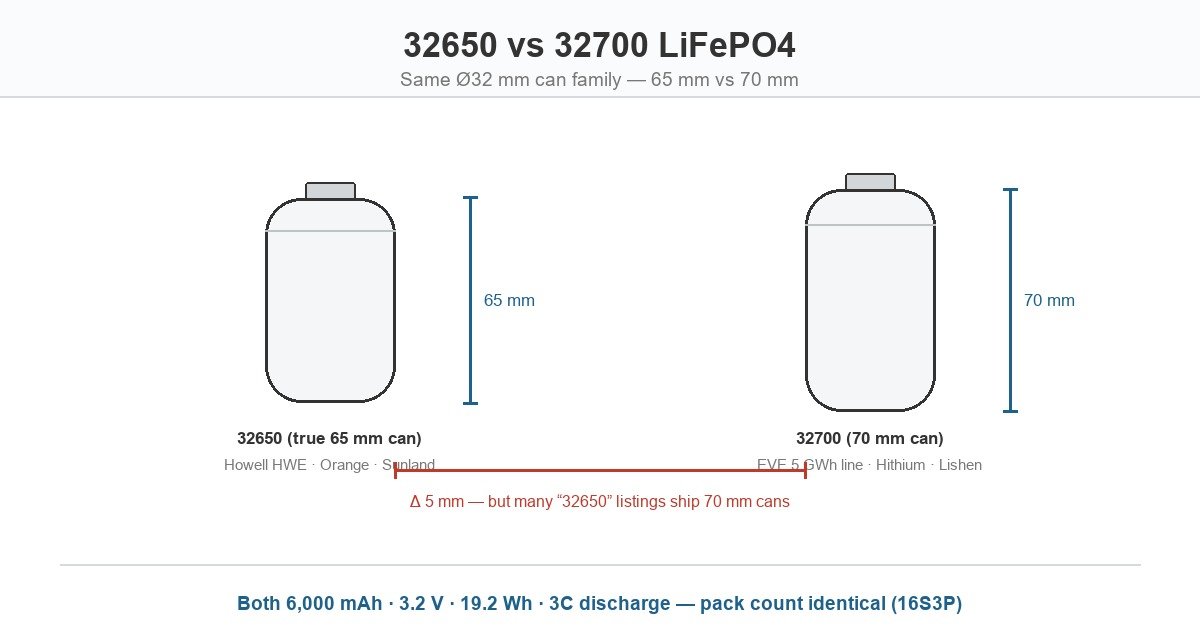
The rule is consistent across the families: first two digits = diameter in mm, remaining digits = length in tenths of mm. An 18650 is 18 mm across and 65 mm long; a 32700 is 32 mm × 70 mm; a 46950 is 46 mm × 95 mm. Two wrinkles worth knowing: some makers round the can to wall thickness rather than nominal bore (so a “32140” can measure Ø33.4 mm outside), and a few designations are applied loosely across the market — the 32650 name covers both true 65 mm cans and 70 mm cans identical to a 32700. The datasheet dimension line always outranks the model code.
The 6Ah Class: 32650 and 32700
The 6Ah class is the volume center of large cylindrical LFP: 19.2 Wh per cell at 3.2 V, roughly 140–150 g, and the deepest multi-maker supply base in the format family.
32700 (Ø32 × 70 mm) is the reference format. Published cells span 6.0 Ah at 2,000+ cycles (EVE LF32700, 10 A max discharge), 5.8 Ah at 3,000+ cycles (Sinopoly BP32700H) and 6.0 Ah at 5,000+ cycles (CATL EnerBlue CB32700, 15 A), per the Alibaba SmartBuy buyer’s guide. Behind the retail-visible lines sit industrial commitments: EVE commissioned a 5 GWh line dedicated to 32700 cylindrical LiFePO4 in September 2025; Hithium supplies 32700 cells rated above 6,000 cycles and holds a 2 GWh European telecom supply contract; Tianjin Lishen, REPT BATTERO, Dynanonic and Aokly all produce the format, per the PW Consulting market report.
32650 (nominally Ø32 × 65 mm) is the same diameter in a shorter can — though, as noted, many listings ship 70 mm cans under this name. Reference cells include the Howell HWE IFR32650 (Ø32 × 65 mm, 195 g, above 3,000 cycles at 100% DOD, 0.5C max charge, 1C max discharge), the Orange IFR32650-6000mAh (145 g, 0.2C standard charge in ≈6 h or 1C fast in ≈2.5 h, 3C max continuous discharge) and the Conno Power IFR32650-6000mAh (Ø32.2 × 70.5 mm, 145 g, ≤8 mΩ, 3C continuous with 10C pulse, ≥2,000 cycles at 100% DOD).
The 15Ah Class: 32140 and 33140
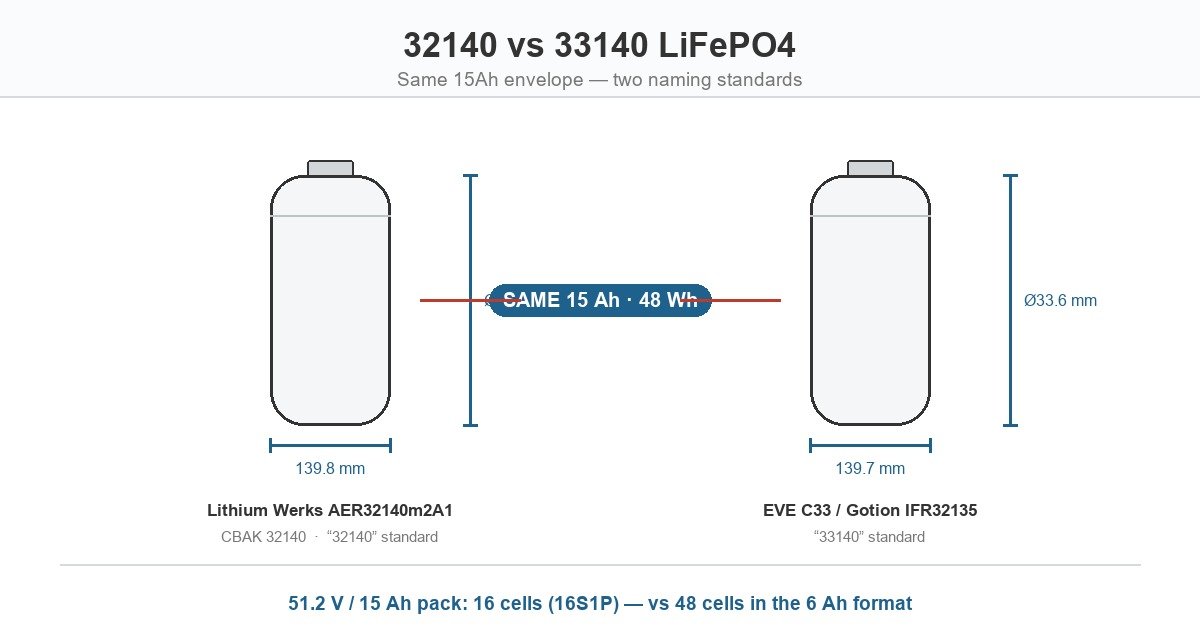
The 15Ah class (Ø33 × 140 mm, 48 Wh, ≈270–290 g) is where large cylindrical LFP becomes pack-economics territory — and where the naming splits into two standards for the same envelope. 32140 is used by CBAK and Lithium Werks; 33140 by Gotion (official model IFR32135-15Ah) and EVE (model C33).
Published specifications span the format: Lithium Werks AER32140m2A1 at above 172 Wh/kg and above 3,500 cycles at 80% DOD with UL 1642 certification; Gotion IFR32135-15Ah at 180 Wh/kg, ≥2,500 cycles, 270 ± 5 g, with the format’s widest temperature window (−20 °C charge, −30 °C discharge); EVE C33 at 4,000 cycles at 25 °C (dropping to 1,500 at 45 °C); CBAK 32140 at ≈290 g with a 1C continuous, 10C pulse profile aimed at power-tool duty. The full trade-off analysis is in our 32140 vs 33140 comparison.
The 20–25Ah Class: 46950
The 46950 (Ø46 × 95 mm) is the high-capacity frontier of cylindrical LFP, at 64–80 Wh per cell. Three reference points define the format: Gotion’s IFR46950A at 20.1 Ah, 363 g and 177 Wh/kg with ≥2,500 cycles; Bounergy’s 20 Ah cell marketed at up to 10,000 cycles; and CHAM’s 46950S25E at 25 Ah, ≈450 g and 5,000 cycles with an ESS-first positioning. At 80 Wh per cell, a 51.2 V / 25 Ah pack is 16 cells — the same count as the 15Ah format, at 67% more capacity.
Format Comparison at a Glance
| Format | Dimensions | Capacity | Energy | Weight | ACIR (1 kHz) | Published cycle life |
|---|---|---|---|---|---|---|
| 32650 | Ø32 × 65 mm (70 mm variants) | 6,000 mAh | 19.2 Wh | 145–195 g | 8–25 mΩ | 2,000–3,000+ |
| 32700 | Ø32 × 70 mm | 6,000 mAh | 19.2 Wh | ~140–150 g | ≤8 mΩ class | 2,000–6,000+ |
| 32140 / 33140 | Ø33 × 140 mm | 15,000 mAh | 48 Wh | 270–290 g | ≤3 mΩ | 2,500–4,000+ |
| 46950 | Ø46 × 95 mm | 20,000–25,000 mAh | 64–80 Wh | 363–450 g | sub-mΩ class | 2,500–10,000 claims |
Weight and impedance ranges consolidate published listings and datasheets; cycle-life figures depend on test conditions (temperature, C-rate, DOD) and must be compared at your operating point, not at the headline number.
Why Cell Count Drops at Every Rung
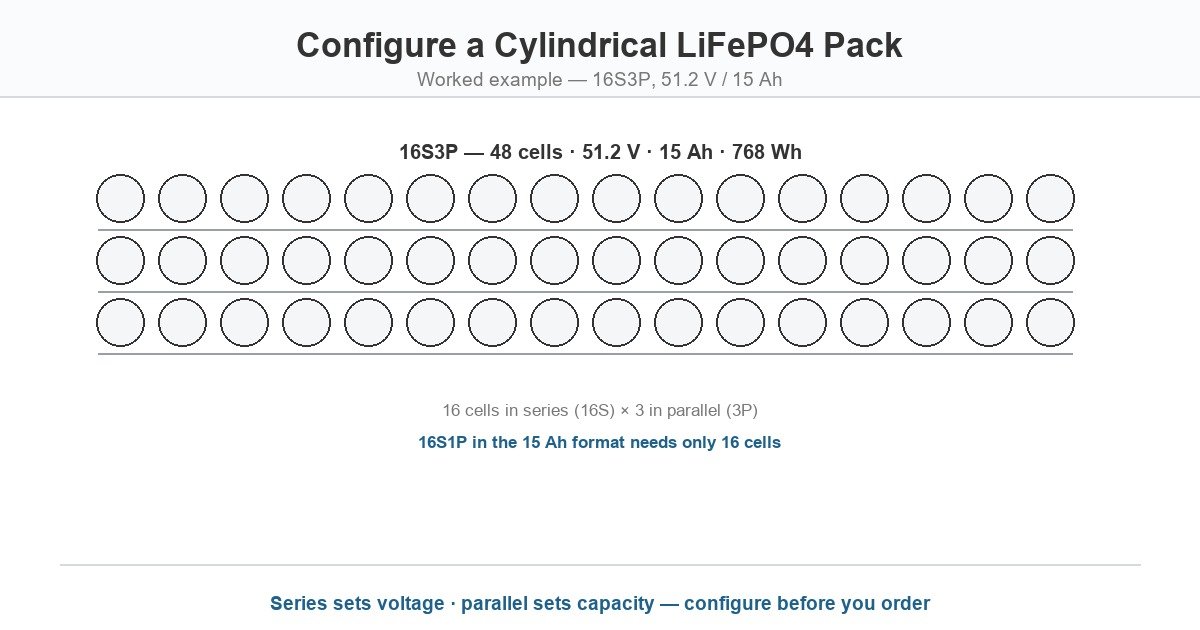
Capacity per cell is the lever that simplifies packs. For a 51.2 V / 15 Ah (768 Wh) target:
| Format | Configuration | Cells | BMS channels |
|---|---|---|---|
| 18650-class (≈2 Ah) | 16S8P | 128 | 128 |
| 26650 (3 Ah) | 16S5P | 80 | 80 |
| 32650 / 32700 (6 Ah) | 16S3P | 48 | 48 |
| 32140 / 33140 (15 Ah) | 16S1P | 16 | 16 |
| 46950 (25 Ah) | 16S1P | 16 (overshoots to 25 Ah) | 16 |
Each rung halves-to-thirds the weld count, busbar count and BMS sampling points — which is why the market’s center of gravity keeps moving up the ladder. The worldwide cylindrical LiFePO4 market was valued at USD 12,450 million in 2025 and is forecast to reach USD 47,233.65 million by 2032, a 21.05% CAGR, with large cylindrical formats identified as a distinct growth segment, per PW Consulting.
Formats We Do Not Supply: 4680, 38121, 38910, 40152
For completeness, the larger cylindrical formats you will encounter in market research that sit outside CMX’s current supply range:
| Format | Dimensions | Market position |
|---|---|---|
| 4680 | Ø46 × 80 mm | High-volume EV format (NCM-dominated); limited LFP supply |
| 38121 | Ø38 × 121 mm | High-capacity storage cell; specialist makers |
| 38910 | Ø38 × 91 mm | Storage and specialty formats |
| 40152 | Ø40 × 152 mm | Very high capacity; niche storage programs |
Producers such as OptimumNano maintain large-cylindrical LFP catalogues spanning 32700, 32800, 38121, 38910, 46110, 46135 and 46950 — a useful map of where the format frontier sits. Programs requiring these formats can be discussed through our inquiry channel.
How to Choose a Large Cylindrical Format
| If your priority is… | Choose… | Because… |
|---|---|---|
| Standardized, multi-source supply | 32700 | Deepest tier-1 base; dedicated multi-GWh lines |
| Drop-in for legacy 65 mm holders | 32650 (65 mm can) | Only the 65 mm length fits legacy holders |
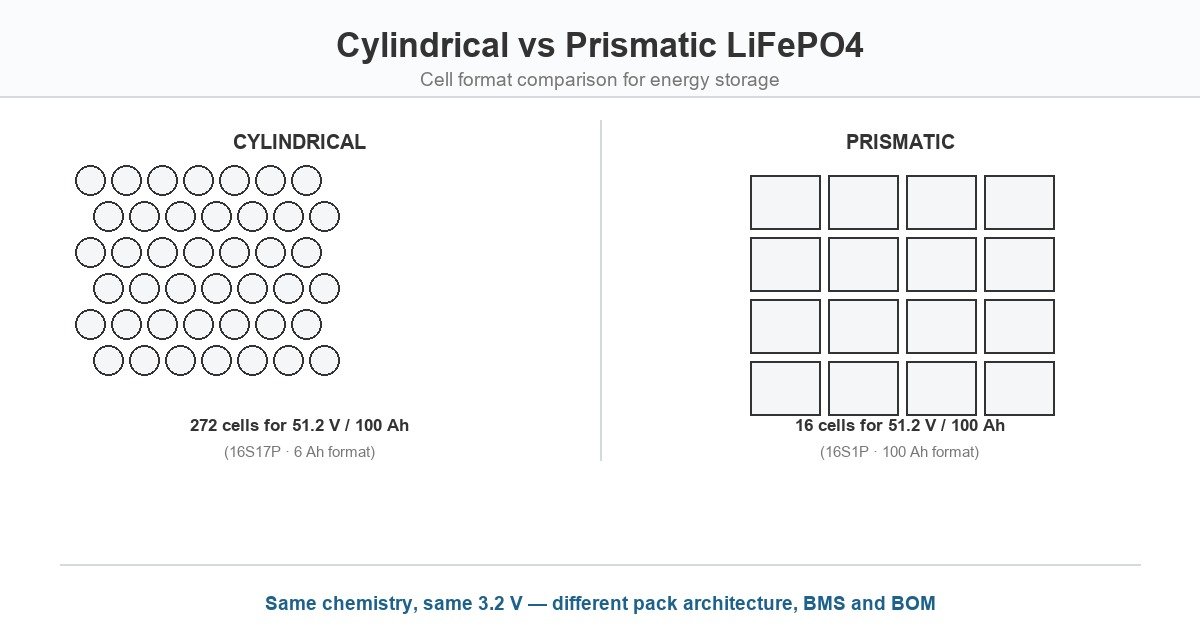
| Fewest cells for a fixed pack | 32140 / 33140 | 16 cells for 51.2 V / 15 Ah vs 48 in 6Ah |
| Maximum capacity per cell | 46950 | 64–80 Wh per cell; 16-cell 25 Ah packs |
| Cold-climate charging | 33140 (Gotion IFR32135) | −20 °C charge window |
| Certified path to North America | 32140 (Lithium Werks) | UL 1642 in place; complete public datasheet |
The honest summary: match the format to the pack architecture, not to the headline capacity. A 6Ah format wins when the design needs granularity and multi-source depth; a 15Ah or 25Ah format wins when cell count and assembly cost dominate the BOM.
Request a Quote
Frequently Asked Questions
What is the largest cylindrical LiFePO4 cell size?
The 46950 (Ø46 × 95 mm) is the largest widely available cylindrical LiFePO4 format, at 20–25 Ah and 64–80 Wh per cell. Larger designations such as 4680 and 40152 exist but are dominated by NCM chemistry or specialist supply.
What does 32700 mean in battery size?
32700 encodes the dimensions: 32 mm diameter × 70 mm length. In LiFePO4 chemistry it delivers 6,000 mAh at 3.2 V nominal (19.2 Wh) and is the industry-mainstream 6Ah cylindrical format.
Are 32650 and 32700 the same size?
They share the same Ø32 mm diameter; nominal length differs (65 mm vs 70 mm). In practice many cells sold as “32650” ship in 70 mm cans dimensionally identical to a 32700, so the datasheet dimension line defines the cell — see our 32650 vs 32700 comparison.
Which large cylindrical LiFePO4 format needs the fewest cells?
For a 51.2 V / 15 Ah pack, the 15Ah formats (32140/33140) need 16 cells (16S1P) versus 48 in the 6Ah formats and 80 in the 3Ah 26650. The 46950 also builds 51.2 V packs at 16 cells, overshooting to 25 Ah capacity.
What is the cycle life of large cylindrical LiFePO4 cells?
Published ratings span 2,000–6,000+ cycles depending on format and maker: 2,000–3,000+ for 32650 listings, 2,000–6,000+ for 32700 lines (Hithium above 6,000; CATL EnerBlue 5,000+), 2,500–4,000+ for the 15Ah class, and 2,500–5,000+ for the 46950 (CHAM 46950S25E at 5,000).
Does CMX supply 4680 or 38121 cells?
Not currently. CMX supplies the 32650, 32700, 32140, 33140 and 46950 cylindrical LiFePO4 formats as Grade-A cells; the 4680, 38121, 38910 and 40152 formats can be discussed through the inquiry channel for future programs.
Final Thoughts
The large cylindrical LiFePO4 ladder is a capacity story: 6 Ah at Ø32 × 70 mm, 15 Ah at Ø33 × 140 mm, 25 Ah at Ø46 × 95 mm — each rung cutting the cell count a 51.2 V pack needs. The 32700 anchors the mainstream with the deepest multi-source supply; the 15Ah class splits into two naming standards over the same envelope; the 46950 pushes capacity per cell toward 80 Wh.
For buyers, the practical sequence is: fix the pack voltage and capacity, count cells in each candidate format, then compare datasheets — internal resistance, charge window and cycle-life test conditions — at your operating point. CMX Battery supplies the full 32650-through-46950 ladder as Grade-A cells with UN 38.3, IEC 62619, CE and MSDS documentation, MOQ 100 pcs and 15-day lead time; specification review and sample validation are available for any format on this page.
Further Reading
- 32650 vs 32700 LiFePO4: which cell fits your pack
- 32140 vs 33140 LiFePO4: the 15Ah dual-standard explained
- Cylindrical vs prismatic LiFePO4 cells for ESS
- 32650 LiFePO4 battery (IFR32650, 3.2V 6000mAh)
- 33140 LiFePO4 battery (15Ah, EVE C33 / Gotion)
- 32140 LiFePO4 battery (15Ah, Lithium Werks / CBAK)
- 32700 LiFePO4 battery (IFR32700, 3.2V 6000mAh)
- 46950 LiFePO4 battery (25Ah, CHAM 46950S25E class)
- Large cylindrical LiFePO4 battery cells — product hub
- Cylindrical lithium battery sizes: the complete guide