Blog
Cylindrical vs Prismatic LiFePO4: Which Cell for ESS?

TL;DR / Key Takeaways
- Cylindrical LiFePO4 cells are wound electrode sheets in a round steel can at standardized sizes (18650 through 46950); prismatic cells are stacked electrodes in a rectangular aluminum can with maker-specific dimensions and 50–280 Ah capacities.
- At cell level, published LFP prismatic cells run 156–180 Wh/kg against roughly 130–137 Wh/kg for 6Ah-class cylindrical cells — the gravimetric gap closes at 15Ah-class cylindrical formats (172–180 Wh/kg).
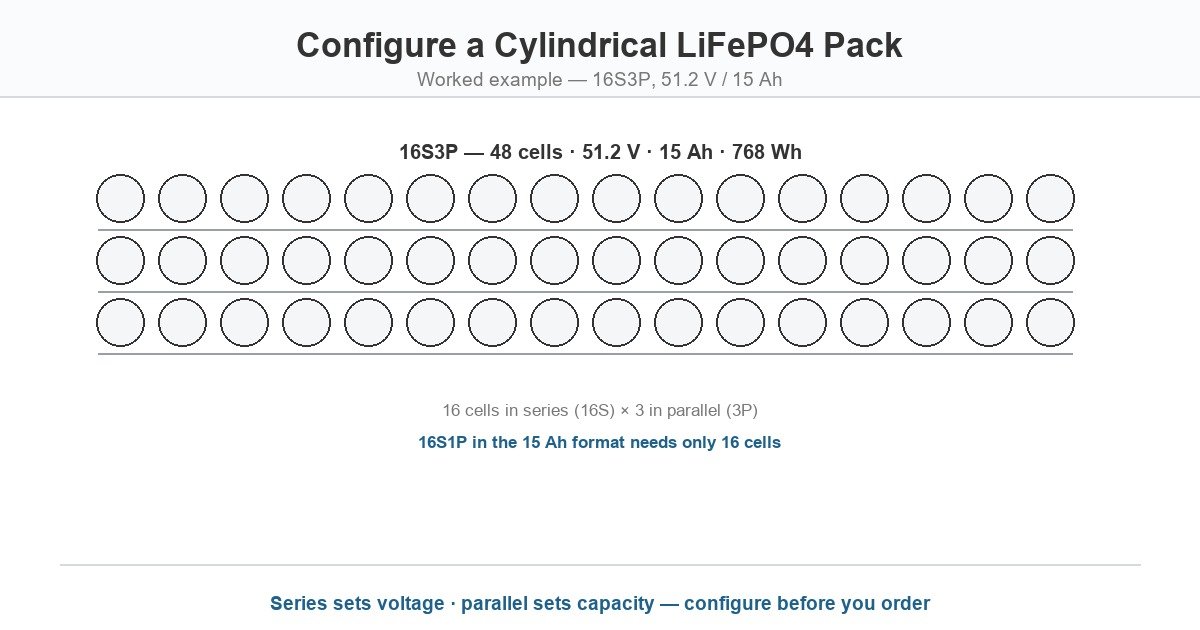
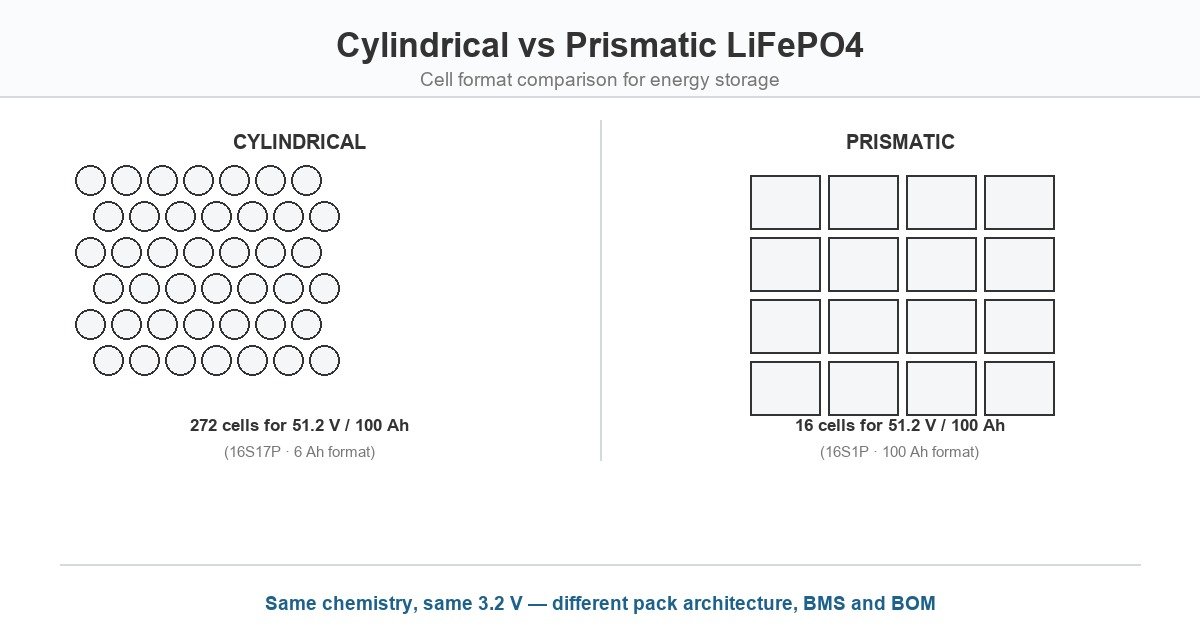
- A 51.2 V / 100 Ah pack needs 16 prismatic cells or 272 cylindrical 6Ah cells — the single biggest pack-architecture difference between the formats.
- Cylindrical wins on standardization, automated production cost and per-cell thermal isolation; prismatic wins on space utilization, cell count and pack-level BOM simplicity.
- Neither format is universally better: cylindrical suits modular, high-rate and cost-sensitive designs; prismatic suits high-capacity ESS and space-constrained enclosures.
Table of Contents
- [What Is a Cylindrical LiFePO4 Cell?](#what-is-a-cylindrical-lifepo4-cell)
- [What Is a Prismatic LiFePO4 Cell?](#what-is-a-prismatic-lifepo4-cell)
- [Cylindrical vs Prismatic: Format-Level Comparison](#cylindrical-vs-prismatic-format-level-comparison)
- [Cell-Level Specs: Real LFP Cells in Both Formats](#cell-level-specs-real-lfp-cells-in-both-formats)
- [The Five Differences That Matter for ESS](#the-five-differences-that-matter-for-ess)
- [Pack-Level Consequences: A 14.3 kWh Worked Example](#pack-level-consequences-a-143-kwh-worked-example)
- [Which Format Should You Choose?](#which-format-should-you-choose)
- [Procurement Notes for Both Formats](#procurement-notes-for-both-formats)
- [Frequently Asked Questions](#frequently-asked-questions)
- [Final Thoughts](#final-thoughts)
What Is a Cylindrical LiFePO4 Cell?
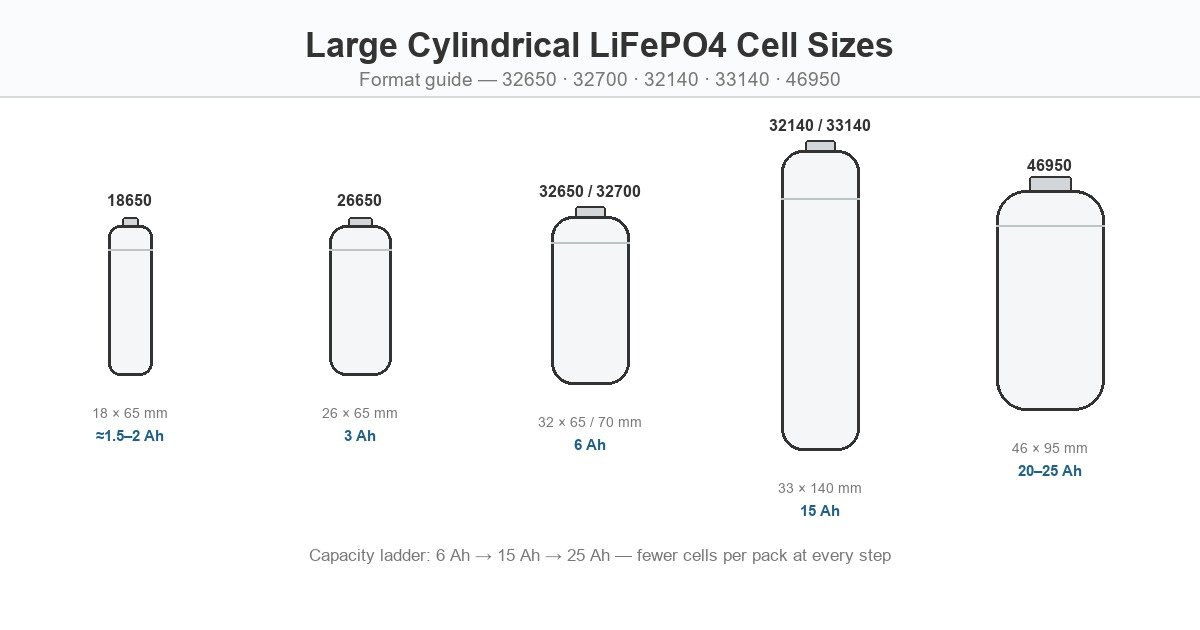
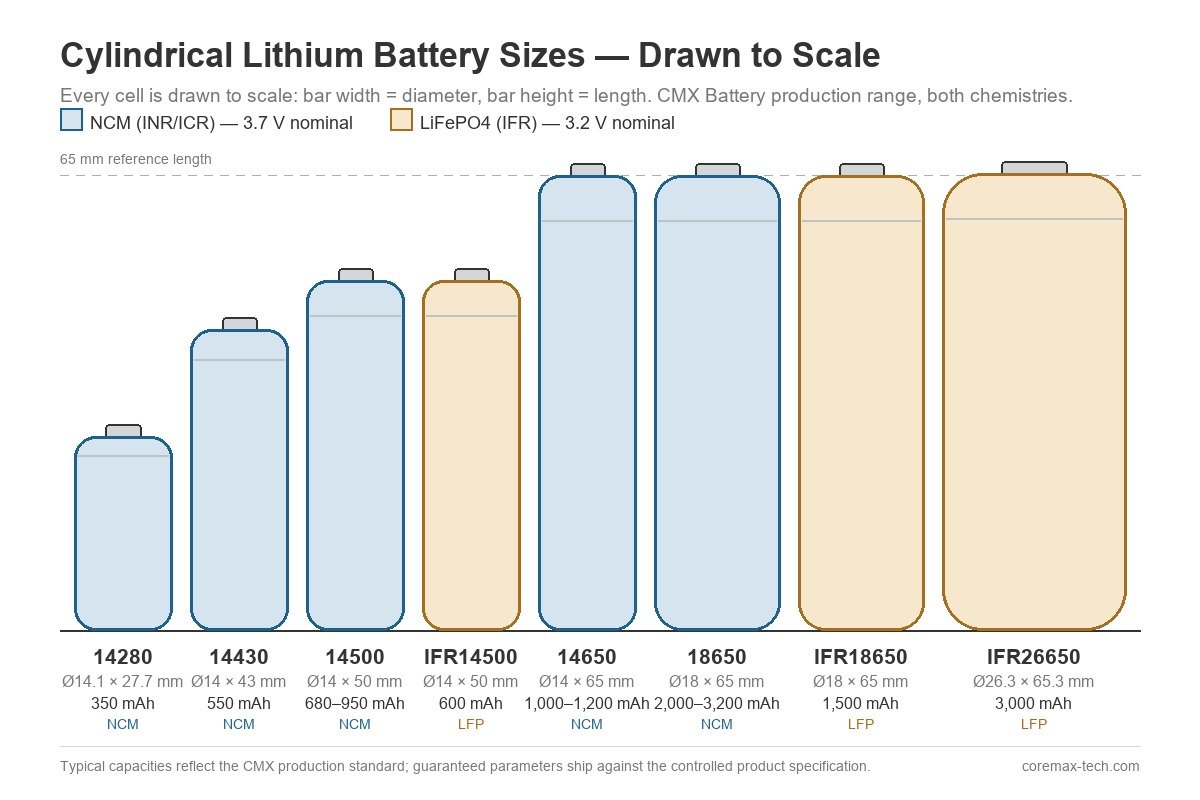
A cylindrical LiFePO4 cell is built by winding cathode, separator and anode sheets into a “jelly roll” and sealing it inside a round steel can. The designation encodes nominal dimensions — 18650 is 18 mm × 65 mm, 32700 is 32 mm × 70 mm, 46950 is 46 mm × 95 mm — making the format family effectively standardized across the industry.
LiFePO4 cylindrical cells span 1.5 Ah (14500) to 25 Ah (46950) at 3.2 V nominal, with the 6Ah class (32650/32700) and 15Ah class (32140/33140) carrying most ESS and telecom volume. Because the can sizes are de facto standards, cells from different makers are dimensionally interchangeable, and the wound structure gives each cell a radial heat path and a strong mechanical shell — properties the industry comparison literature consistently credits with easier air cooling and high mechanical robustness, per Huawen New Power’s format guide.
What Is a Prismatic LiFePO4 Cell?
A prismatic LiFePO4 cell houses stacked (or wound) electrodes in a rigid rectangular aluminum or steel can. There is no universal size naming: each maker publishes its own model codes and dimensions — EVE’s LF280K, Guoxuan’s IFP28148115A, Anchi’s 100Ah cell — optimized for the capacity tier and customer the can was designed for.
Prismatic LFP cells start where cylindrical leaves off: 50–105 Ah in stock formats, scaling to 280 Ah and beyond. That capacity concentration is the format’s defining trait — one prismatic cell can replace dozens of cylindrical cells in the same pack — and it is why prismatic cans dominate grid-scale and C&I ESS enclosures, where rectangular stacking also packs tighter than round cans. The trade-off documented across industry sources is thermal: prismatic cells dissipate heat across large flat faces and need deliberate thermal design, while their maker-specific dimensions limit cross-supplier interchangeability, per CMBatteries’ format comparison.
Cylindrical vs Prismatic: Format-Level Comparison
| Attribute | Cylindrical LiFePO4 | Prismatic LiFePO4 |
|---|---|---|
| Internal structure | Wound jelly roll in round steel can | Stacked electrodes in rectangular can |
| Size standardization | De facto standard sizes (18650–46950) | Maker-specific model codes and dimensions |
| Typical capacity range | 1.5–25 Ah | 50–280+ Ah |
| Volumetric packing | Round cross-section leaves gaps | Rectangular stacking; >20% higher space utilization |
| Cell-level gravimetric density | ~130–137 Wh/kg (6Ah class) | 156–180 Wh/kg (published LFP cells) |
| Thermal behavior | Radial heat path; air cooling between cans | Face cooling; concentrated heat; needs thermal design |
| Per-cell energy in a fault | Low (19–48 Wh typical) | High (160–896 Wh) |
| Production model | Automated high-volume; lower cost per cell | Custom tooling; higher per-cell cost |
| Cell-level serviceability | Individual cell replacement | Module-level replacement |
| BMS channels per pack | High (one per cell) | Low (one per large cell) |
Two clarifications matter before the numbers. First, the gravimetric comparison is format- and size-dependent: the 6Ah cylindrical class trails prismatic at cell level, but 15Ah-class cylindrical cells (172–180 Wh/kg published) close the gap entirely. Second, space utilization is a pack-geometry property, not a cell property — prismatic cans stack without interstitial gaps, which is where the >20% figure comes from, per CMBatteries.
Cell-Level Specs: Real LFP Cells in Both Formats
The tables below use published data only. Prismatic figures come from cells in current stock (first-party listings); cylindrical figures come from manufacturer datasheets and distributor listings cited in our format research.
Prismatic LFP cells (published specs, in stock):
| Cell (maker) | Capacity | Energy | Dimensions (mm) | Weight | Wh/kg † | ACIR | Cycle life |
|---|---|---|---|---|---|---|---|
| Guoxuan IFP28148115A | 52 Ah | 166.4 Wh | 28 × 148 × 115 | 950 g | ~175 (180 published) | 0.5–1 mΩ | ≥3,000 (25 °C, 1C) |
| Guoxuan IFP27175200A | 105 Ah | 336 Wh | 27 × 175 × 200 | 2,060 g | ~163 | 0.4–0.7 mΩ | per datasheet |
| Anchi 100Ah | 100 Ah | 320 Wh | 160 × 50 × 120 | 2,050 g | ~156 | ≤0.5 mΩ | 3,000 |
| EVE LF280K | 280 Ah | 896 Wh | 173.7 × 72 × 207.5 | 5,420 g | ~165 | ≤0.25 mΩ | 6,000 |
Cylindrical LFP cells (published specs, market references):
| Cell (maker) | Capacity | Energy | Dimensions (mm) | Weight | Wh/kg † | ACIR | Cycle life |
|---|---|---|---|---|---|---|---|
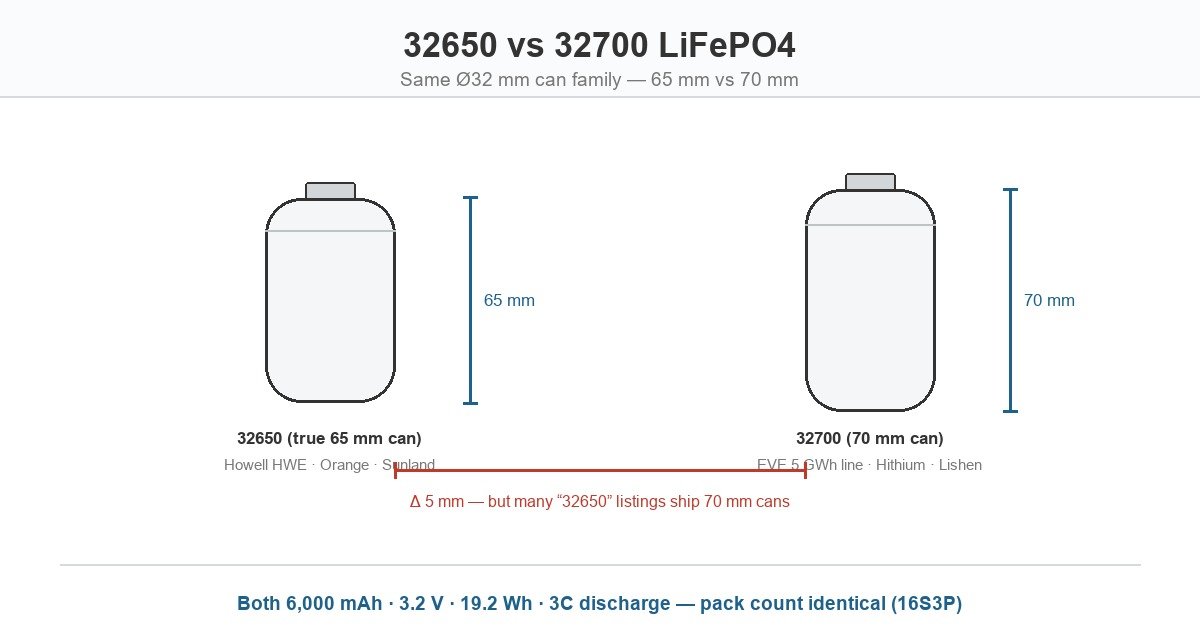
| Conno IFR32650-6000 (70.5 mm can) | 6 Ah | 19.2 Wh | Ø32.2 × 70.5 | 145 g | ~132 | ≤8 mΩ | ≥2,000 (100% DOD, 1C) |
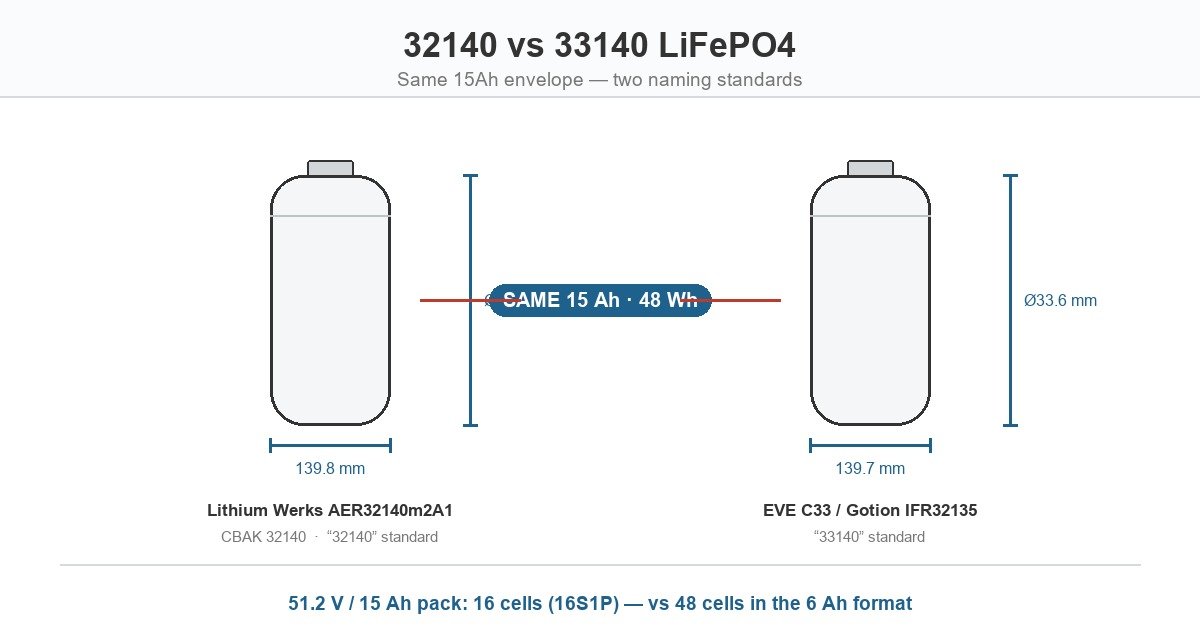
| Gotion IFR32135-15Ah | 15 Ah | 48 Wh | Ø33.6 × 139.7 | 270 g | ~178 (180 published) | 1–3 mΩ | ≥2,500 (80%, 25 °C) |
| Lithium Werks AER32140m2A1 | 15 Ah | 48 Wh | Ø33.4 × 139.8 | 275 g | >172 (published) | <3 mΩ | >3,500 (80% DOD) |
| Hithium 32700 (premium line) | 6 Ah | 19.2 Wh | Ø32 × 70 | ~140 g class | ~137 class | ≤8 mΩ class | >6,000 |
† Wh/kg derived from published energy and weight; “published” values are manufacturer-stated.
The pattern is consistent: within LFP chemistry, prismatic cans currently hold the gravimetric advantage at cell level, and large cylindrical formats match them. The low internal resistance of the big prismatic cells (0.25–1 mΩ versus 3–8 mΩ on cylindrical) follows directly from electrode area — a 280Ah prismatic cell has roughly 47 times the electrode area of a 6Ah cylindrical, and resistance scales inversely with it.
The Five Differences That Matter for ESS
1. Cell count and BMS complexity. This is the largest practical gap. A 51.2 V / 100 Ah pack is 16 prismatic cells or 272 cylindrical 6Ah cells (16S17P). Every cylindrical cell adds a weld, a BMS sampling channel and a potential failure point; industry comparisons repeatedly flag cylindrical’s higher BMS complexity as its structural cost, per Greatech Energy’s format analysis.
2. Space utilization. Prismatic cans stack into rectangular modules without interstitial gaps — published comparisons credit prismatic packing with over 20% higher space utilization than cylindrical clustering (CMBatteries). For wall-mounted and container ESS, that difference lands directly in enclosure volume and shipping cube.
3. Thermal management. Cylindrical cells shed heat radially between cans and tolerate forced-air cooling; prismatic cells concentrate heat across large faces and typically need thermal plates or liquid paths in high-density designs (Huawen New Power; VLP Electric). The counterweight is fault energy: a cylindrical pack spreads 19–48 Wh across hundreds of small cans, while a prismatic pack concentrates 160–896 Wh per cell — a safety-architecture trade, not a defect of either format.
4. Cycle life. Industry analysis credits cylindrical’s wound structure and smaller cells with more even thermal loading and slower aging (CMBatteries). Published LFP data shows parity at the premium end — EVE’s LF280K prismatic is rated 6,000 cycles, matching Hithium’s 6,000+ cycle 32700 cylindrical claims — while mid-tier prismatic cells (3,000 cycles) sit below mid-tier cylindrical lines. Test conditions, not format labels, decide this comparison.
5. Standardization and cost. Cylindrical sizes are industry standards produced on highly automated lines at low unit cost; prismatic cans carry maker-specific model codes and custom tooling, raising per-cell cost and limiting cross-supplier substitution (Greatech Energy). For buyers, prismatic supply means qualifying a specific maker’s line; cylindrical supply means qualifying a size, then choosing among makers.
Pack-Level Consequences: A 14.3 kWh Worked Example
The clearest way to see the format gap is a real pack. Our 51.2 V / 280 Ah (14.3 kWh) wall-mounted ESS is built from 16 EVE LF280K prismatic cells — 16 weld sets, 16 BMS channels, 86.7 kg of cells. The same energy in 6Ah cylindrical cells needs approximately 750 cells (16S47P), 105 kg of cells, and a BMS with 47 times the channels.
| 51.2 V pack | Prismatic (EVE LF280K, 280Ah) | Cylindrical (32700-class, 6Ah) |
|---|---|---|
| 14.3 kWh build | 16 cells (16S1P) | ≈750 cells (16S47P) |
| Cell weight | 86.7 kg | ≈105 kg |
| BMS channels | 16 | ≈750 |
| Envelope | rectangular stack, high density | clustered cans, interstitial gaps |
| Cell-level serviceability | module replacement | individual cell replacement |
Neither column is “better” — the prismatic build wins on count, weight and BOM; the cylindrical build wins on per-cell fault energy, standardized sourcing and cell-level serviceability. The right answer depends on which constraint binds your design: enclosure volume, assembly labor, service model or supply-chain flexibility.
Which Format Should You Choose?
| If your priority is… | Choose… | Because… |
|---|---|---|
| High-capacity ESS (≥5 kWh) in a fixed enclosure | Prismatic | 16 cells vs 272 for 51.2V/100Ah; rectangular packing |
| Wall-mounted / space-constrained designs | Prismatic | >20% higher space utilization; flat stack geometry |
| Modular, field-serviceable architectures | Cylindrical | Individual cell replacement; standardized sizes |
| High-rate duty (power tools, starters, AGVs) | Cylindrical | Radial heat path; 3C-class 6Ah cells; low per-cell fault energy |
| Lowest unit cost at volume | Cylindrical | Automated production at standardized sizes |
| Lowest cell count and assembly labor | Prismatic | 16–32 cells replace 100+ cylindrical cells |
| Existing 32700/33140 pack platform | Cylindrical | Drop-in continuity with the established design |
For ESS specifically, the industry pattern is visible in our own stock: prismatic cells carry the 50–280 Ah stationary-storage tiers, while cylindrical lines serve modular, high-rate and legacy-format demand. A supplier that stocks both — as CMX Battery does — can quote either architecture against the same 51.2 V system brief.
Procurement Notes for Both Formats
- Certification baseline — UN 38.3 (transport), IEC 62619 (industrial storage safety), CE and MSDS apply to both formats; confirm the set matches the destination market.
- Batch matching — series strings require cells from a single batch with sorted open-circuit voltage and internal resistance, in either format; prismatic stacks additionally need managed compression for swelling over life.
- Model-code discipline — cylindrical: specify size plus maker model code; prismatic: specify the maker’s model code (LF280K, IFP28148115A) because dimensions are not interchangeable across makers.
- Thermal design review — prismatic packs need a documented thermal path (plates or liquid) at high continuous rates; cylindrical packs need can spacing for air flow.
- Commercial terms — MOQ 100 pcs, samples and 15-day lead time apply across CMX Battery’s cylindrical and prismatic lines; specification review and sample validation are available for both formats.
Request a Quote
Frequently Asked Questions
What is the difference between cylindrical and prismatic LiFePO4 cells?
Cylindrical cells are wound electrode sheets sealed in a round steel can at standardized sizes (18650–46950, 1.5–25 Ah). Prismatic cells are stacked electrodes in a rectangular aluminum can with maker-specific dimensions and larger capacities (50–280+ Ah). Both use LiFePO4 chemistry at 3.2 V nominal — the difference is mechanical format and the pack architecture each enables.
Which has higher energy density, cylindrical or prismatic LiFePO4?
At cell level, published LFP prismatic cells run 156–180 Wh/kg (Anchi 100Ah ~156 Wh/kg; Guoxuan 52Ah 180 Wh/kg published), against roughly 130–137 Wh/kg for 6Ah-class cylindrical cells. The gap closes at 15Ah-class cylindrical formats: Lithium Werks publishes >172 Wh/kg and Gotion 180 Wh/kg for their 32140/33140 cells.
Are prismatic or cylindrical cells better for thermal management?
Cylindrical cells dissipate heat radially between cans and work well with forced-air cooling; prismatic cells concentrate heat across large faces and usually need thermal plates or liquid cooling in high-density packs. Cylindrical also spreads fault energy across many small cells (19–48 Wh each) versus 160–896 Wh per prismatic cell — different safety architectures, not a ranking.
Which format has longer cycle life?
Published premium lines reach parity: EVE LF280K prismatic is rated 6,000 cycles and Hithium’s 32700 cylindrical above 6,000. Mid-tier cells run ~3,000 cycles in both formats. Industry analysis notes cylindrical’s wound structure distributes thermal load more evenly, but test conditions (temperature, C-rate, DOD) matter more than the format label.
How many cells do I need for a 51.2V 100Ah battery in each format?
Sixteen prismatic cells (16S1P, e.g. Anchi 100Ah or Guoxuan 105Ah) versus 272 cylindrical 6Ah cells (16S17P). At 15Ah cylindrical formats the count drops to 112 (16S7P). Cell count drives BMS channels, weld operations and assembly labor.
Which is cheaper, cylindrical or prismatic LiFePO4 cells?
Cylindrical cells are generally cheaper per cell: standardized sizes on highly automated lines with mature supply chains. Prismatic cans carry maker-specific tooling and lower automation, raising per-cell cost — offset at pack level by fewer cells, fewer welds and smaller BMS. Compare cost per delivered pack, not per cell.
Can I mix cylindrical and prismatic cells in one pack?
No. Series strings require matched capacity, internal resistance, voltage curve and venting behavior. Mixing formats in one string creates imbalance, uneven aging and unpredictable fault propagation. Parallel redundancy within a single format and model code is the accepted practice.
Final Thoughts
The cylindrical vs prismatic question in LiFePO4 is not a ranking — it is a question about which constraint binds your design. Cylindrical cells bring standardization, automated production cost, radial heat paths and cell-level serviceability; prismatic cells bring capacity concentration, packing efficiency and radically simpler pack BOMs. At cell level the published data shows prismatic holding a 156–180 Wh/kg gravimetric advantage today, with large cylindrical formats closing the gap; at pack level the 16-versus-272 cell count for a 51.2 V / 100 Ah build is the number most procurement teams feel first.
For ESS programs, the practical path is to brief the system requirements — voltage, capacity, enclosure, duty cycle, service model — and let the format follow. CMX Battery supplies both architectures from stock: prismatic LFP cells from 50 to 280 Ah (Guoxuan, EVE LF280K, Anchi) and cylindrical LFP cells across the 6Ah, 15Ah and 25Ah classes, with datasheet-matched specification review for either route.
For a format-selection review against your pack specification — including cell-count, thermal and BOM modeling for both architectures — submit your requirement through the inquiry form for a response within 24 hours.
Further Reading
- Wholesale prismatic Guoxuan/Gotion 3.2V 52Ah LiFePO4 cell
- EVE LF280K LiFePO4 cell, Grade-A 280Ah 3.2V
- 51.2V 280Ah 14.3kWh wall-mounted LiFePO4 pack
- 32650 vs 32700 LiFePO4: which cell fits your pack
- 32140 vs 33140 LiFePO4: the 15Ah dual-standard explained
- Large cylindrical LiFePO4 battery cells — product hub
- Cylindrical lithium battery sizes: the complete guide