Blog
32140 vs 33140 LiFePO4: The 15Ah Dual-Standard, Explained

TL;DR / Key Takeaways
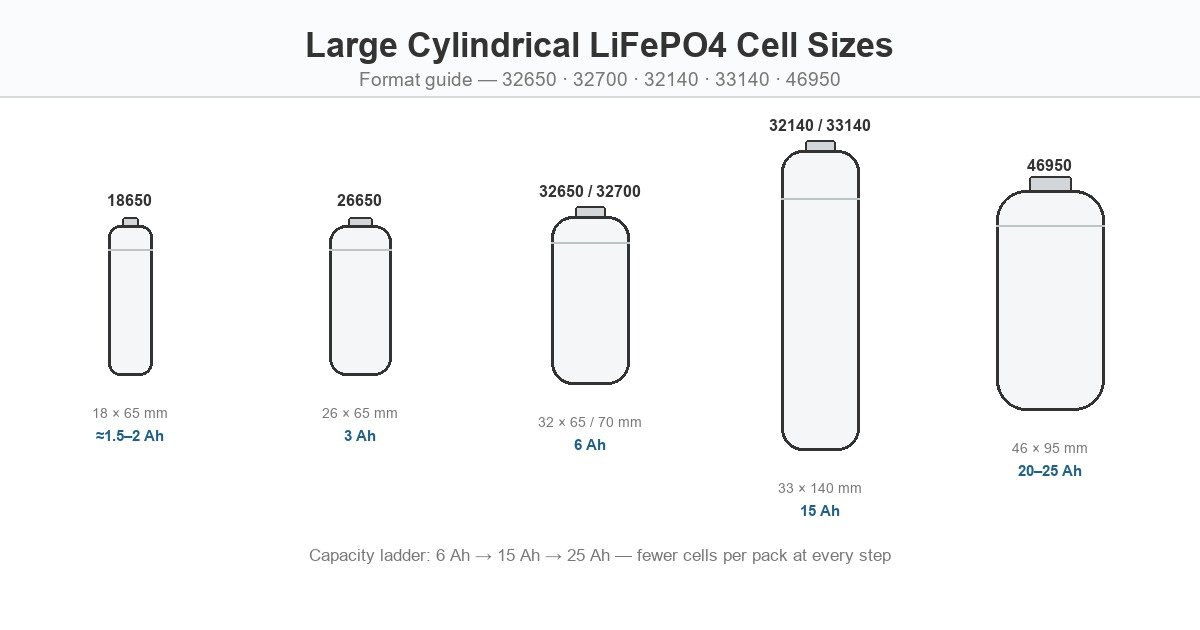
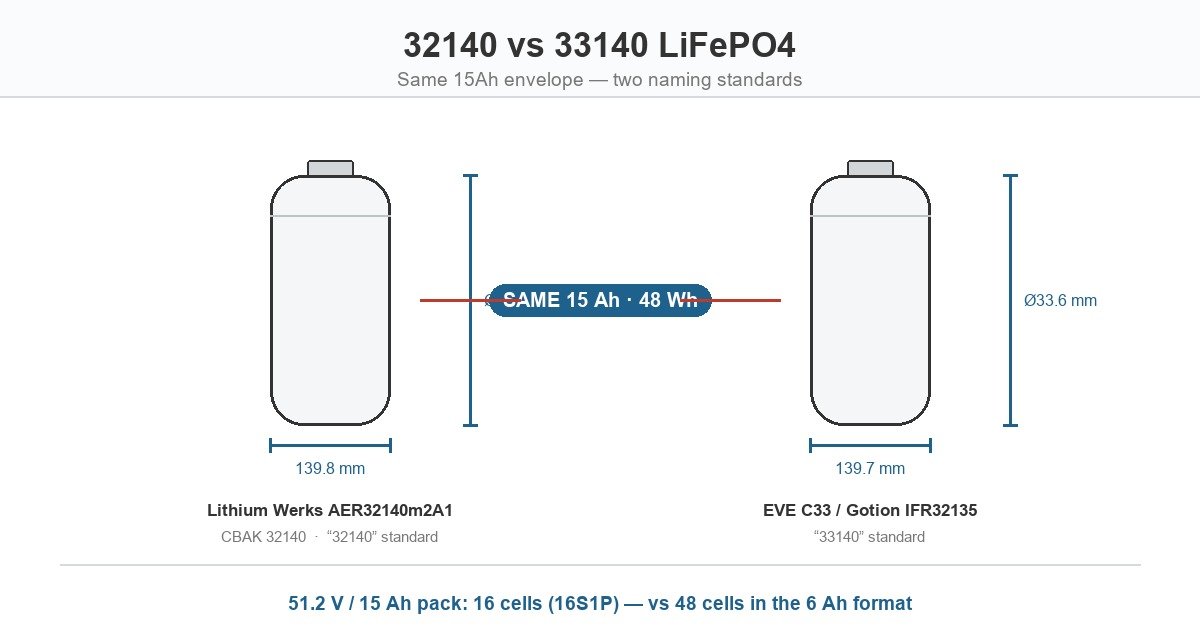
- 32140 and 33140 are two naming standards for the same 15Ah cylindrical LiFePO4 envelope — Ø32–33 × 140 mm, 3.2 V, 48 Wh, roughly 270–305 g.
- The split follows supply chains: 32140 is used by CBAK and Lithium Werks; 33140 (also sold as Gotion IFR32135 and EVE C33) by Gotion and EVE.
- Published cycle life ranges from 2,500 cycles (Gotion IFR32135-15Ah) to 4,000 cycles at 25 °C (EVE C33), with Lithium Werks AER32140m2A1 rated above 3,500 cycles at 80% DOD.
- Temperature performance favors the Gotion cell: charging from −20 °C and discharging to −30 °C, versus −10 °C discharge on the Lithium Werks 32140.
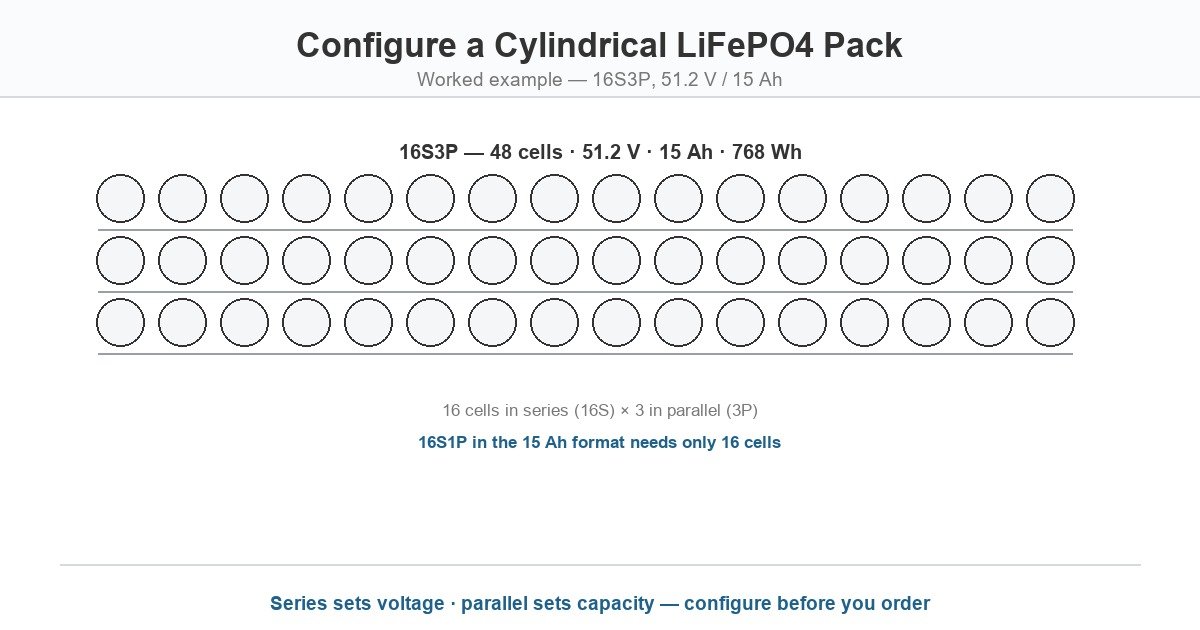
- For a 51.2 V / 15 Ah pack, either 15Ah format needs 16 cells in series — versus 48 cells if built from 6Ah 32700 format.
Table of Contents
- [What Is a 32140 LiFePO4 Battery?](#what-is-a-32140-lifepo4-battery)
- [What Is a 33140 LiFePO4 Battery?](#what-is-a-33140-lifepo4-battery)
- [Why Two Names for the Same Envelope?](#why-two-names-for-the-same-envelope)
- [32140 vs 33140: Side-by-Side Specifications](#32140-vs-33140-side-by-side-specifications)
- [Brand Landscape: Who Makes Which Standard](#brand-landscape-who-makes-which-standard)
- [Performance Differences That Actually Matter](#performance-differences-that-actually-matter)
- [Pack Economics: Why the 15Ah Format Halves Your Cell Count](#pack-economics-why-the-15ah-format-halves-your-cell-count)
- [Which Should You Choose?](#which-should-you-choose)
- [Procurement Checklist for 15Ah Cylindrical LFP Cells](#procurement-checklist-for-15ah-cylindrical-lfp-cells)
- [Frequently Asked Questions](#frequently-asked-questions)
- [Final Thoughts](#final-thoughts)
What Is a 32140 LiFePO4 Battery?
A 32140 LiFePO4 battery is a cylindrical lithium iron phosphate cell whose name encodes its nominal dimensions: 32 mm diameter × 140 mm length. The format delivers 15 Ah at 3.2 V nominal — about 48 Wh per cell — and dominates the mid-capacity segment between 6Ah-class cells such as the 32700 and 20Ah-plus cells such as the 46950.
Two manufacturers publish full datasheets under the 32140 designation. CBAK’s 32140 is a 15 Ah, 3.2 V cell weighing approximately 290 g, rated for 1C continuous discharge with a 10C pulse capability for 60 seconds, as distributed by suppliers including Solargytech. Lithium Werks’ AER32140m2A1 is the more fully documented variant: 15 Ah at C/5, 48 Wh, above 172 Wh/kg gravimetric and 396 Wh/L volumetric energy density, internal impedance below 3 mΩ at 1 kHz, and a Ø33.4 × 139.8 mm, 275 ± 5 g envelope, certified to UL 1642, UN 38.3 and BIS per the Lithium Werks datasheet.
What Is a 33140 LiFePO4 Battery?
A 33140 LiFePO4 battery is the same physical format under the other naming convention: 33 mm diameter × 140 mm length, 3.2 V, 15 Ah, approximately 48 Wh. In practice the two designations describe an overlapping envelope — real 32140 cells measure Ø32.2–33.4 mm and real 33140 cells measure Ø33.0–33.6 mm — so the distinction is about who makes the cell and under which model code, not about a physically incompatible part.
The 33140 designation is used by two of China’s largest cell makers. Gotion’s IFR32135-15Ah is officially a 32135 model but is sold across the distribution channel as the “Gotion 33140” — a naming overlap confirmed by distributors such as NOGI Battery, whose FAQ addresses the question directly. EVE’s C33 is the other major 33140-lineage cell, a 15 Ah, 48 Wh product with 33 × 140 mm dimensions and a 2,730–3,000 g-class weight range, distributed through partners including Misen Power.
Why Two Names for the Same Envelope?
The 32140/33140 split has no single standards body behind it. Cylindrical cell naming is a convention — the first two digits encode diameter, the next two or three encode length — and manufacturers apply it inconsistently once a can is designed to a wall thickness rather than a nominal bore. A cell with a 32 mm nominal diameter and a 1.4 mm steel or aluminum wall physically measures 33.0–33.6 mm outside, which is why one supplier’s “32140” is another’s “33140”.
The practical consequence for buyers: the model code on a quotation matters less than the datasheet behind it. Two cells sold as “33140” can differ by 30 g in weight and 1,500 cycles in rated life depending on whether the source is EVE C33 or Gotion IFR32135. Conversely, a Lithium Werks 32140 and a Gotion 33140 share the same envelope and can be drop-in substitutes in most pack designs. When specifying a 15Ah cylindrical LFP cell, always anchor the purchase to the manufacturer’s model code and datasheet — for example IFR32135-15Ah or AER32140m2A1 — rather than to the generic size name.
32140 vs 33140: Side-by-Side Specifications
The table below consolidates the published specifications of the four reference cells in this format, drawn from manufacturer datasheets and authorized-distributor listings.
| Specification | Lithium Werks AER32140m2A1 (32140) | CBAK 32140 (32140) | EVE C33 (33140) | Gotion IFR32135-15Ah (33140) |
|---|---|---|---|---|
| Nominal capacity | 15 Ah (C/5) | 15 Ah | 15 Ah | 15 Ah |
| Nominal voltage | 3.2 V | 3.2 V | 3.2 V | 3.2 V |
| Nominal energy | 48 Wh | 48 Wh | 48 Wh | 48 Wh |
| Dimensions (Ø × H) | 33.4 × 139.8 mm | 32 × 140 mm | 33 × 140 mm | 33.6 × 139.7 mm |
| Weight | 275 ± 5 g | ≈290 g | ≈273–300 g | 270 ± 5 g |
| AC internal resistance (1 kHz) | < 3 mΩ | ≤ 3 mΩ | ≤ 3 mΩ | 1–3 mΩ |
| Charge cut-off voltage | 3.65 V (float 3.45 V) | 3.60–3.65 V | 3.65 V | 3.65 V |
| Discharge cut-off voltage | 2.0 V | 2.0 V | 2.0 V | 2.0 V (1.8 V at ≤0 °C) |
| Standard charge current | ≤ C/2 (7.5 A) | 0.2C | 0.5C (7,500 mA) | 0.2C (3 A) |
| Max continuous discharge | 3C (45 A) | 1C continuous | 3C max | 1C (15 A) standard |
| Pulse discharge | 5C (75 A, 30 s) | 10C (60 s) | — | 3C (45 A, 30 s DCR) |
| RT cycle life | > 3,500 cycles (80% DOD) | long-life claim (verify) | 4,000 cycles @ 25 °C | ≥ 2,500 cycles (80%, 25 °C) |
| Charge temperature | 0–60 °C | 0–45 °C | per datasheet | −20–55 °C |
| Discharge temperature | −10–60 °C | −20–60 °C | per datasheet | −30–60 °C |
| Gravimetric energy density | > 172 Wh/kg | — | — | 180 Wh/kg |
| Certifications | UL 1642, UN 38.3, BIS | CE, RoHS, UN 38.3, MSDS | CE, RoHS, UN 38.3 | UN 38.3, GB 38031 |
Three patterns stand out. First, weight varies by up to 30 g across the format — 270 g on the Gotion cell against roughly 290 g on the CBAK — which matters for portable and mobility packs where specific energy drives range. Second, cycle-life ratings differ by a factor of 1.6 between the EVE C33 at 4,000 cycles and the Gotion IFR32135 at 2,500 cycles under their respective test conditions, so quoted cycle counts must be compared against test conditions, not headline numbers. Third, only the Gotion cell publishes sub-zero charging at −20 °C, a decisive spec for cold-climate solar storage and telecom installations.
Brand Landscape: Who Makes Which Standard
| Standard designation | Primary manufacturers | Typical channel positioning |
|---|---|---|
| 32140 | CBAK, Lithium Werks | Western-brand and export-channel cells; complete public datasheets; UL 1642 on Lithium Werks |
| 33140 | Gotion (IFR32135), EVE (C33) | Tier-1 Chinese cell makers; high-volume production; strong telecom/ESS channel presence |
| 32140/33140 (LFP-Mn hybrid) | Smaller LMFP specialists | Emerging variant with 3C continuous / 6C pulse claims; datasheet maturity varies |
For B2B buyers, the brand decision usually outranks the size-name decision. A Gotion IFR32135-15Ah arrives with original factory QR codes for traceability and a three-year warranty in the distribution channel, while a Lithium Werks AER32140m2A1 ships under a Western brand with UL 1642 certification already in place — which shortens the certification path for North American and European projects that require it.
Performance Differences That Actually Matter
Cycle life under real conditions. The EVE C33 is rated at 4,000 cycles at 25 °C but drops to 1,500 cycles at 45 °C. The Gotion IFR32135-15Ah holds 2,500 cycles to 80% capacity retention at 25 °C. The Lithium Werks AER32140m2A1 exceeds 3,500 cycles at 80% DOD at room temperature and above 2,000 cycles at 45 °C. For a stationary storage system that spends most of its life at 20–30 °C, all four candidates meet a 10-year daily-cycle duty profile; for high-temperature installations, the 45 °C rating is the number to compare.
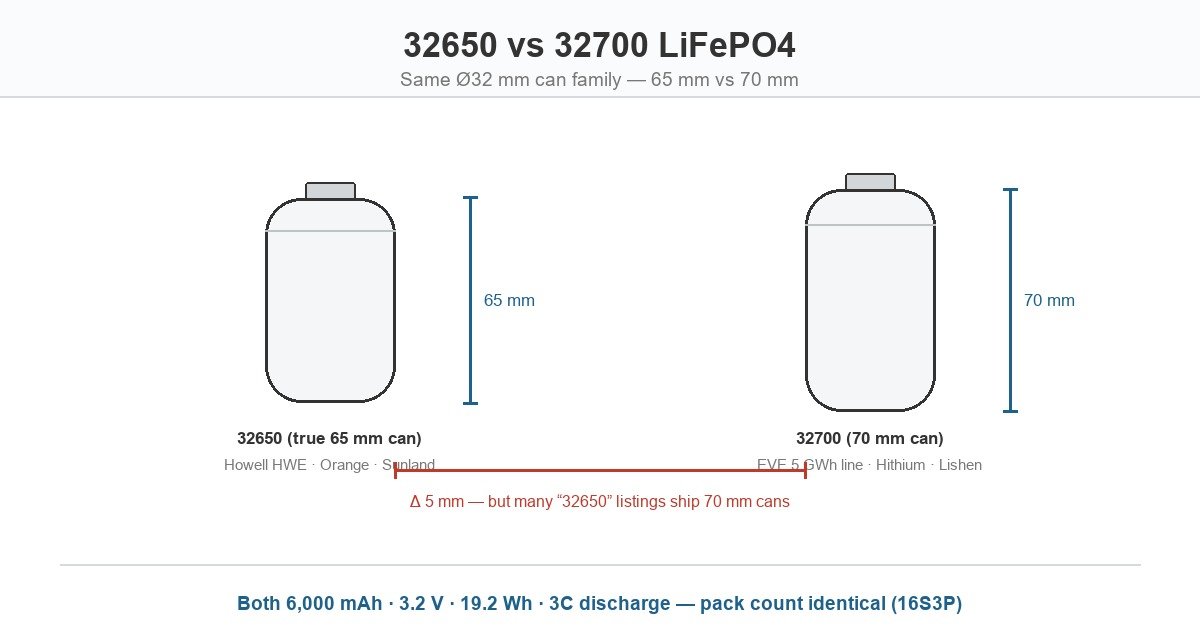
Discharge rate versus application. The CBAK 32140 and Lithium Werks cell target different ends of the rate spectrum: CBAK publishes a 1C continuous, 10C pulse profile aimed at power tools and starter duty, while Lithium Werks recommends ≤1C continuous with a 3C maximum and 5C pulse for 30 seconds. The Gotion cell specifies 1C standard discharge with a 3C DCR test rating. None of the 15Ah cells is a high-rate power cell in the sense of the 32650/32700 3C-class products — if your pack needs sustained 2C output, the 6Ah formats with lower absolute internal resistance are the better starting point.
Temperature window. Gotion’s −20 °C charge / −30 °C discharge window is the widest published in this format. Lithium Werks specifies 0–60 °C charging and −10–60 °C discharging. For off-grid solar in Nordic, Canadian or Russian markets, the sub-zero charging capability removes the need for pack-level heating in most designs — a system-cost argument that outweighs a 1,000-cycle difference in headline ratings.
Pack Economics: Why the 15Ah Format Halves Your Cell Count
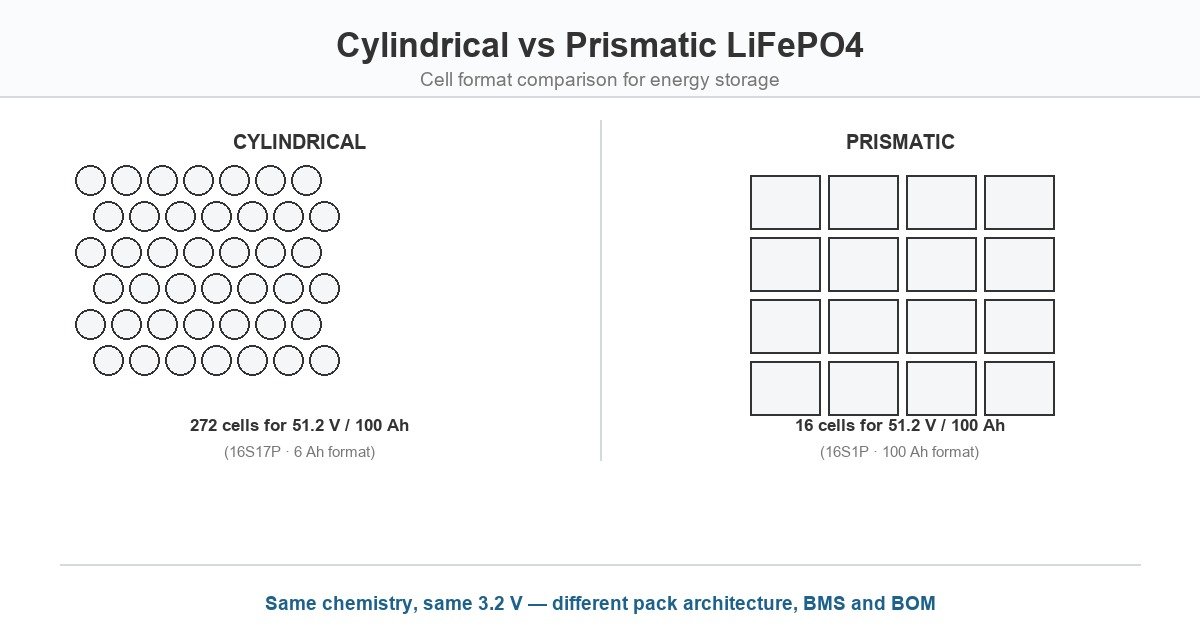
The strongest engineering argument for the 15Ah format is not per-cell performance — it is pack architecture. Because capacity scales with cell count, moving from 6Ah-class cells to 15Ah-class cells reduces the number of cells, welds and BMS channels for any given pack capacity.
| Target pack (51.2 V) | 32700 (6 Ah) | 32140 / 33140 (15 Ah) | 46950 (25 Ah) |
|---|---|---|---|
| 15 Ah (768 Wh) | 16S3P = 48 cells | 16S1P = 16 cells | 16 cells (25 Ah overshoot) |
| 30 Ah (1,536 Wh) | 16S6P = 96 cells | 16S2P = 32 cells | 32 cells (50 Ah overshoot) |
| 100 Ah (5,120 Wh) | ≈272 cells | 16S7P = 112 cells | 64 cells (100 Ah match) |
For the 15 Ah class, the cell count drops by roughly two-thirds against the 6Ah class — with proportional reductions in busbar count, BMS sampling points, weld operations and assembly labor. For a pack builder running 10,000 packs a year, that difference lands directly in cost of goods. The trade-off is flexibility: a 16S3P 6Ah design can be re-configured to 7.5 Ah or 22.5 Ah by changing parallel count, while a 16S1P 15Ah design is locked to its capacity step.
The demand side supports the format’s trajectory. The worldwide cylindrical LiFePO4 battery market was valued at USD 12,450 million in 2025 and is forecast to reach USD 47,233.65 million by 2032 — a 21.05% CAGR — with large cylindrical formats identified as a distinct growth segment alongside the 18650/21700 and 4680 families, per the PW Consulting market report.
Which Should You Choose?
| If your priority is… | Choose… | Because… |
|---|---|---|
| Certified path to North America / Europe | Lithium Werks AER32140m2A1 | UL 1642 in place; complete public datasheet |
| Maximum published cycle life at room temperature | EVE C33 (33140) | 4,000 cycles @ 25 °C |
| Cold-climate charging (−20 °C) | Gotion IFR32135-15Ah (33140) | Widest published charge window in the format |
| Lowest cell weight for mobile packs | Gotion IFR32135-15Ah (33140) | 270 ± 5 g, lightest in class |
| High-pulse power-tool duty | CBAK 32140 | 10C pulse (60 s) profile |
| Tier-1 volume with traceability | Gotion or EVE | Factory QR codes; multi-GWh production lines |
In most ESS and telecom designs the honest answer is that either standard works, and the decision should be made on datasheet-verified cycle life at your operating temperature, certification status, and supply terms — not on the size designation.
Procurement Checklist for 15Ah Cylindrical LFP Cells
Before issuing a purchase order for 32140 or 33140 cells, confirm the following with your supplier:
- Manufacturer model code — IFR32135-15Ah, C33, AER32140m2A1 or equivalent — with the datasheet revision date attached to the quotation.
- Certification set — UN 38.3, IEC 62619, CE and MSDS as a baseline; UL 1642 where the destination market requires it.
- Batch consistency — open-circuit voltage spread and internal-resistance sorting across the lot; cells for series strings must come from a single batch.
- Cycle-life test conditions — the temperature, C-rate and DOD behind the headline cycle number.
- Traceability — factory QR codes or equivalent per-cell marking for warranty administration.
- Commercial terms — MOQ, sample policy, lead time and payment structure, confirmed in writing before tooling or volume commitment.
As a Grade-A cell supplier working with CBAK, Lithium Werks, EVE and Gotion lines, CMX Battery supports specification review, cell matching and sample validation for 15Ah cylindrical LFP programs — inquiries through the contact form receive a datasheet-matched response within 24 hours.
Request a Quote
Frequently Asked Questions
What is the difference between 32140 and 33140?
32140 and 33140 are two naming conventions for the same 15Ah cylindrical LiFePO4 envelope — Ø32–33 × 140 mm, 3.2 V, 48 Wh. The designation follows the manufacturer, not a physical incompatibility: CBAK and Lithium Werks publish as 32140; Gotion (IFR32135) and EVE (C33) sell as 33140. Always specify by manufacturer model code.
Is Gotion IFR32135-15Ah the same cell as a 33140?
Yes. Gotion’s official model code is IFR32135-15Ah, but the cell is widely distributed under the 33140 designation because its measured diameter (Ø33.6 mm) matches the 33 mm naming convention. The datasheet, not the size name, defines the cell.
Can I use a 33140 instead of a 32140?
In most pack designs, yes. The two standards share the same envelope (Ø32–33.6 × 140 mm) and identical electrical format (3.2 V, 15 Ah, 3.65 V charge cut-off, 2.0 V discharge cut-off). Verify three items before substituting: holder clearance for the exact measured diameter, discharge-rate rating against your load profile, and charge-temperature window against your installation environment.
What is the cycle life of a 15Ah cylindrical LiFePO4 cell?
Published ratings range from 2,500 cycles to 80% capacity retention (Gotion IFR32135-15Ah, 25 °C) up to 4,000 cycles (EVE C33, 25 °C), with Lithium Werks AER32140m2A1 above 3,500 cycles at 80% DOD. Ratings at 45 °C fall to roughly 1,500–2,000 cycles across the format. Compare cells at your actual operating temperature, not at the headline 25 °C figure.
How many 15Ah cells do I need for a 51.2V battery?
A 51.2 V nominal pack needs 16 cells in series at 3.2 V per cell. For 15 Ah capacity, that is 16 cells total (16S1P). The same 51.2 V / 15 Ah pack built from 6Ah 32700 cells requires 48 cells (16S3P) — the core pack-economics argument for the 15Ah format.
What certifications should a 15Ah cylindrical LFP cell have?
UN 38.3 (transport), IEC 62619 (industrial storage safety), CE and MSDS form the baseline set for international B2B supply. UL 1642 adds the North American cell-safety certification and is already held by the Lithium Werks 32140 line. Confirm the certification set matches your destination market before ordering.
Which is better for energy storage: 32140 or 33140?
Neither designation is inherently better — both cover the same 15Ah format. For stationary storage, the Gotion IFR32135-15Ah offers the widest temperature window (−20 °C charge, −30 °C discharge), the EVE C33 the highest room-temperature cycle life (4,000 cycles), and the Lithium Werks AER32140m2A1 the fastest certification path with UL 1642. Choose on datasheet-verified cycle life at your operating temperature and certification requirements.
Final Thoughts
The 32140 vs 33140 question turns out to be less a technical choice than a supply-chain literacy test: both designations describe the same 15Ah cylindrical LiFePO4 envelope, and the cells behind them differ in cycle life, temperature window, weight and certification — not in fundamental format compatibility. Buyers who anchor their specification to manufacturer model codes and datasheet-verified numbers, rather than size names, avoid the most common procurement error in this format.
The strategic case for the 15Ah class is pack economics: 16 cells instead of 48 for a 51.2 V / 15 Ah design, with proportional savings in BMS channels, busbars and assembly labor. As large cylindrical LFP capacity scales across the ESS and telecom markets, the format is moving from niche to mainstream — and a datasheet-first evaluation process is the shortest path to a pack design that holds its cost and performance targets over a 10-year duty profile.
For specification support on 32140 or 33140 cells — including CBAK, Lithium Werks, EVE C33 and Gotion IFR32135 lines — submit your requirement through the inquiry form for a datasheet-matched response within 24 hours.
Further Reading
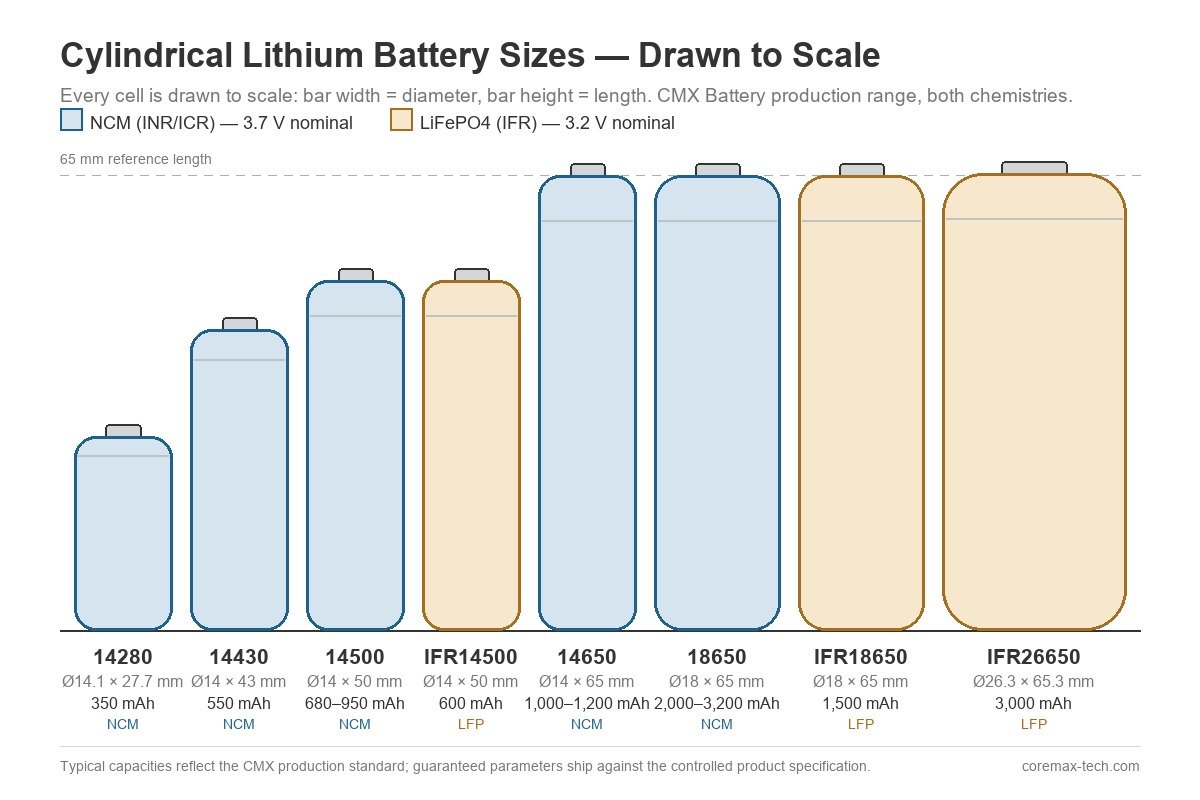
- Cylindrical lithium battery sizes: the complete 14250–46950 guide
- Small cylindrical lithium cells — product hub
- 32650 vs 32700 LiFePO4: which cell fits your pack
- Cylindrical vs prismatic LiFePO4 cells for ESS
- 32140 LiFePO4 battery (15Ah, Lithium Werks / CBAK)
- 33140 LiFePO4 battery (15Ah, EVE C33 / Gotion)
- Large cylindrical LiFePO4 battery cells — product hub
- 26650 LiFePO4 battery (IFR26650, 3.2V 3000mAh)