

Battery Charging Station for Workshop: 48-Position Cell Pool Cabinet
Shortcut: tell us how many bare cells one shift must turn over and we will suggest a slot count and a model line. One cabinet, one handover point, one charged pool.
Industrial and Warehouse Charging Scenario Overview
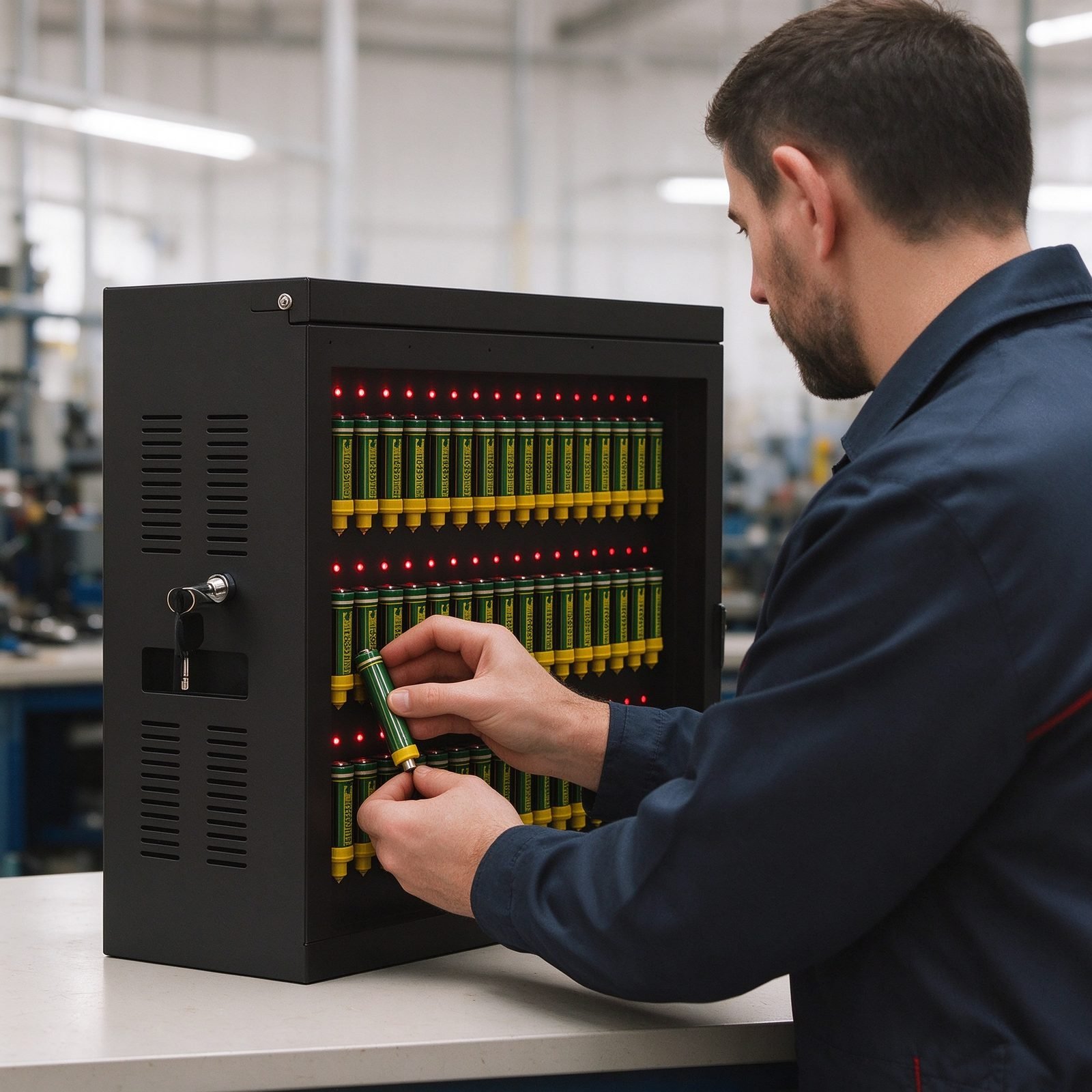
What This Station Is
Standard models charge 3.6/3.7 V Li-ion cylindrical cells (4.2 V cut-off) and 1.2 V Ni-MH/Ni-Cd. LiFePO4 (3.2 V / 3.65 V cut-off), LiPo pouch cells and other chemistries are available as custom-built versions — tell us your cell model and we configure the charging profile.
A battery charging station for workshop is one cabinet that charges a full pool of bare cells at once, each position on its own independent channel, so a charged set is ready when the next shift starts. 48-bay, 48-position and 168-position mean charging positions, not 48 volt; every 48 or 168 on this page counts positions, never a supply voltage. The 90–220 V / 50 Hz figure that appears in the specification table is an input voltage range and has nothing to do with the slot count.
The buyer is a team with a repeatable routine: a pool of cells comes off a bench or a shift, goes onto the cabinet, and a charged pool is collected at handover. The value is the count — how many cells finish in one cycle — not the enclosure. This page covers that routine in workshop, field and warehouse settings, and the two standard model lines that serve it.
What It Is Not
This equipment charges bare cells, not brand tool battery packs, and no brand name is used or implied anywhere on this page. It is not a laptop charging cart, a battery swap cabinet or a device trolley; it holds cylindrical and similar bare cells, not finished equipment. It is not a fireproof safety cabinet: the published certification scope is CE, FCC and RoHS only, with no fire-safety or safety-cabinet claim of any kind, and a buyer who needs a fire-rated enclosure is describing a different product. Nor is it a universal chemistry machine — the 4.2 V and 1.2 V profiles belong to two different cabinets.
Why Workshop Teams Need to Charge Many Cells at Once
Shift Changeover Timing
The pain point is the handover clock. When one shift ends, the cells still in use must be charged and counted before the next shift can start; a queue of individual chargers turns that window into a bottleneck. Charging a whole pool at once means the outgoing team loads one cabinet and the incoming team collects one complete set. The shift rhythm is why the position count is specified first, and it is the same rhythm in a workshop, in field work and in a warehouse fleet.
One Cabinet Replaces a Row of Single Chargers
The gain is countable: one floor footprint instead of a row of chargers, one bench area reclaimed, one mains lead instead of many cables, and one wall socket instead of a strip of them. Those four items are physical facts about how a bench is arranged, not claims about energy use or cell life. A cabinet that charges many cells at once also leaves one place to count the pool at handover. For plan the cabinet size for your pool, compare the two model lines first: the 4.2 V lithium line and the 1.2 V nickel line are separate machines, not two settings on one cabinet.
Central Management of the Battery Pool
Central here means three plain actions: the battery pool returns to one point, the cells sit in numbered positions, and the outgoing shift can count what it hands over. The battery pool is a workshop term for the cells a team rotates — a scene description, not a product feature or a management system. Nothing on this page claims software, tracking or any pool-management capability.
How the Solution Is Built
Start with the cell charging cabinet range overview for the full category. This page stays with the two standard lines and the custom path.
Model Lines and Position Counts
Two standard lines divide the work. The 4.2 V Li-ion cylindrical line is a 48-position cabinet built from 12 smart modules for 3.6/3.7 V cylindrical cells; the 1.2 V Ni-MH / Ni-Cd line is a 168-position cabinet built from 42 smart modules in a 6 columns × 28 rows layout for AA and AAA cells. The 168-position AA and AAA cell pool cabinet covers that second line: standard models charge 3.6/3.7 V Li-ion cylindrical cells to a 4.2 V cut-off and 1.2 V Ni-MH/Ni-Cd cells, so the 1.2 V profile is a separate machine, not a setting on the lithium cabinet. A custom profile built to order is a third path, quoted once we have your cell model. For the naming convention behind bay and position, see slot count terminology for workshop cabinets. 48-bay = 48 charging positions, not 48 volt; 168-position = 168 charging positions.
Independent Channel per Position
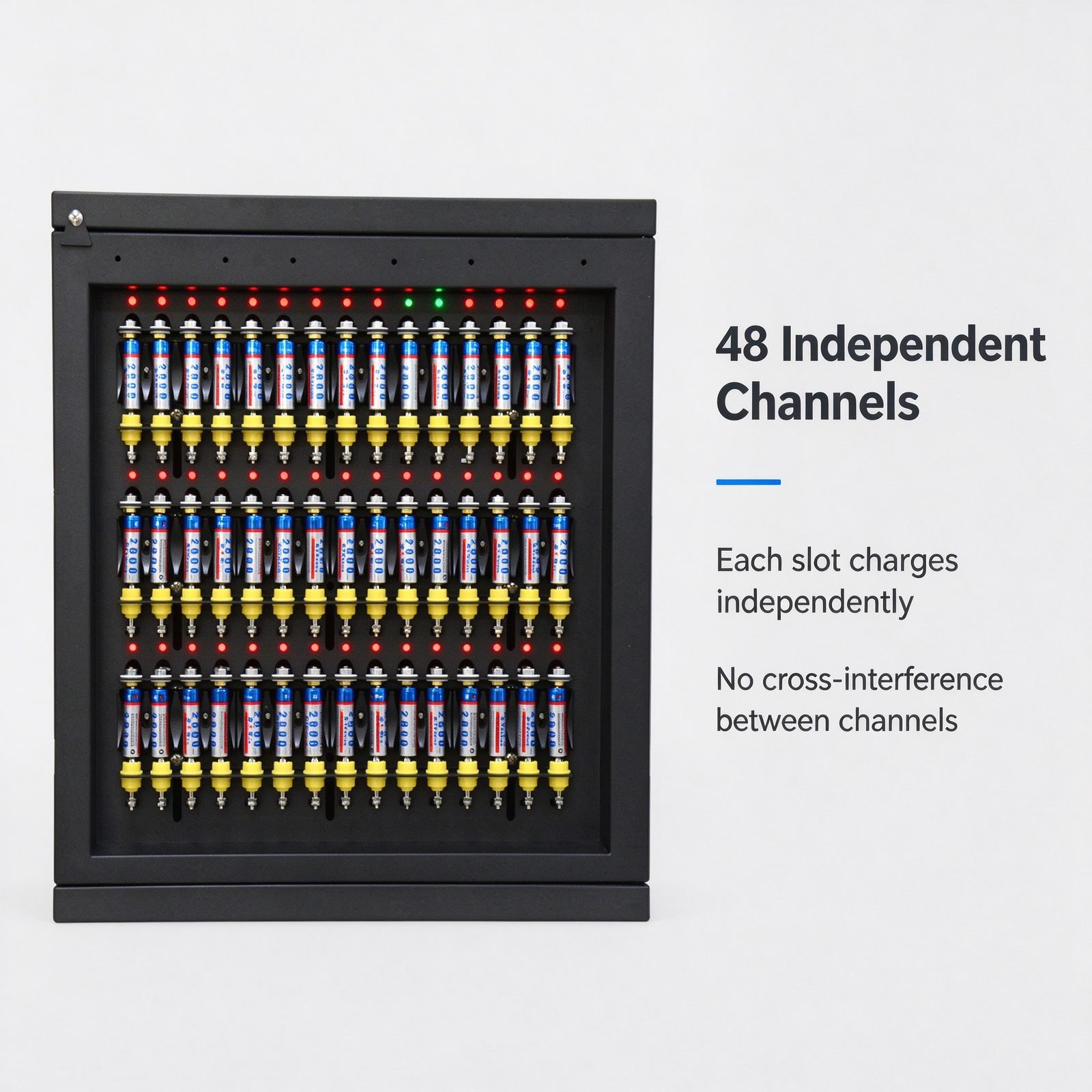
One channel per cell is the prerequisite that makes a large position count work at all. A cell that reaches full charge earlier does not hold up its neighbours, and cells of different ages or capacities can be loaded in one cycle without being sorted into identical groups first. That is the reasoning behind the count, not a separate feature and not a value claim.
Internal Multi-Charge Modules
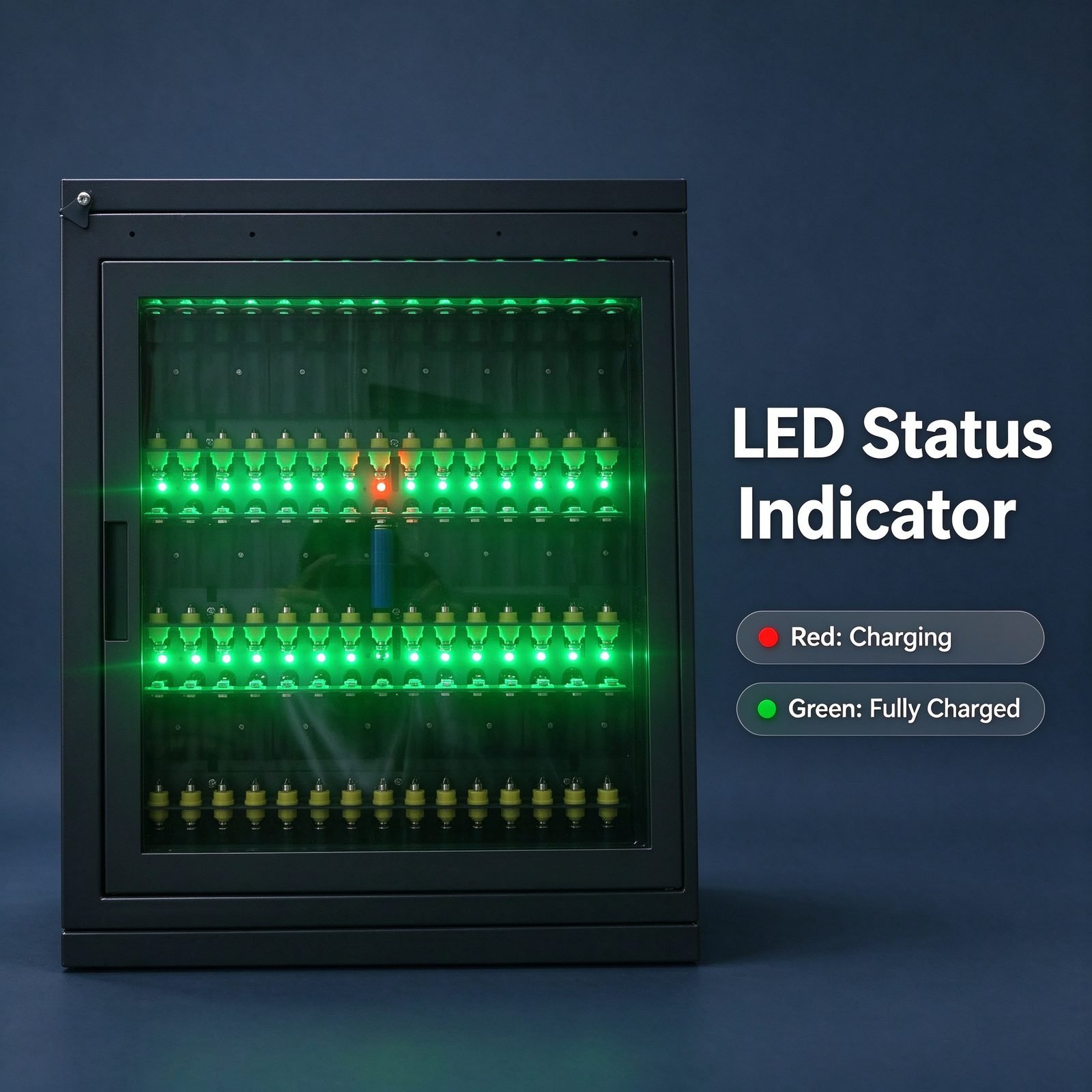
The channel count is a hardware count: each group of four positions is served by one smart module, so a 48-position cabinet holds 12 modules and a 168-position cabinet holds 42. One status LED per position, reverse-polarity protection, an external air switch, a power-on self-test and the CMX48 adjustable negative plate height are construction facts recorded in the specification table below; the adjustable plate is the mechanical reason one cabinet can accept several cylindrical lengths. None of these is a reason to buy on its own.
Compatibility and Voltage Disambiguation
Standard models charge 3.6/3.7 V Li-ion cylindrical cells (4.2 V cut-off) and 1.2 V Ni-MH/Ni-Cd. LiFePO4 (3.2 V / 3.65 V cut-off), LiPo pouch cells and other chemistries are available as custom-built versions — tell us your cell model and we configure the charging profile.
Bare Cells, Not Brand Tool Battery Packs
Every tool-related phrase on this page means a cabinet for bare cells, not brand tool battery packs. A search for a battery charging station for power tools resolves here to a bare-cell cabinet, not a charger for brand tool battery packs. A power tool battery charging cabinet in this catalogue charges bare cells, not brand tool battery packs. A power tool battery charging rack means positions for bare cells, not brand tool battery packs. A cordless power tool charging cabinet likewise charges bare cells, not brand tool battery packs. A site battery charging station is a bare-cell cabinet for shift turnover, not a charger for brand tool battery packs. A construction site battery charging station is the same bare-cell equipment, not a charger for brand tool battery packs. A battery charging station wall mount is a mounting option for that bare-cell cabinet, not a charger for brand tool battery packs. No tool brand is named, compared or implied as compatible.
Industrial Search Terms That Mean Something Else
An industrial battery charging station for cells is a cabinet for bare rechargeable cells, not a forklift or AGV traction charger; an industrial battery charging station for AA cells refers to the 1.2 V Ni-MH / Ni-Cd line, again for bare cells rather than an industrial vehicle pack. Each cross-model link here names its line and its voltage step. Standard models charge 3.6/3.7 V Li-ion cylindrical cells to a 4.2 V cut-off and 1.2 V Ni-MH/Ni-Cd cells, while LiFePO4 at 3.2 V uses a 3.65 V custom cut-off instead: see the 3.65 V LFP option for workshop pools. A single-cell 3.7 V pouch profile with a clamp holder is a custom build on a different configured profile: see the 3.7 V pouch option for workshop pools. The 4.2 V standard profile is not applicable to LiFePO4, and the standard lithium line does not cover pouch cells. For the plain-language voltage answer, see voltage boundaries for workshop charging. 48-bay and 168-position are position counts, not 48 volt.
Workshop and Site Scenarios
Workshop and Assembly Line
On an assembly or inspection bench, the battery pool is sized to the number of people on the shift: one cabinet charges the whole set at once and the next shift collects a charged set. One cabinet in place of a row of single chargers frees the bench and leaves a single point to count at handover. The wording stays at cell level — bare cells are charged, not finished devices or assembled packs — and no customer, throughput figure or case data is published here. 48-bay = 48 charging positions, not 48 volt.
Construction Site and Field Crews
Field crews rotate a pool of bare cells between shifts in the same way; the cabinet charges bare cells, not brand tool battery packs, and no tool brand is named. A wall mount is one deployment form for that bare-cell cabinet, not a charger for brand tool battery packs; it is a shape of installation, and no fixed accessory list is promised. Deployment details are confirmed when the model line is chosen. For the fleet and logistics side of the same routine, see warehouse and logistics charging stations.
Warehouse Battery Charging Station — Fleet and Logistics
Warehouse, Logistics and Retail Fleets
This section carries the warehouse topic after the v2.1 merge: warehouse battery charging station is a heading-level phrase here, not a second landing page. The shift rhythm is shared with the workshop section above, so it is not repeated as a second argument. What changes is the mix of equipment: scanners, two-way radios, security patrol sets and rental devices whose bare cells come back to one point at handover. A scanner battery charging station, a barcode scanner battery charging station, a two way radio battery charger multi unit, a security patrol battery charger and a rental equipment battery charging station are all, in this catalogue, cabinets that charge bare cells, not device battery packs. The battery pool remains a scene description of the cells a fleet rotates, not a product capability. A multi unit charging station or a battery charging station for multiple devices is used here only as scene wording for that bare-cell pool. 168-position = 168 charging positions, not a voltage.
Capacity Planning for Fleet Rotation
The count is a division: the number of cells a shift must top up divided by the slot count of one cabinet gives the number of cabinets, and that is how 48-bay or 168-position is chosen. 48-bay = 48 charging positions, not 48 volt; 168-position = 168 charging positions, not 168 volt. Input is 90–220 V / 50 Hz, a separate figure. Exact dimensions, plug format and position count are confirmed in the enquiry; no price figure, lead time, customer name or case data is published here.
Specification Table
| Field | Workshop and warehouse standard cabinet |
|---|---|
| Charging target | Bare rechargeable cells (not brand tool battery packs) |
| Positions | 48-bay / 168-position (slot count, not volts) |
| Model lines | 4.2 V Li-ion cylindrical (CMX48); 1.2 V Ni-MH / Ni-Cd (CMX168); custom profile on request |
| Independent channel per position | One channel per cell |
| Smart modules | One module per 4 positions (12 modules at 48 positions; 42 modules at 168 positions) |
| Input voltage | 90–220 V / 50 Hz (CMX48); 110/220 V · 50 Hz (CMX168) |
| Charge cut-off voltage | ≈4.2 V ±0.05 V (Li-ion line); 1.2 V profile (Ni-MH / Ni-Cd line) |
| Charging current | 800–1050 mA per position (Li-ion line); < 500 mA (Ni-MH / Ni-Cd line) |
| Per-position status | One status LED per position |
| Protections | Reverse polarity protection; external air switch; power-on self-test |
| Mechanical | CMX48 adjustable negative plate height |
| Deployment | Floor standing; wall mount available for bare-cell cabinets, not brand tool battery packs |
| Certifications | CE / FCC / RoHS |
Table note: this is a two-line general-purpose page, so the table lists only the 13 fields relevant to the scenario, not a multi-chemistry compatibility list; chemistry detail belongs to the cylindrical size reference, the 1.2 V product page and the custom-chemistry page. 48 / 168 are slot counts, not 48 volt. CC/CV, charge termination, protection and indicator behaviour appear here as fields only — baseline charging characteristics, not reasons to buy. The published certification scope is CE, FCC and RoHS only; no fire-safety or safety-cabinet certification is claimed.
Selection Dimensions
Four dimensions decide a standard cabinet order. Position count: 48-bay / 168-position, sized from the cells one shift must turn over — 48-bay = 48 charging positions, not 48 volt; 168-position = 168 charging positions. Chemistry and voltage profile: confirm the cell system first, then the step — 4.2 V Li-ion cylindrical, 1.2 V Ni-MH / Ni-Cd, or a 3.65 V LFP / 3.7 V pouch custom profile built to order. Deployment: floor standing, or a wall mount for a bare-cell cabinet, not brand tool battery packs; the mount is a form of installation, with no accessory list promised. Certification requirements: the published scope is CE / FCC / RoHS, and no other certification is offered; for manufacturer and certification details see the supplier page. See quote dimensions for shift based charging for the variables that shape a quote. 48-bay = 48 charging positions, not 48 volt.
Next step: send your shift’s cell count and chemistry and receive a slot-count and model-line suggestion, then compare the two standard lines before you order.
FAQ and Where to Go Next
How should a workshop battery pool be scheduled? Size the cabinet to the cells one shift must turn over, load the returning pool as one set, and collect a charged set at handover. 48-bay = 48 charging positions, not 48 volt.
How many single chargers can one cabinet replace? That depends on the count you rotate. One cabinet with 48 or 168 positions takes one floor footprint, one bench area, one mains lead and one wall socket in place of a row of individual chargers. 168-position = 168 charging positions, not a voltage.
Can a wall mount be fitted for a field crew? A wall mount is a deployment form for the bare-cell cabinet, not a charger for brand tool battery packs. Confirm the installation shape when you choose the model line; no accessory list is published here.
Can brand tool battery packs be charged in this cabinet? No. This equipment charges bare rechargeable cells; brand tool battery packs are outside its scope, and no tool brand is named, compared or implied as compatible. Standard models charge 3.6/3.7 V Li-ion cylindrical cells to a 4.2 V cut-off and 1.2 V Ni-MH/Ni-Cd cells; LiFePO4 at 3.2 V instead uses a 3.65 V custom cut-off, so the cell system must be confirmed before any cabinet is chosen.
Related Products
For the in-stock 4.2 V Li-ion machine on the standard line, see the 48-position Li-ion workshop charging cabinet product page. Standard models charge 3.6/3.7 V Li-ion cylindrical cells to a 4.2 V cut-off and 1.2 V Ni-MH/Ni-Cd cells; LiFePO4 at 3.2 V uses a 3.65 V custom cut-off instead, so this in-stock model is the lithium line, not an LFP cabinet. 48-position = 48 charging positions, not 48 volt. Alongside it, the site enquiry form is the entry point for a slot-count suggestion and, one step further on, the selection and quote pages.
Next step: confirm your shift’s cell count and cell system, compare the two standard model lines, then decide between a stock cabinet and a custom build.