

3.2V LiFePO4 Cell Charger: 48-Bay Custom Cabinet for LFP Cells
Light enquiry bar: send your LFP cell model and we return a 3.65 V custom configuration. One cabinet, one cell list, one configured charging profile.
One Cabinet, Many Custom Cells at Once — LFP and Pouch
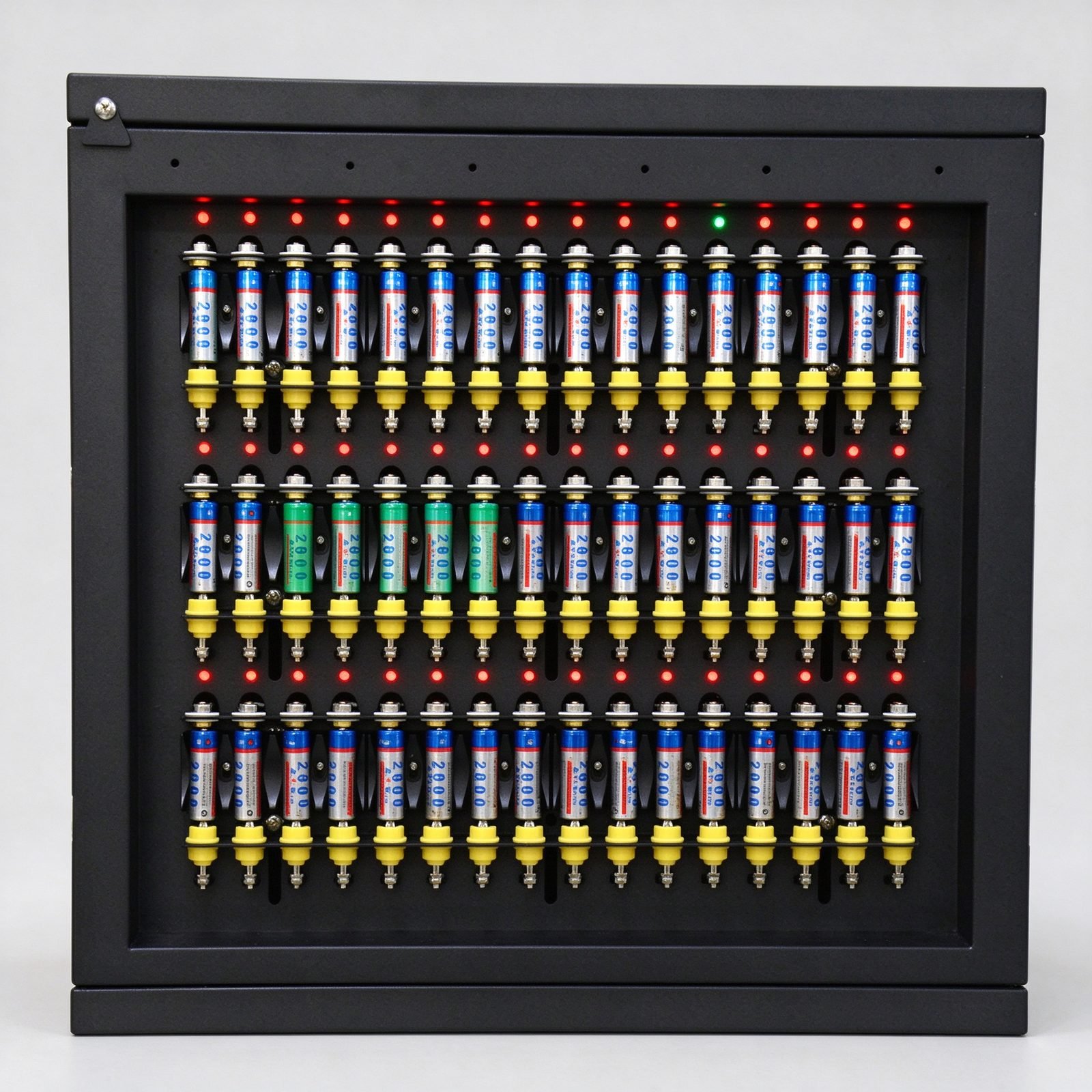
What This Page Covers
Standard models charge 3.6/3.7 V Li-ion cylindrical cells (4.2 V cut-off) and 1.2 V Ni-MH/Ni-Cd. LiFePO4 (3.2 V / 3.65 V cut-off), LiPo pouch cells and other chemistries are available as custom-built versions — tell us your cell model and we configure the charging profile.
A 3.2V LiFePO4 cell charger is a cabinet built to order for bare LFP cells: one enclosure charges 48 cells at once, or 168 cells at once, with each position running its own independent channel. 48-bay and 48-position mean 48 charging positions, not 48 volt; 168-position means 168 charging positions, not a voltage. Wherever 48 or 168 appears on this page, it counts positions. Input is 90–220 V / 50 Hz, a separate figure.
This page belongs to the ODM custom line. LiFePO4 needs a 3.65 V cut-off and cannot use the standard 4.2 V profile. Pouch / LiPo and NMC pouch cells are also custom builds, configured for a single-cell 3.7 V condition with a clamp holder. The standard in-stock line is not the main subject here; it appears once, as a comparison in the Related Products block. Phrases such as a 3.2v lifepo4 charger, an lfp cell charger, a lifepo4 charging cabinet, a lifepo4 multi channel charger, charging multiple lifepo4 batteries at once and a 32700 lifepo4 charger all point to this cell-level custom line rather than to a standard machine. 48-bay = 48 charging positions, not 48 volt.
The category definition is narrow on purpose: bare cylindrical or pouch cells, not finished equipment and not assembled packs. One cabinet, many cells at once, each on its own channel — that is the whole value, and the custom profile is what makes it usable for LFP. 168-position = 168 charging positions.
Cell-Level, Not Pack-Level
This page covers cell-level charging only. It does not cover 12 V / 24 V / 50 A recreational-vehicle or solar-storage pack chargers, so a search for a pack-level product is not served here: a 12 V pack and a bare 3.2 V LFP cell are different products with different charging profiles. Nor does this page cover branded tool battery packs. The full phrase that names the pack-level market is deliberately not our subject.
The readers we build for are cell makers, test laboratories, and incoming-inspection or cell-sorting posts at storage and device OEMs. They work with a named cell model, a known chemistry and a required cut-off voltage, and they need a cabinet configured against that list. 48-bay = 48 charging positions, not 48 volt; 168-position = 168 charging positions.
Why LFP Needs 3.65 V, Not the Standard 4.2 V
The Voltage Disambiguation Sentence
Standard models charge 3.6/3.7 V Li-ion cylindrical cells (4.2 V cut-off) and 1.2 V Ni-MH/Ni-Cd. LiFePO4 (3.2 V / 3.65 V cut-off), LiPo pouch cells and other chemistries are available as custom-built versions — tell us your cell model and we configure the charging profile.
In plain terms, a 3.6/3.7 V Li-ion cylindrical cell is charged to a 4.2 V cut-off on the standard line, while a 3.2 V LiFePO4 cell is charged to a 3.65 V cut-off on a custom build. These are two separate configured voltage steps on two separate machines, not two settings on one cabinet. The standard 4.2 V cut-off is not applicable to LiFePO4; applying a higher cut-off to a chemistry that must stop at 3.65 V is the mismatch a custom build exists to prevent. Standard machines in this line cannot charge LFP cells. 48-bay = 48 charging positions, not 48 volt.
Every enquiry therefore starts with the cell model, because the model fixes the chemistry and the chemistry fixes the cut-off. A 4.2 V and a 3.65 V requirement are quoted as separate builds. 168-position = 168 charging positions, not a voltage.
LFP Cell Models We Build For
The LFP cell models named in the first-party material are 32700, 32650 and 26650 LFP. Each is a cylindrical LFP format built to order on the 3.65 V custom cut-off; the charge current and holder are set from the cell specification supplied in the RFQ, so no fixed electrical value for an individual LFP model is published on this page. Other models, large 4680 cylindrical cells and other rechargeable chemistries are evaluated per order rather than promised as a fixed option.
A 32700 lifepo4 charger, a 26650 lifepo4 charger and a 32700 battery charger in this catalogue all mean the same thing: a custom 3.65 V cabinet configured for that LFP cell, not a standard 4.2 V machine. The cylindrical cell charger size reference covers the standard 3.6/3.7 V Li-ion cylindrical line at a 4.2 V cut-off; those standard sizes are a different list from the LFP formats above, and the two profiles are not interchangeable. 48-bay and 168-position are position counts, not 48 volt.
How the Cabinet Is Configured
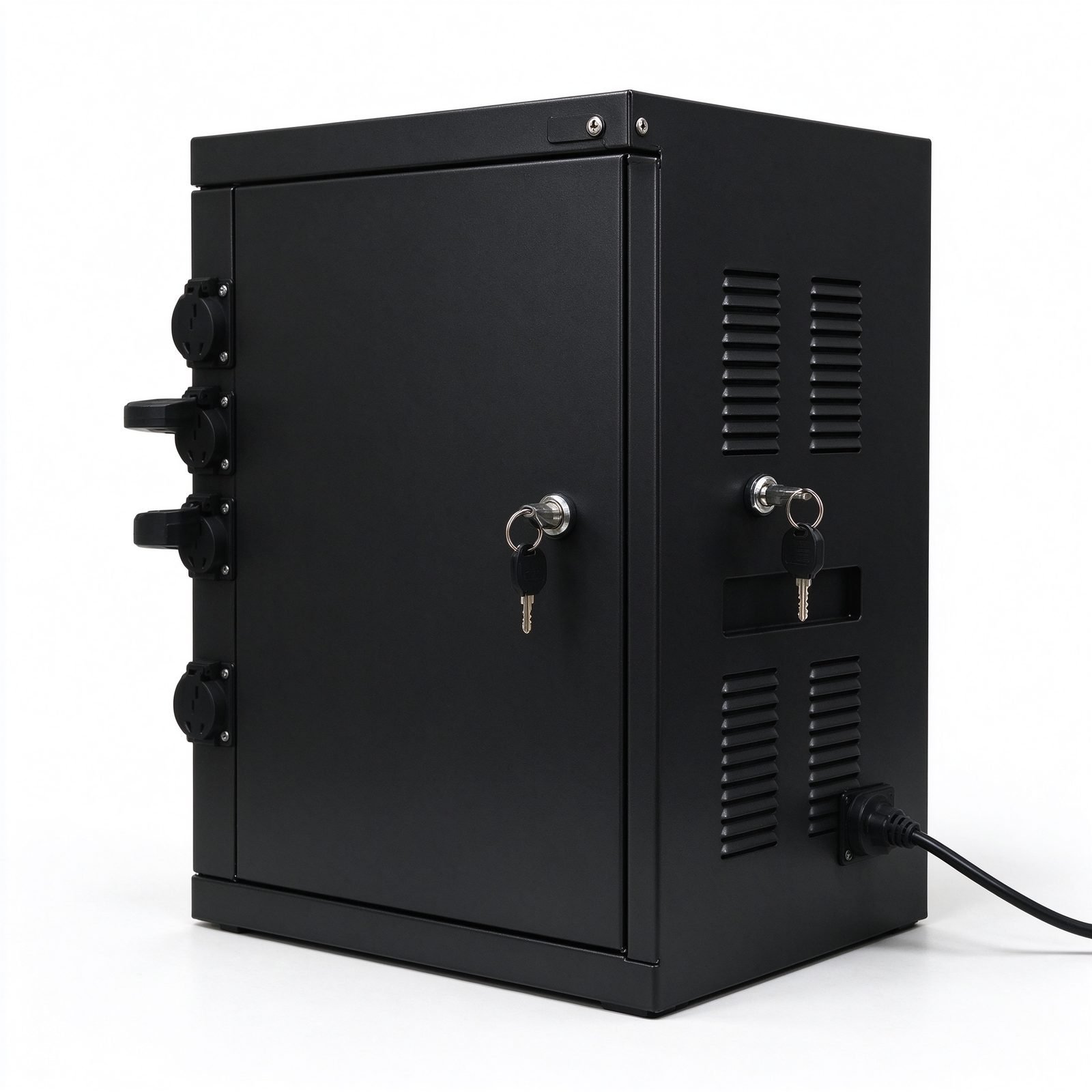
For the full two-line range and the position terminology, see the 48-position and 168-position cabinet range. 48-bay = 48 charging positions, not 48 volt; 168-position = 168 charging positions.
Positions and Independent Channels
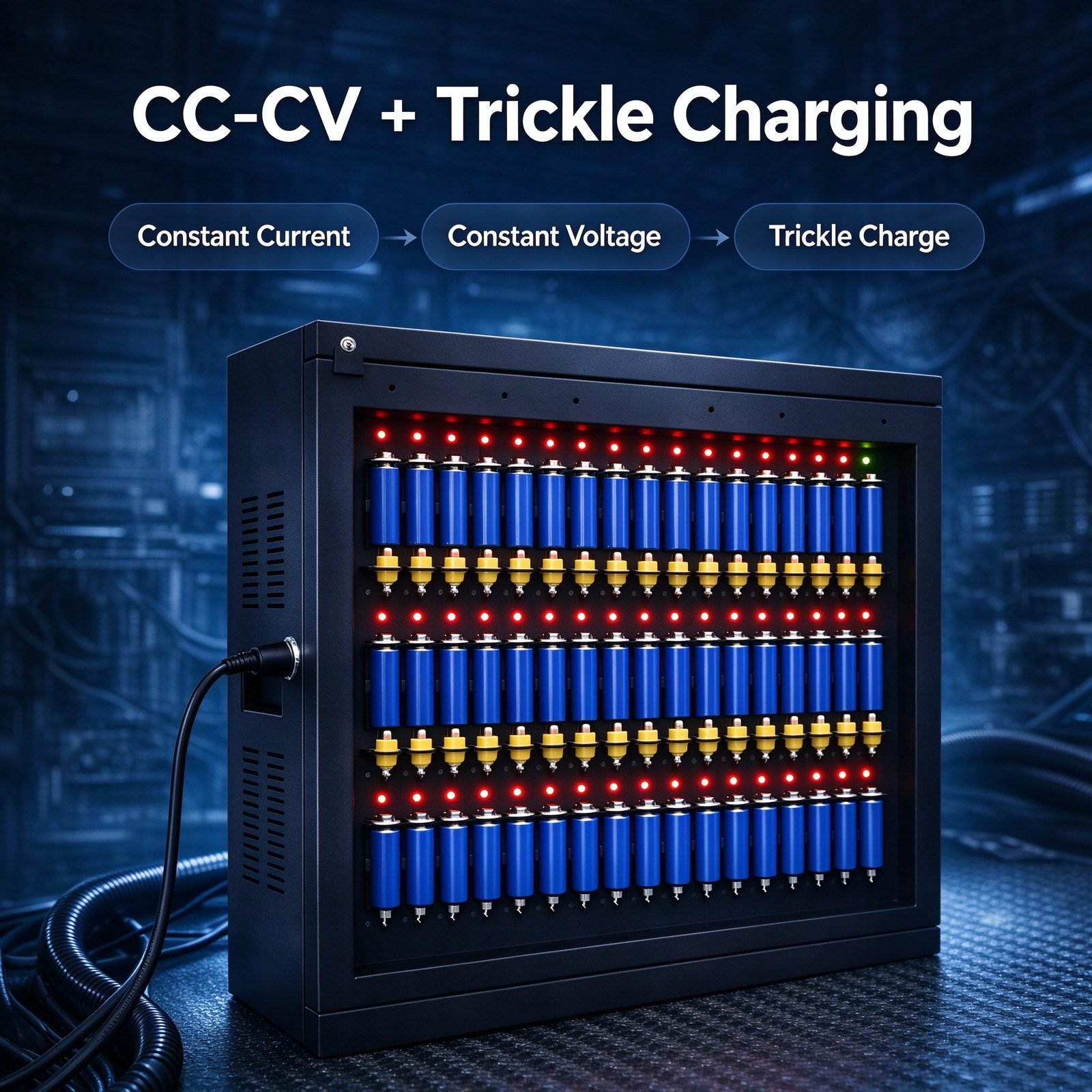
The one value that does not change on a custom build is the shape of the job: one cabinet charges many cells at once, each on its own channel. An independent channel per position is the prerequisite that makes a 48-bay or 168-position count work at all. A cell that finishes earlier does not hold up its neighbours, and cells of different ages, capacities or states of charge can be loaded in one cycle without being sorted into identical groups first. That is the reasoning behind the count, not a separate feature to advertise. 48-bay = 48 charging positions, not 48 volt; 168-position = 168 charging positions.
Internal Multi-Charge Modules
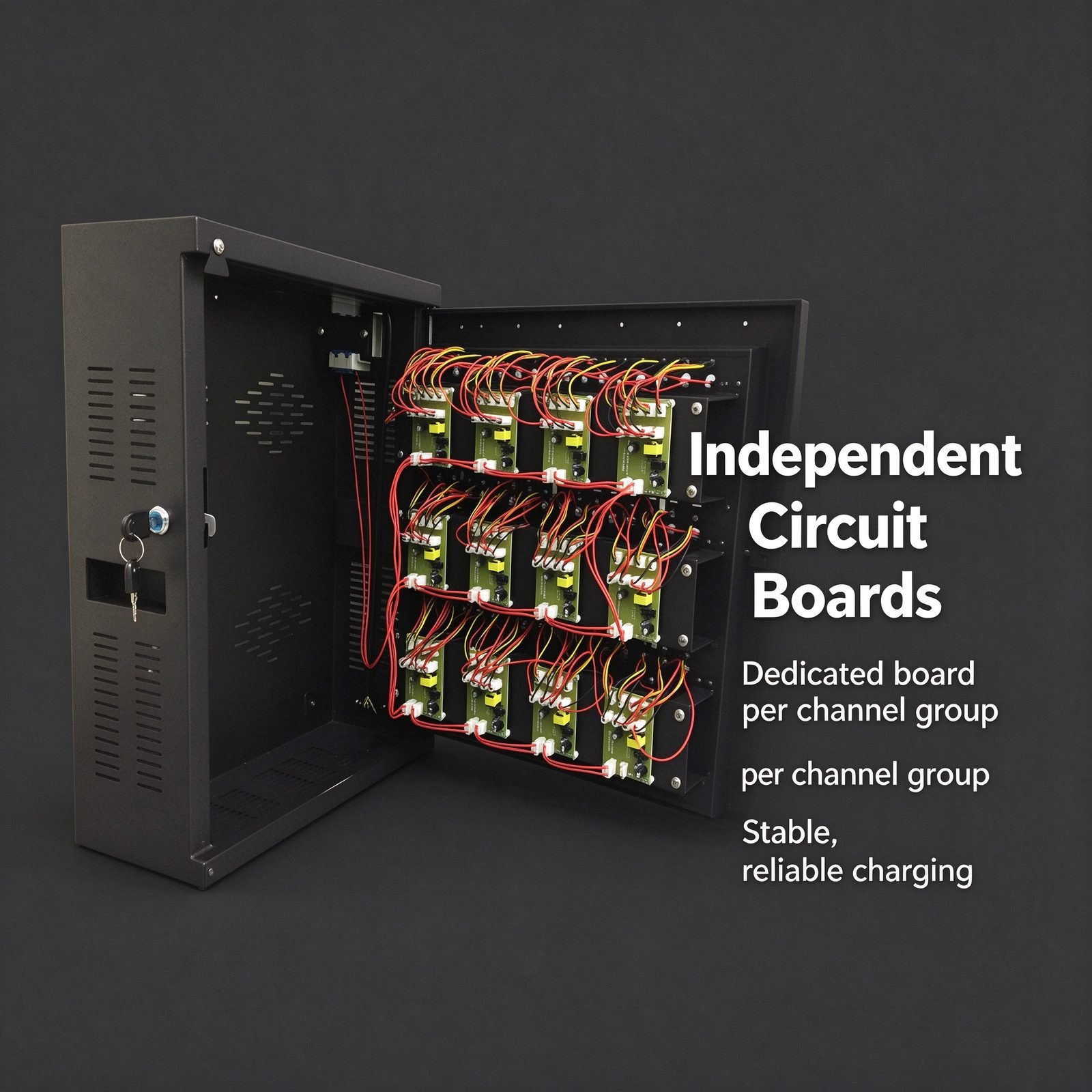
The channel count is a hardware count. A 48-position cabinet is built from 12 smart modules with four positions per module; a 168-position cabinet is built from 42 smart modules in a 6 columns × 28 rows layout. One module serves a small group of positions, so the cabinet is many controlled channels inside one enclosure rather than one shared charging path fanned out to many cells. The remaining construction facts are listed in the specification table below and are not reasons to buy. 48-bay = 48 charging positions, not 48 volt; 168-position = 168 charging positions.
48-Bay vs 168-Position
The difference between the two counts is how many cells finish in one cycle, not an electrical parameter: 48-bay is 48 charging positions and 168-position is 168 charging positions; neither is 48 volt or 168 volt. Input is 90–220 V / 50 Hz, a separate figure. Exact dimensions, holder or clamp, plug format and position count are custom items set in the RFQ. For the naming convention behind bay and position, see slot count terminology for LFP cabinets. 48-bay = 48 charging positions, not 48 volt.
Pouch Cell Charger — Clamp Holders and 3.7 V Cells
What This Section Covers
This section carries the pouch cell charger topic after the v2.1 merge: the earlier separate pouch / LiPo / NMC page is now part of this custom-chemistry page, so pouch cell charger is a heading-level phrase here, not a second landing page. Pouch / LiPo and NMC pouch cells are custom builds only — they need a clamp holder and a configured single-cell 3.7 V condition. The standard CMX48 covers 3.6/3.7 V Li-ion cylindrical cells including NMC ternary cylindrical cells at a 4.2 V cut-off; that standard cylindrical coverage is a different thing from an NMC pouch cell built to order. The two are not written as one coverage claim. 48-bay = 48 charging positions, not 48 volt.
Wording such as a lithium pouch cell charger, a pouch battery charger, an nmc battery charger, an nmc cell charger, a lipo multi battery charger, a polymer lithium battery charger, charging multiple lipo batteries at once, or an industrial multi chemistry cell charger for cells all describes this custom pouch route. An industrial multi chemistry cell charger is still a set of configured profiles, not one cabinet that covers every chemistry: each chemistry keeps its own cut-off. 168-position = 168 charging positions, not a voltage.
Clamp Adaptation and Mechanical Fit
Two mechanical paths sit side by side. Cylindrical cells use the CMX48 adjustable negative plate height, so one 48-position cabinet can accept several cylindrical lengths and diameters in one cycle. Pouch / LiPo cells use a clamp holder built to order instead. The difference is written in one place so a buyer can compare the two paths, and both land on the same outcome: one cabinet charges many cells at once, each on its own channel. 48-bay = 48 charging positions, not 48 volt.
Clamp form, plug format and slot layout are custom items described in How to Request a Custom Build; no fixed clamp accessory list is published here. A buyer should not read the adjustable negative plate as pouch coverage — the pouch profile needs its own holder and its own configured single-cell 3.7 V condition. 168-position = 168 charging positions.
Chemistry and Voltage Boundaries — LFP 3.65 V, Pouch / NMC 3.7 V, Standard 4.2 V
Cross-Model Links with Voltage Notes
Each cross-model link below names its line and its voltage step, so no link implies that this page covers every chemistry.
- 1.2 V Ni-MH / Ni-Cd, standard CMX168. Standard models charge 3.6/3.7 V Li-ion cylindrical cells to a 4.2 V cut-off and 1.2 V Ni-MH/Ni-Cd cells; LiFePO4 at 3.2 V instead uses a 3.65 V custom cut-off. The nickel line is a separate machine: see the 168-position Ni-MH and Ni-Cd pool cabinet. 168-position = 168 charging positions, not a voltage.
- 4.2 V Li-ion cylindrical, standard CMX48. The 4.2 V standard cut-off belongs to 3.6/3.7 V cylindrical Li-ion cells, while 3.2 V LiFePO4 cells are charged to 3.65 V on a custom build; the two cut-offs are not interchangeable. The size and holder detail for that standard line is on the selection page. 48-bay = 48 charging positions, not 48 volt.
- Pouch / LiPo / NMC, custom. Pouch, LiPo and NMC pouch cells are handled within this page rather than on an external page: see pouch and NMC custom cell formats. Standard models charge 3.6/3.7 V Li-ion cylindrical cells to a 4.2 V cut-off and 1.2 V Ni-MH/Ni-Cd cells; a single-cell 3.7 V pouch profile with a clamp holder is a custom build. 48-bay = 48 charging positions, not 48 volt.
- In-stock 4.2 V Li-ion comparison. The 4.2 V standard profile is not applicable to LiFePO4, which needs the 3.65 V custom cut-off; the in-stock comparison machine is linked once in Related Products below. 48-bay = 48 charging positions, not 48 volt.
What Is Not Covered Here
Two exclusions keep the boundary explicit. 1.2 V Ni-MH / Ni-Cd AA and AAA cells belong to the standard CMX168 line on the 168-position page, not to this custom-chemistry page. Standard 3.6/3.7 V Li-ion cylindrical cells at a 4.2 V cut-off belong to the in-stock lithium cabinet described in the Related Products block. Pouch / LiPo / NMC are not exclusions: after the v2.1 merge they are part of this page’s custom pouch section. 48-bay = 48 charging positions, not 48 volt; 168-position = 168 charging positions.
Where Custom Cell Charging Is Used
Cell Makers and Test Labs
Three workstations recur: incoming inspection at a cell maker, cell sorting, and laboratory cell testing. The routine is the same in each — a pool of bare cells comes off the bench, goes onto the cabinet, and is collected at the shift change. One cabinet charging a full set in one cycle replaces a row of individual chargers that would each occupy a bench position and an inspection point; the charged pool is ready as a set for the next shift. Pouch and NMC cell makers use the same shift rhythm for sorting and incoming inspection, so the narrative is shared rather than repeated as a second scenario. No customer names, throughput figures or case data are published here. 48-bay = 48 charging positions, not 48 volt; 168-position = 168 charging positions.
Workshop and Device Fleets
Device makers and maintenance sites keep a pool of bare LFP cells, for example around a 32700 LFP assembly line. Replacing a row of individual chargers with one cabinet frees bench and floor space and leaves one mains connection to manage. The wording stays at cell level: bare cells are charged, not assembled packs or finished devices. 48-bay = 48 charging positions, not 48 volt.
Specification Table
| Field | LFP custom build |
|---|---|
| Chemistry | LiFePO4 / LFP, 3.2 V nominal |
| Charge cut-off voltage | 3.65 V (custom profile); standard 4.2 V cut-off not applicable |
| Supported LFP cell models | 32700 / 32650 / 26650 |
| Positions | 48-bay / 168-position (slot count, not volts) |
| Independent channel per position | One channel per cell |
| Smart modules | One module per 4 positions (12 modules at 48 positions; 42 modules at 168 positions) |
| Charging current | Set for the LFP cell model in the RFQ, confirmed per cell spec; no fixed LFP value is stated on this page |
| Input voltage | 90–220 V / 50 Hz (standard input); plug configurable on request |
| Per-position status | One status LED per position |
| Protections | Reverse polarity protection; external air switch; power-on self-test |
| Mechanical | CMX48 adjustable negative plate height |
| Custom items | Voltage / clamp holder / plug / position count built to order |
| Certifications | CE / FCC / RoHS |
| Not applicable | Standard 4.2 V Li-ion profile; 1.2 V Ni-MH / Ni-Cd profile |
| Pouch / LiPo / NMC custom profile | Single-cell 3.7 V, clamp holder built to order |
| Holder options | Adjustable negative plate height (cylindrical) / clamp holder (pouch) |
| Spelling convention | NMC only; the historical misspelling is a banned term |
Table note: this is the LFP custom profile. LiFePO4 charges to a 3.65 V cut-off and the standard 4.2 V cut-off is not applicable to it. CC/CV, overcharge protection, automatic charge termination and LED status change at end of charge are baseline charging characteristics recorded here, not reasons to buy. 48-bay = 48 charging positions, not 48 volt; 168-position = 168 charging positions.
Related Products
For an in-stock 4.2 V Li-ion machine rather than a 3.65 V LFP custom build, see the in-stock 4.2 V Li-ion 48-position cabinet product page. Standard models charge 3.6/3.7 V Li-ion cylindrical cells to a 4.2 V cut-off and 1.2 V Ni-MH/Ni-Cd cells; LiFePO4 at 3.2 V uses a 3.65 V custom cut-off instead, so this in-stock 4.2 V model is a different line, not an LFP cabinet. 48-bay = 48 charging positions, not 48 volt.
Next step: send your LFP cell model and we return a 3.65 V custom configuration, or compare the in-stock model above first.
How to Request a Custom Build
Start at the LFP custom build RFQ entry. Five fields make the RFQ complete: the cell model and chemistry; the nominal voltage and the cut-off voltage; the position count; the dimensions and clamp or holder requirements; and the certification requirement. Once we have the cell model, we configure the charging curve — the template sentence at the top of this page ends with that step for a reason. 48-bay = 48 charging positions, not 48 volt; 168-position = 168 charging positions.
Because the cut-off must match the chemistry one-to-one, a 3.65 V LFP requirement is never quoted on the standard 4.2 V profile. No price figure, lead time, customer name, certificate number or certification promise is published here. See quote factors for LFP builds for the variables that shape a quote. 48-bay and 168-position are position counts, not 48 volt.
Next step: send the five RFQ fields and receive a configuration built around your LFP cell list.
FAQ and Next Step
What is the difference between 3.65 V and 4.2 V? 4.2 V is the standard cut-off for 3.6/3.7 V Li-ion cylindrical cells; 3.65 V is the custom cut-off for 3.2 V LiFePO4 cells. They are two builds, not two settings on one cabinet. 48-bay = 48 charging positions, not 48 volt.
Can old and new LFP cells be charged in the same cycle? Yes, because each position has its own independent channel and each cell follows its own condition. See independent channels for LFP cells for the general explanation. 48-bay = 48 charging positions, not 48 volt.
Can a 32700 LFP cell be charged in a standard lithium cabinet? No. 32700 LFP is a 3.65 V custom build; the standard 4.2 V cabinet is a different machine. For the plain-language version of the voltage question, see LFP charging voltage for cell makers — that question is answered there rather than expanded here. 48-bay = 48 charging positions, not 48 volt.
How is the position count calculated? Count the cells that must finish in one cycle. 48-bay = 48 charging positions, not 48 volt; 168-position = 168 charging positions. For the wider background, see blog guide to LFP cell charging profiles. 48-bay = 48 charging positions, not 48 volt.
Next step: submit the LFP RFQ above, or compare the in-stock 4.2 V lithium model in Related Products before deciding between the standard line and a 3.65 V custom build.